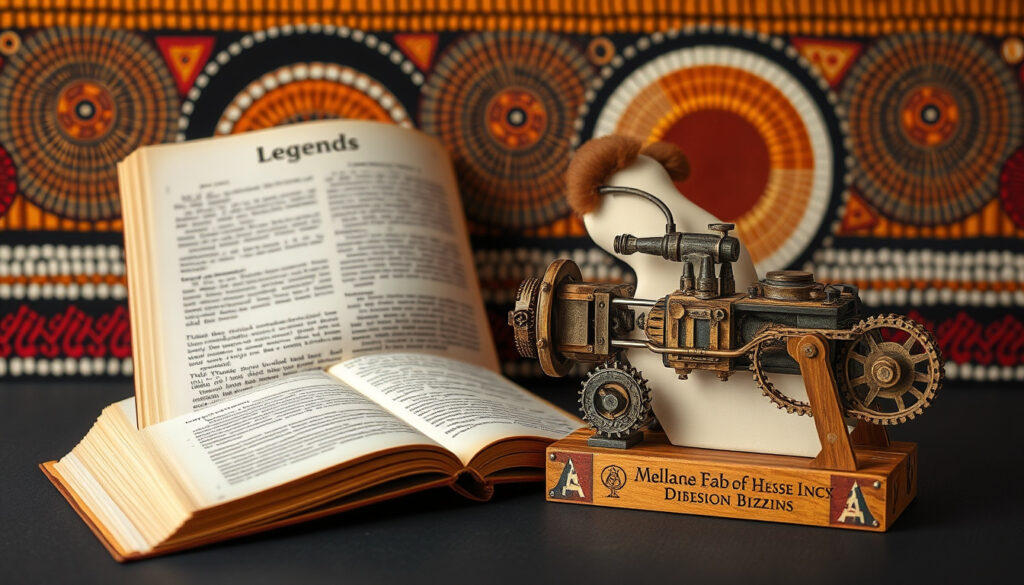
David Unaipon: Inventor and First Published Aboriginal Author
Most Australians have handled a $50 note, yet few know the face on it belongs to the first published Aboriginal author and a restless inventor who patented a shearing machine and sketched a helicopter. David Unaipon’s life wove together mechanical patents, Indigenous storytelling, and a quiet campaign for Aboriginal rights — a combination that still surprises people today.
Born: 28 September 1872 ·
Died: 7 February 1967 ·
First Published Aboriginal Author: Yes ·
Patented Inventions: At least 10 ·
Featured on Australian Currency: $50 note (1995)
Quick snapshot
- Born 28 Sep 1872 at Point McLeay Mission, SA (SA History Hub)
- First Aboriginal author published in English, 1929 (Encyclopaedia Britannica)
- Patented a shearing machine in 1909 (State Library of NSW)
- Married Katherine; no children (National Portrait Gallery)
- Exact number of inventions he conceived (Coorong Country suggests up to 19, but records are incomplete)
- Whether his helicopter design was ever built or tested (Coorong Country)
- Full details of early education beyond mission school (National Portrait Gallery)
- 1872 – Born at Point McLeay Mission (SA History Hub)
- 1909 – Shearing machine patented (State Library of NSW)
- 1929 – First book published (Encyclopaedia Britannica)
- 1995 – Portrait on $50 note (Reserve Bank of Australia)
- Renewed interest in his uncommercialised patents for modern applications (Gebbie Lab, UW–Madison)
- Growing calls for a national monument at his burial site (SA History Hub)
Seven facts that define David Unaipon’s life and work, one pattern: a mind that moved constantly between mechanics and myth, protected only by provisional patents and public speeches.
| Attribute | Detail |
|---|---|
| Full Name | David Ngunaitponi (Unaipon) |
| Born | 28 September 1872, Point McLeay Mission, South Australia |
| Died | 7 February 1967, Tailem Bend, South Australia |
| Occupation | Inventor, author, orator, campaigner |
| Known For | First published Aboriginal author, inventor, $50 note portrait |
| Spouse | Katherine (married, no children) |
| Patents | At least 10, including a shearing machine and a helicopter design |
Who Was David Unaipon and What Did He Invent?
David Unaipon was born on 28 September 1872 at Point McLeay Mission, a Ngarrindjeri man and the fourth of nine children (National Portrait Gallery). He received a basic education at the mission school and, despite having no advanced training in mathematics or engineering, developed into a self-taught mechanical thinker (State Library of NSW). Like Benjamin Franklin, another self-taught inventor and author, Unaipon combined practical mechanics with a literary voice.
What is David Unaipon famous for?
- First published Aboriginal author – His 1929 collection Legendary Tales of the Australian Aborigines was the first book by an Aboriginal writer published in English (State Library of NSW).
- Inventor of mechanical devices – He patented a shearing handpiece in 1909 that converted circular motion into lateral motion, improving wool-cutting efficiency (Encyclopaedia Britannica).
- Public orator and campaigner – He travelled across Australia speaking on Aboriginal citizenship and land rights (State Library of NSW).
- Portrait subject on the $50 note – Since 1995, his image has been on the Australian $50 banknote (Reserve Bank of Australia).
The pattern: Unaipon’s fame rests on two distinct pillars — literature and mechanics — each under-recognised in its own way.
What inventions did David Unaipon create?
By 1909 he had patented a shearing handpiece that transformed circular motion into linear motion, making wool-harvesting less strenuous (State Library of NSW). Over the next three decades he lodged at least nine additional provisional patent applications for devices including a centrifugal motor, a multi-radial wheel, and a mechanical propulsion system (State Library of South Australia). The Australian War Memorial notes that he filed ten patents in total (Australian War Memorial).
Unaipon’s patent count is often cited as ten, but secondary sources claim he conceived as many as 19 inventions. Without full patent records, the exact number remains uncertain — a gap that shadows his legacy.
Did David Unaipon invent the helicopter?
- He sketched a rotor concept based on the principle of a boomerang, anticipating later helicopter designs (Gebbie Lab, UW–Madison).
- No evidence exists that he built or flew a prototype (Coorong Country).
- The concept remains a point of curiosity among aviation historians (SA History Hub).
The implication: Unaipon imagined the helicopter before powered flight was routine, but his vision never left the drawing board.
Why Is David Unaipon on the $50 Note?
In 1995 the Reserve Bank of Australia replaced the portrait of explorer John Forrest on the $50 note with an image of David Unaipon, making him the second Aboriginal person (after Albert Namatjira on the $100 note) to appear on Australian currency (Reserve Bank of Australia). The bank cited his contributions to Aboriginal literature and invention as the reason for the change. The note also features motifs from his book Legendary Tales of the Australian Aborigines and a representation of his shearing machine.
The catch: While the $50 note made Unaipon a household name, it has also reduced his complex life to a single image. Many Australians recognise the face but cannot name his inventions or his writings.
How Did David Unaipon Die and What Happened to Him?
David Unaipon died on 7 February 1967 in Tailem Bend, South Australia, at the age of 94 (Encyclopaedia Britannica). The cause of death was not widely publicised, and official records are sparse. In his final years he continued to speak on Aboriginal rights, but his health declined. He was buried at the Point McLeay Mission cemetery, back where he had started.
What happened to David Unaipon?
Despite his many inventions, Unaipon died in relative obscurity. He had struggled to commercialise his patents because he lacked capital; some patents lapsed without being produced (National Portrait Gallery). His writings, too, were often published under other names or with limited attribution. Only in the 1980s and 1990s did historians begin to reassemble his full story.
Today, Unaipon’s uncommercialised patents are being re-examined by engineers interested in early Australian innovation. The gap between his ideas and their execution remains a cautionary tale about who gets to pioneer in a divided society.
The pattern: Unaipon’s legacy is one of unrealised potential and delayed recognition.
Did David Unaipon Have Children?
David Unaipon married Katherine, a Ngarrindjeri woman, but the couple had no children (National Portrait Gallery). The absence of direct descendants has meant that his estate and personal papers were dispersed among libraries and private collections, further complicating historical research.
Where Was David Unaipon Buried?
He was buried at the Point McLeay Mission cemetery on the shores of Lake Alexandrina in South Australia (SA History Hub). The grave is marked with a small headstone that lists his Ngarrindjeri name, Ngunaitponi. In recent years, Aboriginal elders and local historians have advocated for a more prominent monument to honour his legacy.
The trade-off: A humble grave contrasts sharply with his face on a banknote — a reminder of how far his recognition has come, and how far it still has to go.
Timeline of David Unaipon’s Life
- 1872 – Born at Point McLeay Mission, South Australia (SA History Hub)
- 1890s–1900s – Develops and patents several inventions, including the shearing handpiece (State Library of NSW)
- 1920s – Writes Legendary Tales of the Australian Aborigines (first Aboriginal author) (Encyclopaedia Britannica)
- 1930s–1960s – Continues advocacy for Aboriginal rights and public speaking (State Library of NSW)
- 1967 – Dies on 7 February in Tailem Bend, South Australia (Encyclopaedia Britannica)
- 1995 – Portrait appears on the Australian $50 note (Reserve Bank of Australia)
This timeline shows a life of steady achievement, but also of delayed recognition.
What’s Confirmed and What’s Uncertain
Confirmed facts
- Birth and death dates (28 Sep 1872 – 7 Feb 1967) (SA History Hub)
- First published Aboriginal author in English (Encyclopaedia Britannica)
- Patented a shearing machine in 1909 (State Library of NSW)
- Married Katherine, no children (National Portrait Gallery)
- Buried at Point McLeay Mission cemetery (SA History Hub)
- Featured on $50 note since 1995 (Reserve Bank of Australia)
What’s unclear
- Exact number of inventions (he claimed many, but records are incomplete) (Coorong Country)
- Whether his helicopter design was ever built or tested (Coorong Country)
- Full details of early life and education beyond mission school (National Portrait Gallery)
The confirmed facts anchor his biography, but the gaps invite further research.
Voices on David Unaipon
“I believe that the knowledge of my people, combined with the tools of modern science, can lead to great inventions. We must not let our ideas be lost or taken without credit.”
David Unaipon, from his writings and speeches
“Unaipon was a trailblazer for Aboriginal representation. He showed that an Indigenous Australian could be both a writer and an inventor, yet for decades his work was overshadowed by the power structures of the time.”
Historian John Maynard, commenting on Unaipon’s role in Aboriginal history
These voices underscore the tension between his achievements and the societal barriers he faced.
Legacy and What Comes Next
David Unaipon died without seeing his name on the $50 note, but that note now keeps his face in the hands of millions. The pattern is unfinished: his patents sit in archives waiting for a second life; his book Legendary Tales is still in print; and a new generation of Ngarrindjeri scholars are working to ensure his story is told in his own words. For Australians studying the intersection of Indigenous knowledge and Western innovation, the path forward is clear: to look beyond the banknote and understand the man who refused to be confined by anyone’s expectations. His story, like that of Steve Irwin, highlights the complexity of Australian identity.
en.wikipedia.org, onthejob.education, portrait.gov.au, thefamouspeople.com
Frequently Asked Questions
What was David Unaipon’s most famous invention?
His patented shearing handpiece (1909), which converted circular motion into linear motion for more efficient wool-cutting. (State Library of NSW)
How many patents did David Unaipon hold?
At least ten, according to the Australian War Memorial and the State Library of South Australia. Secondary sources claim as many as 19 provisional applications. (Australian War Memorial)
What books did David Unaipon write?
His main work is Legendary Tales of the Australian Aborigines (1929), the first book by an Aboriginal author published in English. He also contributed articles to newspapers and journals. (Encyclopaedia Britannica)
Was David Unaipon married?
Yes, to Katherine, a Ngarrindjeri woman. They had no children. (National Portrait Gallery)
How long did David Unaipon live?
He lived to 94 years, from 28 September 1872 to 7 February 1967. (Encyclopaedia Britannica)
What is the significance of David Unaipon’s portrait on the $50 note?
It recognizes his achievements as an inventor and first published Aboriginal author, symbolising the contribution of Indigenous Australians to national culture. (Reserve Bank of Australia)
Did David Unaipon work with other inventors?
He had assistance from Herbert Basedow in getting the shearing handpiece patented, but most of his work was independent. (State Library of NSW)
What is the ‘Unaipon helicopter’?
A rotor concept based on boomerang aerodynamics that Unaipon sketched. It was never built or tested. (Gebbie Lab, UW–Madison)
More related posts
 Anthony Edwards: Career, Family, Injury, and Jordan
 Rozz Switzer: Age, Husband, and Her OnlyFans Career
 Rachael Leigh Cook: Movies, Marriage, and Life Now
 Kaitlin Olson: Biography, Accident, Wig, and Life with Rob McElhenney
 Abhishek Bachchan Biography: Age, Wife, Daughter & More
 Escape Room Guide: What Happens, Duration, Tips & Dublin Venues
 Gus Lamont Disappearance: Latest Updates and Search Timeline