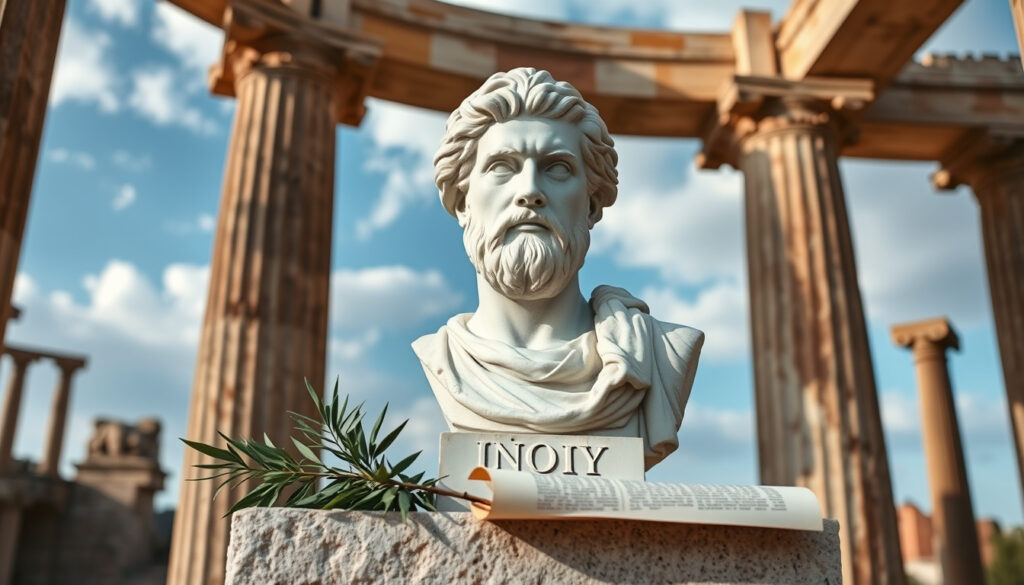
Marcus Aurelius: Stoic Emperor and His Enduring Wisdom
Every morning, millions of people scroll past the same ancient advice: get up, do your work, don’t complain — advice from a Roman emperor who never expected an audience. Marcus Aurelius ruled from 161 to 180, but the private journal he left behind has become a quieter kind of legacy: a Stoic manual for anxiety, overthinking, and the discipline of starting the day anyway.
Born: 26 April 121 · Died: 17 March 180 · Reign: 161–180 · Famous work: Meditations · Philosophy: Stoicism
Quick snapshot
- Roman emperor from 161 to 180 (World History Encyclopedia (history reference))
- Wrote Meditations as a private journal (Stanford Encyclopedia of Philosophy (academic))
- Whether Meditations was ever meant for publication — the text reads like a private notebook (Stanford Encyclopedia of Philosophy Archive (academic))
- How far his edicts on Jewish proselytism were enforced; historians still debate the scope (World History Encyclopedia (history reference))
- The “7 principles” attached to his name — a modern summary, not an ancient list (Internet Encyclopedia of Philosophy (academic))
- Became emperor in 161, initially alongside Lucius Verus (World History Encyclopedia (history reference))
- Died 17 March 180; Commodus succeeded him (Britannica (encyclopedia))
- His works show the strong influence of the Stoic teacher Epictetus (Internet Encyclopedia of Philosophy (academic))
- Historians keep reopening the question of his religious policies (Britannica (encyclopedia))
Six facts, one pattern: the man is remembered less for what he did than for what he wrote.
| Attribute | Detail | Source |
|---|---|---|
| Full name | Marcus Aurelius Antoninus | Standard record |
| Life | – | Britannica (encyclopedia) |
| Reign | – | Britannica (encyclopedia) |
| Philosophy | Stoicism | Stanford Encyclopedia of Philosophy (academic) |
| Notable work | Meditations (Greek: Τὰ εἰς ἑαυτόν) | Perseus Digital Library (primary text) |
| Status | Last of the Five Good Emperors | World History Encyclopedia (history reference) |
What is Marcus Aurelius most famous for?
Marcus Aurelius is most famous for the Meditations, a diary he wrote for himself (Project Gutenberg (public-domain translation)). He sat on the Roman throne from 161 to 180 — close enough to the empire’s peak that historians still describe him as the last of the Five Good Emperors (Britannica (encyclopedia)), and close enough to its unraveling that the diary reads like a survival manual.
The Meditations is a Greek-language notebook written in the middle of a life that included war, plague, and the death of his co-emperor Lucius Verus. It was not written for us. That is exactly why it still works.
What is the most famous saying by Marcus Aurelius?
The most quoted line from Meditations, Book 4: “The impediment to action advances action. What stands in the way becomes the way.”
It gets printed on posters, but inside the book it is doing harder work. Marcus is telling himself that a blocked road is not a stop sign; it is the route.
Two other passages travel almost as far. From Book 7: “We own nothing. Everything is here on loan.” From Book 2: “When you wake up in the morning, tell yourself: the people I deal with today will be meddling, ungrateful, arrogant, dishonest, jealous, and surly.”
What is the wisest quote ever said?
There is no canonical winner for “wisest quote ever.” Readers nominate the same Meditations lines again and again: Book 4’s “What stands in the way becomes the way” and Book 2’s morning warning about meddling people are the two most common. The translation changes, but the argument does not: judgment is yours, and the obstacle is part of the work.
What is Marcus Aurelius’ most famous quote about time?
The “time” line you see quoted online depends on the translator. The thought behind all of them is the same: stop living as if tomorrow were guaranteed.
He returns to mortality constantly. His point is never poetic; it is practical. You do not own your time, so spend it on judgment, on work, on kindness — not on imaginary futures. This is where Meditations feels modern. The advice to “live in the present” has been repackaged a thousand times, but Marcus means something stricter: the present is the only moment in which you can choose to act well.
What are the 7 Stoic principles of Marcus Aurelius?
The honest answer first: he never wrote a list of seven principles. The number comes from modern summaries of Meditations, not from the text itself.
What the text contains is a sterner system built on one premise: only virtue is good, and only vice is bad (Stanford Encyclopedia of Philosophy (academic)). Everything else — money, health, status — belongs to a category the Stoics called “indifferents”: worth dealing with, but not what makes a life good.
- Wisdom: knowing what deserves your attention.
- Justice: treating people fairly even when they are not.
- Courage: acting rightly under pressure.
- Temperance: moderating pleasure and impulse.
Add the practices that run through Meditations — negative visualization, mindfulness of mortality, and the habit of asking “is this in my control?” — and you have the raw material of most modern Stoic lists. The lists are summaries; the book is the source.
What this means: if you want Marcus’ Stoicism, ignore the listicle and start with the four virtues. Everything else is commentary.
What are the 12 Stoic Rules for Life?
- The “12 rules” is a contemporary framework popularized by modern Stoic authors — not a passage from Meditations.
- Marcus Aurelius circles the same disciplines repeatedly: control over judgment, patience with others, acceptance of mortality.
Modern rule-lists make the philosophy easier to share, and harder to practice deeply. A rule tells you what to do; Meditations shows an emperor arguing with himself about whether he can do it. The second is the more honest training manual.
What this means: if you want Marcus’ Stoicism, ignore the listicle and start with the four virtues. Everything else is commentary.
The pattern: the listicle is not the philosophy; the diary is.
What did Marcus Aurelius say every morning?
“When you wake up in the morning, tell yourself: the people I deal with today will be meddling, ungrateful, arrogant, dishonest, jealous, and surly.”
— Marcus Aurelius, Meditations, Book 2
That is the line people quote. The fuller practice is in Book 5, part 1: a short affirmation he aimed at himself, telling himself to stop complaining about waking up and to get on with work.
The logic is pure Stoicism. A human being is built for usefulness, so a morning is not punishment — it is the start of the work you exist for.
The routine is not about waking early for productivity. It is about refusing to let your own comfort write the day’s agenda.
What did Marcus Aurelius say about sleeping in?
The sleeping-in passage is often read as a productivity rebuke. In context, it is a rebuke to confusion about what a human being exists to do.
Marcus treats a lie-in as indulgence, not recovery. He tells himself that getting out of bed is simply doing the work of a human being, and that preferring warmth and rest over that work is a failure of purpose. That is also where critics raise an eyebrow. Constant discipline can curdle into self-shaming. The Stoic reply: the goal is not punishment, it is alignment — do what the day requires, then rest without guilt.
Why this matters: if the morning quote lands as guilt, read it again. Marcus is not scolding laziness; he is proposing that usefulness is what makes a day human.
What did Marcus Aurelius say about anxiety?
He never uses the modern word, but he nails the mechanism: anxiety arrives when the mind locks onto things outside its control — what other people think, what might happen next year, whether a plan will survive contact with reality.
His remedy is the present moment. If the disturbance is not here, right now, it has no claim on your thinking.
“The impediment to action advances action. What stands in the way becomes the way.”
— Marcus Aurelius, Meditations, Book 4
That line is an anxiety treatment in one sentence. The obstacle is not a signal to panic; it is the material you have to work with.
Modern cognitive behavioral therapy draws on this exact Stoic move: separate the event from your judgment of it, then act on the judgment, not the alarm.
What does Marcus Aurelius say about overthinking?
- Overthinking, in his model, is rehearsing futures that have not arrived.
- The countermove is one question: is this within my control or not?
- The “inner citadel” — his image for the mind’s power to refuse disturbance — is built by repetition, not willpower.
The inner citadel is one of Meditations’ most durable ideas: no outside event can disturb your mind unless you let it through the gate. What you think about an event is a judgment, and judgments are yours to make.
Overthinking collapses when you stop asking “what if” and start asking “what can I do now.”
The implication: the most practical Stoic tool is also the simplest. When worry shows up, name whether you can act on it. If you can, act. If you cannot, it has no vote.
How did Marcus Aurelius treat Jews?
The sources from the 160s–170s are fragmentary, and historians read them differently. This section flags what is documented and what is contested.
The short answer: the record is thin and the debate is genuine. According to the surviving sources, edicts restricting Jewish proselytism were issued during his reign; some scholars interpret them as part of a wider campaign to reinforce traditional Roman religion, while others argue they point to a harsher edge.
Some scholars also argue that advisors such as Fronto helped shape those policies; others say the evidence is too fragmented to assign motive. What is easier to document is the context: he ruled through an era in which Roman authorities treated some religious practices as threats to public order, and the empire’s legal machinery was available for that purpose.
What is the dark side of Stoicism?
- Critics say the Stoic ideal of freedom from passion can slide into emotional suppression.
- Calling health, wealth, and relationships “indifferents” can sound coldly dismissive of real loss.
- The discipline that builds resilience can also excuse passivity in the face of injustice.
The indifferents doctrine is the core of the criticism. In Stoic theory, money, status, and even health do not make a life good or bad; only virtue does. That is liberating when you lose a job — and it can sound cruel when someone else is starving.
Marcus Aurelius is the test case. The man who wrote about patience and justice spent years fighting wars and presiding over a religiously repressive state. The gap between the private notebook and the public throne is the real dark side of Stoicism.
The internet overcorrects in both directions: Marcus Aurelius becomes either a saint or a monster. The sources support neither.
The trade-off: Stoicism buys resilience at the price of acceptance. When the philosophy asks you to accept what you cannot change, it also asks you to draw the line between acceptance and surrender.
The measure of the debate: the sources are too fragmentary for certainty, and the strongest readings stay on the cautious side.
How solid is the record on Marcus Aurelius?
Two lists separate what historians treat as established from what stays open. The second is longer because the sources are.
Confirmed facts
- He ruled as Roman emperor from 161 to 180 (Britannica; World History Encyclopedia)
- He wrote Meditations as a private journal (Stanford Encyclopedia of Philosophy)
What’s unclear
- Whether he intended Meditations for publication.
- How far the edicts on Jewish proselytism were enforced.
- Whether advisors such as Fronto shaped his religious policy.
- Whether the “7 principles” list reflects his philosophy or a modern brand.
The implication: read confident summaries of Marcus Aurelius with suspicion. The record rewards patience.
Two passages that still travel
One comes from the emperor’s own hand; the other from the historians who keep trying to sum him up.
“We own nothing. Everything is here on loan.”
— Marcus Aurelius, Meditations, Book 7
“Marcus Aurelius is often described as the last of the Five Good Emperors following Nerva, Trajan, Hadrian, and Antoninus Pius.”
— World History Encyclopedia
The first quote explains the second. The emperor who owned an empire kept insisting that nothing was truly his — not time, not reputation, not even the next breath. That is why historians still argue about him: he is the rare ruler who judged himself by a standard he could not meet.
The measure of a Stoic emperor
Marcus Aurelius offers no seven-step program. What survives is a man arguing with himself about staying decent while holding power in a brutal empire. The method inside Meditations is compact: check the judgment, ignore the noise, do the useful thing. For anyone reading this with a racing mind at midnight, the choice is clear — turn one line of Meditations into tomorrow’s first action, or hand the remote control to the next anxious thought.
en.wikipedia.org, medium.com, susanrushton.net, sloww.co, plato.stanford.edu, goodreads.com
Frequently asked questions
What did Marcus Aurelius say about life?
His shortest answer is in Meditations, Book 7: “We own nothing. Everything is here on loan.” The longer version appears across the book: life is short, so spend it on virtue — wisdom, justice, courage, and temperance — and stop renting your attention to things that do not matter.
Do Stoics drink alcohol?
Stoicism never made alcohol a moral absolute. Pleasure belongs to the “indifferents” — things that do not make life good or bad by themselves. The real question is temperance: can you enjoy a glass without being ruled by it? Marcus Aurelius would measure the drink by whether it disturbed your judgment.
Who are modern day Stoics?
A loose movement of writers, therapists, and readers who use Meditations and related texts as practical tools. The best-documented crossover is cognitive behavioral therapy, which borrows the Stoic move of examining judgments about events rather than the events themselves.
Which religion is closest to Stoicism?
Stoicism is a philosophy, not a religion, but people often compare it to Buddhism — both emphasize equanimity, impermanence, and self-examination. Others hear echoes of Stoic ethics in Jewish and Christian traditions. The overlaps are real, but they are family resemblances, not identity.
Why are people against Stoicism?
Three critiques recur: emotional suppression, fatalism, and coldness. If nothing outside virtue matters, critics ask, why grieve, why protest, why fight injustice? The indifferents doctrine can sound like a license for withdrawal — and in the hands of a ruler, that withdrawal has real consequences.
Are there any female Stoics?
The surviving canon is almost entirely male because the institutions that preserved ancient texts preserved mostly men’s voices. The philosophy itself never limited its claims to men, and modern Stoic practice has a broad, mixed readership. The absence in the record is about who wrote history, not who could be Stoic.
The pattern across the answers: Stoicism keeps returning to judgment, temperance, and the limits of control.
Related reading
Two articles that follow similar threads: how the unconscious shapes us, and how writers turn private struggle into public art.
- Carl Jung: Collective Unconscious, Archetypes, and Analytical Psychology Explained
- Fyodor Dostoevsky: Biography, Novels, and Famous Quotes
The connection: Jung and Dostoevsky turned private struggle into durable public work, the same loop Marcus ran in Meditations.
More related posts
 Alexa Bliss: What Happened? Husband, Real Name, Height & Return
 Eddie Guerrero Death: Cause, Legacy & Last Match
 A-League Standings – Final 2024/25 Ladder & Playoffs
 2026 Dining Tables Trends: Round & Extendable in Ireland
 Marilyn Manson: Biography, Controversies, and Rumors Explained
 Vanessa Redgrave: Health, Relationships, Career, and More
 Chris Scott AFL Coach: Biography, Record, and Net Worth
 Red Hot Summer Tour 2026: Lineup, Venues & Tickets