Blue Mountain: Australia, Collingwood, Cost and Where to Go
Two of the most confusing travel names in English are actually one name: Blue Mountain. One belongs to a UNESCO World Heritage-listed national park west of Sydney, Australia; the other is Ontario’s largest ski resort, a short drive from the town of Collingwood — here’s how to tell them apart and which to pick.
Drive from Sydney: About 90 minutes by car ·
Collingwood to Blue Mountain Village: About 10 minutes by car ·
UNESCO listing: Greater Blue Mountains Area, listed in 2000 ·
Australian name source: Fine eucalyptus oil droplets and dust scatter blue light ·
Ontario resort owner: Alterra Mountain Company
Quick snapshot
- Two well-known destinations share the Blue Mountain name: the Blue Mountains in New South Wales, Australia, and Blue Mountain Resort near Collingwood, Ontario, Canada (Destination Ontario (the provincial tourism agency)).
- The Greater Blue Mountains Area was UNESCO World Heritage-listed in 2000 (UNESCO World Heritage Centre (the listing authority)).
- Blue Mountain Resort in Ontario operates as part of Alterra Mountain Company (Alterra Mountain Company (the resort’s parent)).
- The exact documentary trail for the naming of the Ontario landform is thinner than the Australian eucalyptus explanation.
- Individual ownership of shops and condominium units inside Blue Mountain Village is not public information and can change.
- 2000 — UNESCO World Heritage listing for the Greater Blue Mountains Area (UNESCO World Heritage Centre (the listing authority)).
- Today — Alterra Mountain Company operates the Ontario resort (Alterra Mountain Company (the resort’s parent)).
- Seasonal — summer and winter activity rosters change, so confirm operating dates before you book. (UNESCO World Heritage Centre (the listing authority))
- If you mean the Australian park, start with a Sydney day trip built around lookouts and walks (Tourism Australia (the national tourism authority)).
- If you mean the Ontario resort, book lift or activity tickets and lodging before you drive up. (Tourism Australia (the national tourism authority))
Seven facts, one pattern: the fastest way to tell the two apart is geography, not scenery.
| Fact | Detail |
|---|---|
| Blue Mountains (Australia) | A World Heritage-listed national park and mountain region in New South Wales |
| Blue Mountain (Canada) | A ski resort and village in the Town of The Blue Mountains, Ontario |
| Distance from Sydney | About 90 minutes by car |
| Distance from Collingwood | About 10 minutes by car |
| Australian UNESCO listing | Greater Blue Mountains Area, 2000 |
| Name origin (Australia) | Eucalyptus oil and dust scatter blue light |
| Name origin (Canada) | The resort is named after the local Blue Mountain landform |
Where is Blue Mountain located?
Blue Mountain is two places, and they are not close. The first is the Blue Mountains of New South Wales, Australia — a World Heritage-listed national park and mountain region about 90 minutes west of Sydney by car (NSW National Parks and Wildlife Service (the park manager)). The second is Blue Mountain Resort near Collingwood, Ontario — Ontario’s largest ski resort on the Niagara Escarpment, with 43 runs, 30 of them lit for night skiing, 365 skiable acres, seven chairlifts, and drive times of about 157 km (90 minutes) from Toronto and 66 km (45 minutes) from Barrie (Blue Mountain Resort (the operator’s guide)).
Australia’s Blue Mountains is a region; Ontario’s Blue Mountain is a resort. The address tells you which one you’re actually planning.
The implication: type the name into a navigation app and both destinations will usually appear. The country code in the address — NSW or ON — settles which one you meant.
What’s so special about Blue Mountain?
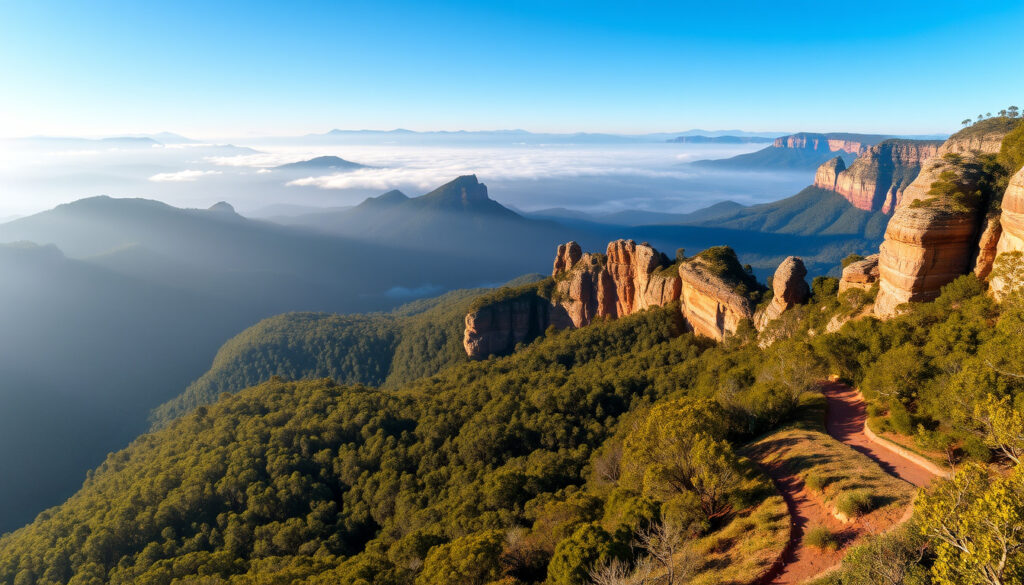
In Australia, the Blue Mountains are special for their scale and silence: a national-park landscape of sandstone cliffs, eucalyptus forest and lookouts, not a single summit. The Greater Blue Mountains Area was added to the World Heritage list in 2000 for its natural values. The classic first stop is the Three Sisters rock formation, and the park service manages a network of walks around the main lookouts. Paid rides at Scenic World add cableway, railway and skyway views of the valley (Scenic World (the attraction operator)).
Ontario’s Blue Mountain Resort is special for the opposite reason: everything is concentrated. Destination Ontario describes it as a year-round outdoor recreation destination offering skiing, snowboarding, hiking, mountain biking and water sports, and the resort adds a summer lineup built around the Ridge Runner Mountain Coaster, high ropes, zip lines and aquatic play.
The pattern: Australia sells a landscape you move through; Ontario sells a village where everything is a short walk from where you sleep. They share a name, not an experience.
Is Blue Mountain worth visiting?
Match the destination to the traveler, not the other way around. A hiker’s version of “worth it” and a skier’s version are different trips.
Tourism Australia positions the Australian park as an easy day trip from Sydney, and for that use — fresh air, big views, a walk, and back in the city for dinner — it is one of the easiest worthwhile calls in the country.
If the plan involves skiing, snowboarding or a village weekend, the Ontario resort is the one with the lifts and the lodging. Its first-timer guide emphasizes the village as the center of the stay: bars, restaurants and shops in one walkable base.
- One day in Sydney → the Australian park, an easy yes.
- A weekend with skis or a family activity list → the Ontario resort.
Why this matters: “worth it” is a geography question, and the correct answer depends on how many days you have.
How long to spend in Blue Mountain?
- One day: the Australian park from Sydney — lookouts, a walk, and the drive home.
- One weekend: the Ontario resort — one or two days on the hill, plus the village.
- A week: Ontario as a base for Georgian Bay, or a slow Australian ridge-town escape.
One day is enough for the Australian park as a first visit; two or three days suit the walk network and the small towns along the ridge. The Ontario resort works as a weekend package, and it stretches into a week when you add the summer activity roster and the lake.
The catch: accommodation cost compounds faster on the Ontario side, so length of stay and budget move together.
Do Aboriginal peoples still live in the Blue Mountains?
Yes — the Blue Mountains remain an Aboriginal cultural landscape, not a historical one.
The NSW National Parks and Wildlife Service, which manages the park, points to continuing Aboriginal cultural connection and heritage sites within the landscape, and asks visitors to treat those places with care.
For a visitor, the cultural layer is another reason to stay on marked tracks. The rock shelters, art sites and storylines are part of a living place, protected by park rules that outlast any single visit.
Why is it called Blue Mountain in Australia?
The Australian name has a well-documented natural explanation. Eucalyptus forests release fine droplets of oil, and those droplets, combined with dust, scatter blue light — producing the haze that hangs over the valleys. Tourism Australia gives this as the official account of the name.
Ontario’s name comes from somewhere else entirely: the local Blue Mountain landform the resort occupies, not from eucalyptus. The documentary trail for the exact naming of that landform is thinner, but the surrounding municipality is literally called The Blue Mountains, and the resort takes its name from the rise of land on the Niagara Escarpment.
Same word, two mechanisms: Australia’s blue haze is atmospheric chemistry; Ontario’s name is local geography.
The pattern: the naming difference mirrors the trip difference — natural phenomenon versus geographic marker.
Are Collingwood and Blue Mountain the same?
No, but the address system makes it feel that way. Collingwood is a town in Ontario; Blue Mountain Resort is the destination beside it. The resort sits within the Town of The Blue Mountains, a municipality that wraps around Collingwood — a layer of geography that explains a lot of the confusion.
How far is Blue Mountain from Collingwood?
Downtown Collingwood to Blue Mountain Village: about 10 minutes by car
That short drive means the two function as one trip: visitors sleep in Collingwood, ski at the resort, and eat anywhere in between. Keep the municipality name in mind when comparing hotel addresses, because “Blue Mountain” can legitimately appear on both sides of the equation.
- Stay in Collingwood for a wider range of rooms and a short drive to the slopes.
- Stay at the resort for walk-to-lift convenience and village evenings.
The implication: Collingwood and Blue Mountain are separate places that behave like one destination — which is exactly why booking confusion happens.
Who owns the village at Blue Mountain?
Blue Mountain Village operates as part of Blue Mountain Resort, and the resort runs under Alterra Mountain Company, the North American mountain-resort group. Inside the village, ownership is mixed: resort-run businesses sit beside privately owned condominiums and shops, so the answer to “who owns Blue Mountain Village” changes from building to building.
What ski resort did Bruce Willis own?
- Soldier Mountain in Idaho — a small, independent ski area whose records name Bruce Willis as an owner.
- Not Blue Mountain Resort in Ontario — no such ownership link exists in the resort’s record.
The Bruce Willis story attaches to Soldier Mountain, and the ski area’s own records are the source of the connection (Soldier Mountain (the Idaho ski area)). The mix-up is understandable: both are North American ski areas with mountain-style names. The paperwork just names a different mountain.
The pattern: celebrity rumors travel faster than property records. When a story assigns a famous owner to a resort, the dirt is usually elsewhere.
How expensive is Blue Mountain?
This is where the two destinations split hardest. The Australian park has genuinely cheap days: a car, a sandwich, a lookout, a walk, with Scenic World as the optional paid extra. The Ontario resort runs on a resort economy, where lodging, dining, parking and activities stack quickly.
The summer full-access pass at Blue Mountain Resort starts at CAD 60 for adults and CAD 48 for children 12 and under, with the resort warning that online rates can be higher and that weather, queues and operating hours can stop you from completing every activity (Blue Mountain Resort (the ticket operator)). Advance-purchase tickets may be refundable up to three days before the scheduled date under the resort’s stated policy.
Budget for transport, parking or transfers, tickets, food and lodging — the five-line trip budget that applies to either Blue Mountain. On the Australian side, the daily costs sit in getting there, parking at busy lookouts, and any paid attraction; on the Ontario side, the pass is just the first line.
The trade-off: Australia’s version can cost almost nothing on a clear day; Ontario’s version is a planned expense where the biggest line is usually accommodation, not the lift ticket.
Blue Mountain at a glance: Australia vs Ontario
The deciding variable is rarely the mountain itself — it’s the shape of the trip you have time for.
| Factor | Blue Mountains, Australia | Blue Mountain Resort, Ontario |
|---|---|---|
| What it is | UNESCO-listed national park and mountain region | Purpose-built four-season ski resort and village |
| Best known for | Three Sisters, lookouts, waterfalls, bushwalks | Skiing, night skiing, village dining, summer adventure park |
| Typical visit length | One-day trip from Sydney | Weekend or week-long resort stay |
| Main cost drivers | Transport, parking, Scenic World tickets | Lift or activity passes, lodging, village dining |
Blue Mountain Resort, Ontario: the operating stats
These are the resort’s own published figures — useful for planning what to expect on site, not for comparing against the Australian park.
| Metric | Value |
|---|---|
| Address | 190 Gord Canning Drive, The Blue Mountains, Ontario |
| Resort standing | Ontario’s largest ski resort |
| Ski terrain | 365 skiable acres; 720-foot vertical rise |
| Runs | 43 total; 30 lit for night skiing |
| Lifts | 7 chairlifts |
| Village | More than 50 bars, restaurants and retail shops |
| Winter extras | Mountaintop skating, Hike N Tube, snowshoeing, Plunge Aquatic Centre |
| Summer extras | Gondola, hiking, biking, Ridge Runner Mountain Coaster, high ropes, zip lines, aquatic facilities |
| Drive from Toronto | About 157 km / 90 minutes |
| Drive from Barrie | About 66 km / 45 minutes |
| Summer full-access pass | From CAD 60 (adult) / CAD 48 (child 12 and under) |
Upsides
- Match the destination to the season and both trips are easy wins: Australia for landscape, Ontario for alpine play.
- Both sides have strong official planning sources: the park service, UNESCO, Tourism Australia, the resort and the provincial tourism agency.
- The Ontario village works as a self-contained weekend even in changeable weather, with lodging, food and activities close together.
Downsides
- Book the wrong one and the correction is a different continent, not a different exit.
- Ontario’s cost stack — pass, lodging, dining, parking — catches first-timers who budget only for the ticket.
- Australia’s park requires self-management: weather, trail conditions, and tour-bus crowds at the main lookouts.
Plan a Blue Mountain trip in five steps
- Step 1: Check the country code. An NSW address means the Australian park; an ON address means the Ontario resort. Nothing else matters more.
- Step 2: Match the season to the activity. Australia’s park works year-round for walks and lookouts; Ontario’s skiing is a winter sport, and the summer coaster and ropes are warm-weather play.
- Step 3: Book transport before tickets. From Sydney, allow about 90 minutes by car; from Collingwood, plan about 10 minutes to the village.
- Step 4: Reserve pass dates and gear. Scenic World and the Ontario full-access pass both reward advance booking, and the resort’s refund policy covers tickets cancelled up to three days ahead.
- Step 5: Budget the full bill. Transport, parking or transfers, tickets, food and lodging — the five-line trip budget that applies to either Blue Mountain.
Confirmed facts
- Two well-known destinations share the Blue Mountain name: one in New South Wales, Australia, and one near Collingwood, Ontario, Canada.
- The Greater Blue Mountains Area was UNESCO World Heritage-listed in 2000.
- Blue Mountain Resort in Ontario operates as part of Alterra Mountain Company.
What’s unclear
- The exact documentary trail for the naming of the Ontario landform is thinner than the Australian eucalyptus explanation.
- Individual ownership of shops and condominium units inside Blue Mountain Village is not public information and can change.
- Current prices for lift tickets, rooms and tours shift by season, so no single published price stays accurate for long.
What the official record says
“Exceptional natural beauty” is the phrase UNESCO applies to places like the Greater Blue Mountains Area, where eucalyptus forests, deep gorges and cliff-lined valleys sit close to a major city.
UNESCO World Heritage Centre, on the 2000 listing
Aboriginal people have cared for this landscape for millennia, and the national park protects places of continuing Aboriginal cultural significance.
NSW National Parks and Wildlife Service, park management
Blue Mountain Resort is a four-season destination: winter skiing and riding, then a summer lineup of mountain coaster, ropes courses, zip lines and aquatic play.
Destination Ontario, provincial tourism agency
Blue Mountain is not a choice between two mountain towns; it is a choice between two kinds of trip. The Australian park rewards travelers who want scale, silence and scenery on a day budget, while the Ontario resort rewards planners who want lifts, lodging and a village that works in winter and summer alike. For a first-time visitor, the decision rule is simple: check the country code on the address before you book anything — because the cost of the wrong Blue Mountain is not a changed itinerary, it’s a missed trip on the wrong continent.
bluemountain.ca, bluemountain.ca, bluemountain.ca, bluemountain.ca, bluemountain.ca
Frequently asked questions
What is the best time of year to visit the Blue Mountains near Sydney?
Autumn (March to May) and spring (September to November) are the most comfortable months for walking, with cooler mornings and clearer lookouts. Summer weekends are the busiest; winter days are short but the views are often crisp and quiet.
How do you get from Sydney to the Blue Mountains without a car?
Trains run from Sydney to the main mountain towns, with Katoomba the most common stop for the Three Sisters and the main walk network. Guided day tours from the city also cover transport and the top lookouts in one day.
Does Blue Mountain Resort operate outside the winter ski season?
Yes. Destination Ontario describes the resort as a year-round outdoor recreation destination. The summer roster includes the open-air gondola, hiking and mountain biking, the Ridge Runner Mountain Coaster, high ropes, zip lines and the Plunge Aquatic Centre.
Do you need to book Scenic World tickets in advance?
Booking in advance is the safer play, especially at peak times — it locks in your date and avoids the risk of sold-out sessions. Scenic World’s own site handles online bookings directly.
Are there easy walks in the Blue Mountains for first-time visitors?
Yes. The main lookout at the Three Sisters is a short easy walk from the carpark, and several sealed tracks suit first-timers. For anything longer, check current trail alerts with the park service before you set out.
Related reading
More related posts
 Custom Shirts: Design & Print in Ireland
 What Happened to Josh Frydenberg? Post-Politics Career and Life
 Allegiant Stadium Capacity: NFL, Concerts & Events (65,000 Seats)
 Chad Morgan: Real Name, Biggest Hits, Cause of Death & Legacy
 Caroline Catz: Real Name, Age, and Life After Doc Martin
 Irrfan Khan: Biography, Net Worth, Last Film, Hollywood Legacy
 Mark Webber: Career, Family, and His Role with Oscar Piastri
 Anna Delvey Today: What She’s Doing, Her Sentence, and More