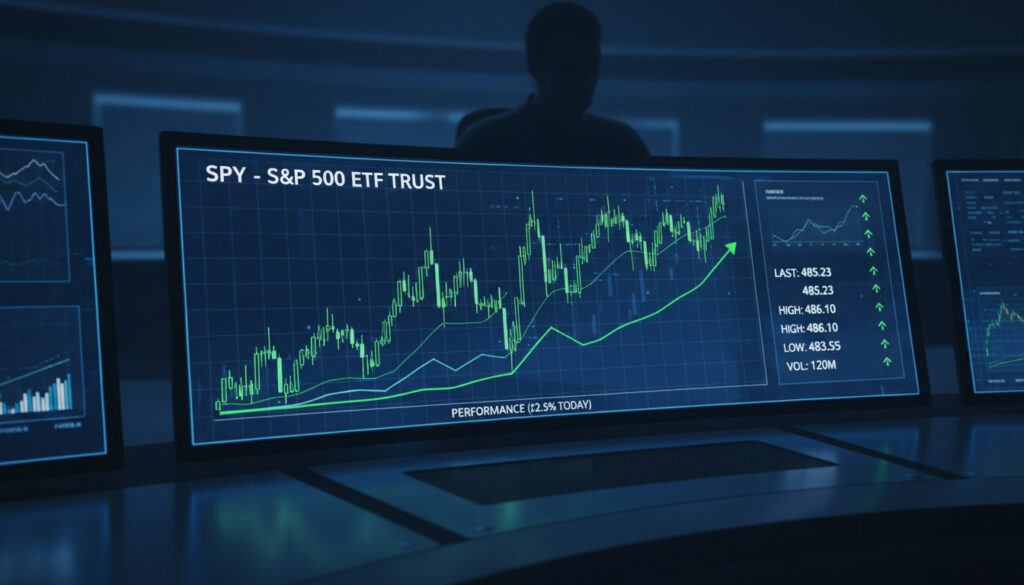
Spy Share Price – Live Price Charts Performance Data
The SPDR S&P 500 ETF Trust (SPY) commands global attention as the most liquid exchange-traded fund tracking American large-cap equities, with recent trading sessions in early April 2026 showing prices oscillating between approximately $655 and $670 per share. State Street Global Advisors has operated the fund since January 22, 1993, utilizing full replication to mirror the S&P 500 Index’s market-cap-weighted composition of roughly 500 leading U.S. companies.
Assets under management currently exceed $683 billion, reflecting institutional and retail demand for passive equity exposure. Daily trading volumes regularly surpass 88 million shares, creating tight bid-ask spreads that average 0.01% during regular market hours. The ETF’s price fluctuates in real-time based on underlying stock movements, macroeconomic developments, and geopolitical events such as the recent Iran ceasefire speculation that pushed the broader S&P 500 up 0.27% in single-session trading.
What Is the Current SPY Share Price?
Market data from April 6, 2026, reveals SPY trading across a multi-dollar range depending on the timestamp and data provider. Intraday snapshots show values between $655.86 and $670.09, with volume-heavy sessions reaching 94.70 million shares exchanged. This variability underscores the importance of verifying timestamps when evaluating quotes from different financial platforms.
- Year-to-date returns stand at +8.53%, translating a $1,000 investment into $1,085 over the period.
- The fund maintains an expense ratio of 0.09%, extracting approximately $9 annually per $10,000 invested.
- Price-to-earnings ratios hover near 27.74 based on rolling twelve-month earnings of underlying constituents.
- Nvidia currently represents the largest single holding at 8.22% of total assets, followed by Microsoft at 7.16% and Apple at 6.32%.
- Dividend yield registers at 1.1% with distributions occurring quarterly from constituent payouts.
- The 52-week trading range spans $481.80 to $697.84, indicating significant volatility over the past year.
- Average daily volume consistently exceeds 88 million shares, providing institutional-grade liquidity for entry and exit.
| Metric | Value | Source Context |
|---|---|---|
| Open | $655.86–$660.78 | Pre-market settlement variance |
| High | $658.75–$670.67 | Intraday peak by timestamp |
| Low | $655.52–$658.75 | Session trough levels |
| Previous Close | ~$655.83 | Prior day 4:00 PM ET |
| 52-Week Range | $481.80 – $697.84 | 12-month high/low |
| Average Volume | 88.27M–89.0M | 30-day mean |
| Dividend Yield | 1.1% | Annualized distribution rate |
How Does SPY Structure Its Portfolio?
Replication Methodology
SPY employs full replication to track the S&P 500 Index, meaning the fund physically holds all constituent stocks in proportions matching their index weights. The portfolio contained approximately 504 stocks as of early April 2026, capturing the 500 primary listings plus any transitional positions during index reconstitution. State Street Global Advisors adjusts these holdings during quarterly rebalancings when S&P Dow Jones Indices modifies the benchmark’s composition.
Concentration in Mega-Cap Technology
Despite holding hundreds of stocks, SPY exhibits significant concentration at the top. The ten largest positions collectively command over one-third of total assets. Nvidia leads with an 8.22% allocation, while Microsoft and Apple contribute 7.16% and 6.32% respectively. Amazon, Meta Platforms, and Broadcom each maintain weightings between 2.65% and 3.88%, creating leveraged exposure to technology sector performance relative to the broader economy.
SPY charges a 0.09% annual expense ratio, deducted daily from fund assets rather than billed directly to shareholders. This fee structure means investors do not receive separate invoices; instead, the cost is reflected in the net asset value calculation. Over a decade, this expense compounds to approximately 0.9% of total returns, significantly lower than actively managed alternatives.
What Drives Daily Price Movements in SPY?
Macroeconomic Data Releases
SPY responds immediately to economic indicators including employment reports, inflation data, and Federal Reserve policy announcements. The fund’s 27.74 P/E ratio makes it sensitive to interest rate expectations, as higher discount rates reduce the present value of future corporate earnings. Trading activity often accelerates at 8:30 AM ET when the Bureau of Labor Statistics releases employment figures, with prices stabilizing by the 9:30 AM opening bell.
Geopolitical Risk Premiums
Recent trading sessions have demonstrated SPY’s sensitivity to international developments. On April 6, 2026, shares rallied amid reports of Iran ceasefire negotiations, illustrating how risk-off sentiment can drive capital into large-cap U.S. equities perceived as safe havens. Such movements typically reverse quickly if diplomatic situations deteriorate, creating intraday volatility that technical traders exploit.
Historical Performance and Long-Term Returns
Extended time horizons reveal SPY’s wealth-compounding characteristics, though recent volatility has tested investor conviction. The three-month period ending April 2026 showed a -4.75% decline from January highs, contrasting with the +30.41% gain recorded over the full 52-week cycle. Long-term holders have fared better, with ten-year annualized returns of 13.56% growing $1,000 initial investments into $3,567.
Over five-year periods, SPY has delivered 15.77% annualized returns, ranking in the 23rd percentile among large-cap blend ETFs. This performance places the fund in the top quarter of passive vehicles despite its age and massive asset base, which theoretically could impede agility.
The one-month performance through early April 2026 registered -2.00%, with prices swinging between $629.28 and $683.36. Such 8.5% monthly ranges are not uncommon for equity ETFs but may surprise investors expecting steady appreciation.
How Has SPY’s Price Evolved Over Recent Months?
- 52-week low established at $481.80 during broad market correction.
- Index peaks at $697.84 amid technology earnings optimism.
- Monthly high of $683.36 precedes mid-month correction.
- Monthly low of $629.28 tests support levels before rebound.
- Trading range consolidates between $655 and $670 on reduced volatility.
What Data Is Verified and What Remains Uncertain?
Established Information
- Expense ratio fixed contractually at 0.09% annually.
- Full replication methodology validated by daily holdings disclosures.
- Dividend distributions occur quarterly with 30-day yield at 1.06%.
- Inception date remains January 22, 1993, with continuous trading since.
Variable or Uncertain
- Real-time NAV deviations of ±0.05% during volatile sessions.
- After-hours pricing liquidity varies significantly from regular session.
- Exact share count fluctuates around 996 million due to creation/redemption.
- Closing auction prices may differ from 4:00 PM snapshots by several cents.
What Is SPY’s Role in Modern Markets?
SPY represents the first exchange-traded fund to track the S&P 500, pioneering the accessible index fund structure that democratized institutional-grade diversification. The vehicle functions as both investment product and economic indicator, with its real-time price serving as a proxy for American corporate health. Retail accessibility through standard brokerage accounts requires no minimum investment beyond the current share price, unlike mutual fund alternatives often demanding $1,000 to $3,000 initial commitments.
The fund’s structure allows for same-day liquidity, with shares created or redeemed in-kind to accommodate demand without taxable distributions to existing holders. This mechanism distinguishes SPY from closed-end funds and many mutual funds, providing tax efficiency alongside transparency. For those monitoring retail consumer trends, Lindt Chocolate Woolworths – Prices, Deals and Availability offers related market analysis.
Where Does SPY Pricing Data Originate?
“Real-time bids and asks update every 3 seconds via Nasdaq Basic, providing institutional-grade price discovery for retail participants.”
“The SPDR S&P 500 ETF Trust holds approximately 504 stocks selected by the S&P Committee to represent the large-cap U.S. equity market.”
— State Street Global Advisors Fund Documentation
What Should Investors Remember About Current Valuation?
SPY trades at a premium to its 52-week low established last April, yet remains approximately 6% below January 2026 peaks. The current P/E near 27.74 suggests elevated valuations relative to historical norms, necessitating careful position sizing for new entrants. Those seeking portfolio diversification might also consider Best Travel Credit Cards No Fees – Top Picks for 2025 for financial planning purposes, though equity exposure through SPY requires distinct risk tolerance compared to credit products.
Frequently Asked Questions
What is the minimum investment required for SPY?
SPY requires no minimum investment beyond the price of one share, currently approximately $658. Fractional shares available at many brokerages allow investments as low as $1.
How frequently does SPY rebalance its holdings?
The fund rebalances quarterly to match S&P 500 Index changes, though corporate actions like mergers or spin-offs trigger immediate adjustments to maintain accurate tracking.
Does SPY distribute qualified dividends?
Most SPY dividends qualify for favorable tax treatment, though a small percentage may constitute ordinary income depending on constituent payouts. Tax forms detail the precise breakdown annually.
What are SPY’s official trading hours?
Standard trading occurs 9:30 AM to 4:00 PM ET on weekdays. Pre-market sessions begin at 4:00 AM ET, while after-hours trading extends until 8:00 PM ET, though liquidity diminishes outside regular hours.
How does SPY handle stock splits?
The fund automatically adjusts share counts and prices when underlying constituents split their stock, maintaining proportional market cap weightings without requiring investor action.
Is SPY appropriate for day trading strategies?
Deep liquidity and tight spreads make SPY suitable for active trading, though the 0.09% expense ratio accrues daily, potentially eroding profits from high-frequency positions held overnight.
More related posts
 Lisa Bonet: Biography, Relationships, Career Highlights
 Iced Tea Guide: How to Make, Health Benefits & Diabetics
 Email Sign In: How to Login to Gmail, Outlook, Hotmail, Yahoo
 Kerry O’Keeffe: Nickname ‘Skull’, Age, Career Stats & Commentary
 How Many Grams in a Teaspoon – Charts for Sugar, Flour, Salt & More
 Katie Allen: Allergist, MP and Cancer Battle
 Xi Jinping: Leadership, Term Limits, and Power Structure
 Jordan Belfort: Stratton Oakmont Rise, Fall and Life Today