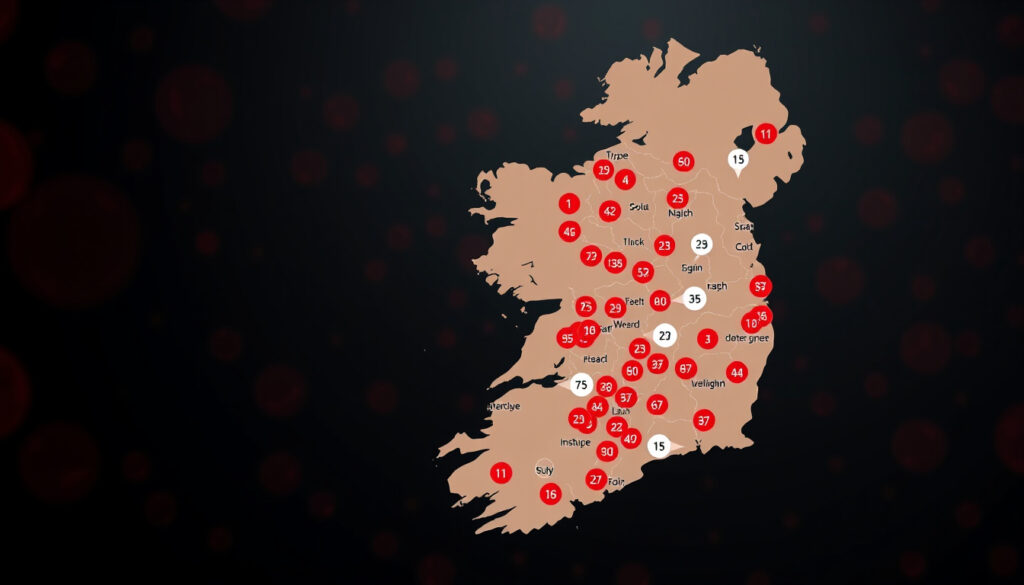
Blood Types: Rarity, Myths, and Irish Distribution
You probably know your blood type from a donation card or a hospital bracelet, but the letter and the plus or minus sign carry more weight than most people realize — in Ireland, the mix looks noticeably different from the global average, shaping everything from emergency transfusions to historical research. Here’s a grounded look at rarity, commonality, and the science behind circulating claims.
Number of main blood types: 8 ·
Most common blood type globally: O+ ·
Least common blood type globally: AB- ·
Percentage of Irish people with O+: 47% ·
Percentage of people with O-: 7%
Quick snapshot
- O positive is the most common blood group in Ireland at about 47% (Irish Blood Transfusion Service)
- AB negative is the rarest blood group in Ireland at about 1% (Irish Blood Transfusion Service)
- O negative red blood cells can be transfused to any patient in emergencies (American Red Cross)
- Whether any blood type is significantly healthier than others
- The actual blood type of Jesus — no definitive evidence exists
- The precise mechanisms behind blood type-disease correlations remain unclear
- Modern Irish donor data (2021 study) refines population estimates with phenotype frequencies
- Ongoing research refines blood type-disease correlations as larger datasets emerge
| Attribute | Value |
|---|---|
| Number of blood group systems | 36 recognized by ISBT |
| Most common blood type in Ireland | O positive (47%) |
| Percentage of universal donors (O negative) | ~7% |
| Rarest blood type overall | AB negative (~1%) |
| Blood type with lowest risk of severe COVID-19 | Type O (observational) |
Which is the rarest blood type?
Among the eight main blood types, AB negative is the rarest across most populations. The Irish Blood Transfusion Service (national blood service) identifies AB negative as the least common blood group in Ireland, appearing in about 1% of the population.
AB negative is the least common blood group in Ireland, appearing in about 1% of the population.
Irish Blood Transfusion Service
The ABO and Rh systems
Blood type is determined by two systems working together. The ABO system sorts blood into groups A, B, AB, and O based on antigens on red blood cells. The Rh system adds a second dimension: you either have the Rh antigen (positive) or you don’t (negative). This creates the eight main types: A+, A-, B+, B-, AB+, AB-, O+, and O-.
Rarity of AB negative
AB negative requires both the AB antigen pattern and the absence of the Rh factor, a combination that’s uncommon globally. The Irish Blood Transfusion Service (official donation authority) reports it at roughly 1% in Ireland, matching the global pattern.
Top 3 rarest blood types
- AB negative — rarest, around 1%
- B negative — second rarest, around 2%
- A negative — third rarest, around 5-6%
The pattern: rarity tracks with the Rh negative factor, which is simply less common than Rh positive in most of the world. The clinical consequence is that hospitals keep smaller stocks of these types, which makes targeted donation drives more important for patients with rare combinations.
What blood type do most Irish people have?
O positive leads in Ireland. The Irish Blood Transfusion Service (national blood service) says O positive accounts for about 47% of the population. That’s a higher share than the global average, which typically sits in the 37-40% range.
Blood type distribution in Ireland
A peer-reviewed study published in 2021 examined modern Irish donors and found O positive at 45.55%, A positive at 24.31%, B positive at 9.78%, and AB positive at 2.63%. Among Rh negative types, O negative was 9.40%, A negative 5.52%, B negative 2.25%, and AB negative 0.58%.
Why Irish DNA is unique
Ireland’s relative geographic isolation and historical settlement patterns shaped its blood type mix. The Irish Blood Transfusion Service (national blood service) observes that people in the West of Ireland are predominantly group O, while group A is more concentrated in counties that historically received Viking, Anglo Norman, and English settlement. Rh negative blood is more concentrated on the East coast than the West.
Comparison with global averages
Globally, O positive is the most common type, but Ireland’s 47% sits on the higher end. A World Population Review (population data aggregator) table lists Ireland at O positive 47%, A positive 26%, B positive 9%, O negative 8%, A negative 5%, B negative 2%, AB positive 2%, and AB negative 1%.
What this means: Ireland’s blood type profile isn’t just trivia. It informs donation campaign targeting and hospital inventory planning, because the mix determines which types are in steady supply and which need active recruitment.
Why is O negative better than O positive?
O negative carries the label “universal donor” for red blood cells, but that status needs context. In emergencies, when a patient’s blood type is unknown, O negative is the safe choice because it lacks the A, B, and Rh antigens that can trigger immune reactions.
Universal donor status of O negative
The American Red Cross (blood donation authority) explains that O negative red blood cells can be given to patients of any blood type, which makes it the standard for emergency transfusions and for premature or immunocompromised newborns. That demand is why blood banks actively recruit O negative donors.
O negative red blood cells can be given to patients of any blood type.
American Red Cross
Compatibility with all blood types
O positive, by contrast, can only be given to Rh positive patients (O+, A+, B+, AB+). The Rh factor is the divider: an Rh negative recipient would develop antibodies against Rh positive cells, so O positive cannot be safely used for universal donation.
Limitations of O positive
While O positive is the most common type and therefore the most frequently transfused, it’s not universal. The clinical advantage of O negative is the safety margin it provides in uncontrolled situations like trauma care or when a patient’s blood type hasn’t been typed yet.
The trade-off: O negative’s universal status means it’s perpetually in short supply relative to demand. Blood centers hold O negative units in reserve for emergencies, which is why donors with this type get targeted appeals even though they represent only about 7% of the population.
Is there a healthiest blood type?
The short answer: no blood type is definitively healthier. Some studies show correlations between blood type and disease risk, but those associations are modest and don’t translate into a “best” type for overall health.
Blood type and disease risk studies
Research from Northwestern Medicine (academic medical center) notes that type O individuals may have a lower risk of blood clots, while types A and B may have slightly higher risks of certain cardiovascular conditions. Observational studies also found type O associated with lower risk of severe COVID-19, though the mechanism remains unclear and the finding isn’t definitive.
Myths vs scientific evidence
The “blood type diet” popularized by naturopath Peter D’Adamo claims that eating according to your blood type optimizes health. A systematic review found no evidence supporting this approach. The diet’s success likely comes from the fact that it recommends generally healthy eating patterns, not from any blood-type-specific mechanism.
Factors more important than blood type
- Genetics overall — far more influential than blood type alone
- Lifestyle — diet, exercise, and sleep dominate disease risk
- Environmental factors — stress, pollution, and social determinants
Blood type tells you something about compatibility, but RNA sequencing, microbiome diversity, and genetic predisposition data all carry more health-relevant signal. A “healthiest blood type” framing oversimplifies a multivariate picture.
Why this matters: the healthiest-blood-type question gets amplified online because it’s simple and shareable. But the evidence points to blood type as a minor variable in a much larger health equation.
What was Jesus’s blood type?
There is no verifiable answer to this question. Claims about Jesus’s blood type come from the Shroud of Turin, a linen cloth some believe wrapped his body, but mainstream science has not accepted these findings.
Claims from the Shroud of Turin
Some researchers have claimed to identify type AB from blood residue on the Shroud of Turin. These claims are speculative and haven’t been replicated in controlled settings. The Shroud’s authenticity as a burial cloth from the first century is itself debated.
Scientific limitations
No verifiable sample of Jesus’s blood exists. Blood typing requires intact red blood cells or preserved genetic material, and no such sample has been confirmed by independent laboratories. The Shroud’s testing history is marked by contested results and methodological disputes.
Religious and historical context
The question sits at the intersection of religious artifact veneration and forensic science. Wikipedia (crowdsourced reference) documents that carbon dating in 1988 placed the cloth in the 13th-14th century, which many scholars take as evidence it’s a medieval artifact. That datapoint alone makes any blood type claim further speculative.
Claims about Jesus’s blood type rest on a single contested artifact with unresolved dating. Treat any definitive answer as a red flag for credibility.
What are the most common blood types?
Globally, O positive is the most common blood type, found in about 37-53% of populations depending on the region. The American Red Cross reports O positive at 38% of the U.S. population, with A positive at 34%.
Global frequency order
| Blood Type | Global Frequency (approx.) |
|---|---|
| O+ | 37-53% |
| A+ | 28-34% |
| B+ | 8-12% |
| O- | 6-8% |
| A- | 5-7% |
| AB+ | 2-4% |
| B- | 1-2% |
| AB- | 0.5-1% |
Regional variations
Blood type distribution shifts by geography. The peer-reviewed study in PMC (academic research database) found Ireland’s donor population at O 54.95%, A 29.82%, B 12.02%, and AB 3.21% in ABO phenotype terms, with RhD positive at 82.26% and RhD negative at 17.74%.
Donation impact
Common types are easier to stock, but rare types like AB negative require sustained recruitment. The American Red Cross notes that while AB negative is rare, AB plasma is actually universal for plasma donation, creating a different kind of demand.
The pattern: frequency drives availability, but compatibility needs drive donor messaging. O negative donors get called because their blood covers everyone, not because it’s rare.
Blood type compatibility at a glance
Eight main types, multiple compatibility rules, one pattern that matters in the ER.
| Blood Type | Can Receive From | Can Donate To |
|---|---|---|
| O- | O- | All types |
| O+ | O-, O+ | O+, A+, B+, AB+ |
| A- | A-, O- | A-, A+, AB-, AB+ |
| A+ | A-, A+, O-, O+ | A+, AB+ |
| B- | B-, O- | B-, B+, AB-, AB+ |
| B+ | B-, B+, O-, O+ | B+, AB+ |
| AB- | AB-, A-, B-, O- | AB-, AB+ |
| AB+ | All types | AB+ |
The implication: O negative’s universal acceptance and AB positive’s universal reception bookend the compatibility chart. Between them, the rules get specific quickly, which is why hospitals keep type-specific inventories.
Blood type myths and misconceptions
Personality typing, diet claims, and health rankings circulate widely, but evidence support is thin. The Northwestern Medicine (academic medical center) covers blood type and health correlations while noting the limits of what blood type can predict.
Personality and blood type
In Japan and South Korea, blood type personality theory is popular — Type A “organized,” Type B “creative,” Type O “optimistic,” Type AB “eccentric.” The Wikipedia (crowdsourced reference) page on the subject documents its pop-culture roots. No scientific evidence supports a connection between blood type and personality.
Diet and blood type
The blood type diet recommends different foods per type, but research published in the U.S. National Library of Medicine (peer-reviewed database) notes that study designs don’t isolate blood type as a factor. Adherence to the diet’s general healthy principles, not the blood-type match, likely drives any reported benefits.
Emergency response
The American Red Cross emphasizes that O negative blood is critical for trauma settings where type isn’t known. This is operational guidance, not a health superiority claim.
Blood type tells you about antigen compatibility, yet online discourse treats it as a personality compass or dietary guide. The gap between what blood type determines and what people claim it determines is vast.
southernreview.net, en.wikipedia.org, poplix.uk, sundayreport.uk, maplepulse.net, mediaroar.uk, youtube.com, civicviewpoint.net
For a deeper look at how these figures compare regionally, you can find similar Irish distribution data in a related analysis.
Frequently asked questions
Can your blood type change?
In rare cases, blood type can change after bone marrow transplantation because the stem cells that produce red blood cells come from the donor. A stem cell transplant can permanently switch the recipient’s blood type to the donor’s. That’s an exception to the general rule that blood type is fixed for life.
How is blood type determined genetically?
Blood type is inherited from your parents. The ABO gene has three alleles — A, B, and O — and you get one from each parent. A and B are co-dominant, meaning if you inherit both, you’re type AB. The Rh factor is inherited separately; the positive allele is dominant, so Rh negative requires two negative copies.
What is the Rh factor and why does it matter?
The Rh factor is an antigen on red blood cells. If you have it, you’re Rh positive; if not, you’re Rh negative. During pregnancy, an Rh negative mother carrying an Rh positive baby can develop antibodies that affect subsequent pregnancies. That’s why Rh status is a standard prenatal test.
Is blood type related to personality?
Blood type personality theory is popular in Japan and South Korea, but no scientific evidence supports a link between blood type and personality traits. It’s a cultural belief system, not a validated psychological framework.
Why do some blood types have different frequencies in different countries?
Blood type frequencies vary by population due to genetic drift, migration patterns, and historical settlement. Ireland’s high O positive rate and regional distribution reflect centuries of isolation and specific population movements — Vikings, Normans, and English settlers left genetic traces in the blood type map.
What happens if you receive incompatible blood?
Receiving incompatible blood triggers an immune response where your antibodies attack the donor cells. The reaction can cause fever, kidney failure, and in severe cases, death. That’s why hospitals type and cross-match blood before transfusion — a process that takes about 45 minutes in emergencies.
Related reading
- Tatiana Schlossberg’s Acute Myeloid Leukemia Battle
- Poison Ivy: Symptoms, Treatment, and Geographic Myths
The bigger picture here is that blood types are a system of compatibilities, not judgments. For a hospital blood bank, O negative is the safest emergency option and the hardest to keep stocked. For a patient with AB negative, the same scarcity creates a different kind of pressure — a reliance on donor registries and rare-type networks. For Ireland specifically, the distribution data shows a population profile that’s distinct from global averages, shaped by history and isolation. The practical takeaway for donors in Ireland is straightforward: O positive is common, so its supply is steady; O negative and AB negative are the types that benefit most from regular, targeted donations. If you’re in the healthcare system, the numbers matter for planning. If you’re a donor, they matter for knowing where your contribution lands. Either way, the science is settled on the core facts — the myths, the personality claims, and the healthiest-type debate are cultural overlays on a system that, at its heart, is about keeping blood flowing to the patients who need it.
More related posts
 NRL Scores Today – Live Results Ladder Updates
 Song Ji-hyo: Biography, Name Change & Relationship Facts
 John Summit: Verified Facts vs Rumors About the DJ
 151 Booster Bundle – Contents, Value and Buying Guide
 Range Rover Sport 2025: Price, Problems, Best Years
 Caitlin Foord: Age, Height, Partner, Arsenal Stats
 Cicerone Surry Hills: Roman Menu, Booking & Reviews
 Channel 9 Presenter Departure – Livinia Nixon Leaves Weather Role After 21 Years