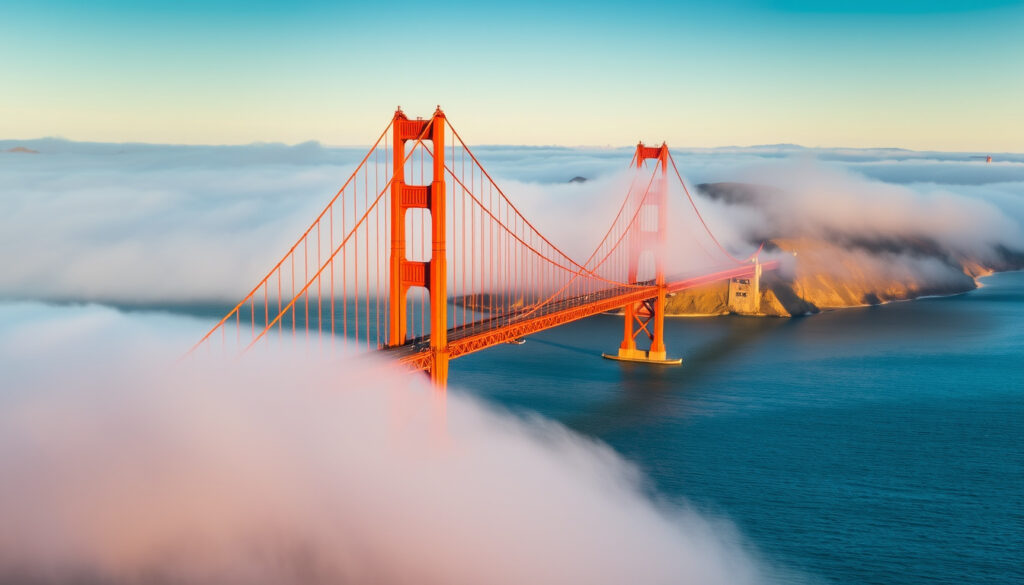
Golden Gate Bridge – History, Facts and Visitor Guide
The Golden Gate Bridge stands as one of the most recognizable structures in the world, spanning the Golden Gate Strait to connect San Francisco with Marin County in northern California. Since opening on May 27, 1937, this suspension bridge has become both an engineering marvel and a symbol of American innovation during the Great Depression era. The bridge’s striking International Orange color and elegant Art Deco design have made it one of the most photographed landmarks on the planet.
Construction of the Golden Gate Bridge took just over four years, beginning on January 5, 1933, and was completed ahead of schedule and $1.3 million under budget. The project cost $35 million to build, a remarkable achievement considering initial estimates had reached $100 million. Today, the bridge carries more than 100,000 vehicles daily and remains a critical artery for the San Francisco Bay Area’s transportation network.
Beyond its practical function, the Golden Gate Bridge represents a significant chapter in American infrastructure history. The project overcame formidable engineering challenges, including strong ocean currents, dense fog, and the need to construct towers rising 746 feet above the water. Its completion transformed regional commerce and community connections while establishing an enduring icon that attracts millions of visitors each year.
When Was the Golden Gate Bridge Built and Who Designed It?
Building the Golden Gate Bridge required an extraordinary collaborative effort. Chief engineer Joseph Strauss led the project, though his original 1921 cantilever design was rejected as unsuitable for the iconic setting. Key contributors included Leon Moisseiff, Irving Morrow who influenced the aesthetic choices, and Charles Ellis who handled much of the detailed engineering work.
The concept of bridging the Golden Gate Strait dates back to 1872, when railroad mogul Charles Crocker first proposed the idea during the Gold Rush era population boom. The $35 million bond financing (approximately $630 million in 2024 dollars) was secured with support from Bank of America, falling far below the initial $100 million estimates.
Construction was handled by McClintic-Marshall, a subsidiary of Bethlehem Steel, and faced significant challenges during the Great Depression. Despite these difficulties, the project was completed in just over four years, finishing ahead of schedule and $1.3 million under budget.
What Are the Key Dimensions of the Golden Gate Bridge?
The Golden Gate Bridge’s engineering scale ranks among the most impressive of its era. Its main span of 4,200 feet made it the longest suspension bridge in the world from 1937 until 1964, when the Verrazzano-Narrows Bridge in New York surpassed this feat. As of available records, the bridge now ranks as the ninth longest suspension bridge globally, though it remains the tallest structure in the San Francisco Bay Area.
The two towers anchoring the bridge rise 746 feet above the water, making them the tallest structures in the region until 1998. These towers bear the weight of two massive cables, each containing 27,572 wires that, if stretched end to end, would reach around the Earth nearly three times. The bridge’s total length of 8,981 feet spans the Golden Gate Strait, providing a critical connection between San Francisco and the North Bay counties.
The roadway itself has undergone significant modifications since the original construction. During a major retrofit between 1982 and 1986, the concrete deck was replaced with lighter steel orthotropic panels over 401 nights of work, costing $68 million. This reinforcement allowed for wider travel lanes, with outer lanes expanded to 11 feet and inner lanes measuring 10 feet. The retrofit strengthened the bridge significantly, making it the strongest it had been since its original construction.
Why Is the Golden Gate Bridge Called “Golden Gate” and Why Is It Orange?
The Origin of the Name
The name “Golden Gate” refers to the strait itself, not the bridge or any associated gold reference. The strait serves as the entrance from the Pacific Ocean into San Francisco Bay, and its naming predates the bridge by several decades. The term first appeared in formal discussions during 1917, and the Golden Gate Bridge and Highway District Act formally established this nomenclature in 1923.
This waterway had been a significant geographical feature since California’s early settlement. As the Gold Rush brought population growth to the region, ferry demand across the strait increased dramatically, creating the necessity for a permanent crossing. The name has no connection to the historical Gold Rush, despite common misconceptions suggesting otherwise.
The International Orange Color
The bridge’s distinctive color, known as International Orange, was chosen by architect Irving Morrow primarily for practical reasons related to San Francisco’s famous fog. This warm orange shade provided the best visibility for mariners and motorists navigating through the frequent low clouds that shroud the area. The color also complemented the natural surroundings, blending harmoniously with the earthy tones of the surrounding hills during clear weather.
Interestingly, the original intent was not to paint the bridge orange at all. Early proposals included a striped black and yellow design for visibility, or even a silver finish. However, International Orange emerged as the superior choice both aesthetically and functionally. The color has since become so synonymous with the bridge that few can imagine it any other way, and the structure frequently appears in marketing materials, films, and photographs as an unofficial emblem of San Francisco.
How Many Died Building the Golden Gate Bridge?
Construction of the Golden Gate Bridge resulted in the deaths of at least 11 workers during the project. This figure, while tragic, was significantly reduced thanks to safety innovations implemented by chief engineer Joseph Strauss. He introduced a safety net suspended beneath the deck during construction, a feature that ultimately saved 19 workers who fell but were caught by this barrier.
Those workers who survived falls into the safety net became members of what was humorously nicknamed the “Half Way to Hell Club,” reflecting the precarious nature of their positions above the turbulent waters below. Strauss’s safety measures were considered revolutionary for the era and helped establish new standards for construction site safety that influenced future projects across the industry.
Can You Walk Across the Golden Gate Bridge and What Is the Toll?
Pedestrian Access
Pedestrians can cross the Golden Gate Bridge via the south-side walkway, which remains open to the public. Cyclists share the north-side pathway, creating a separated system that accommodates both activities safely. On opening day in 1937, approximately 200,000 people crossed the bridge on foot, demonstrating the public’s enthusiasm for this new connection.
Walking hours vary by season, typically running from 5 AM to 9 PM during summer months and 5 AM to 6 PM in winter. These schedules are subject to change based on weather conditions and maintenance needs. Visitors should verify current operating hours at the official Golden Gate Bridge website before planning their visit, as seasonal adjustments occur regularly throughout the year.
Tolling System
Tolls collected on the Golden Gate Bridge fund ongoing maintenance and operations through the Golden Gate Bridge and Highway District. The financing model dates back to the original construction, when bond repayments were secured against future toll revenue. Electronic toll collection via FasTrak remains the preferred payment method for drivers crossing the bridge.
The toll structure has evolved significantly since the bridge opened, adapting to changing traffic patterns and funding requirements. For current toll rates and payment options, visitors should check the official tolling information page, as rates are subject to periodic adjustment. The revenue continues to support essential maintenance work, including the seismic retrofits and ongoing preservation efforts that keep the bridge safe and functional.
A Timeline of the Golden Gate Bridge
The journey from concept to completion spanned several decades of planning, financing challenges, and engineering innovation. Understanding this timeline reveals why the bridge became such a significant achievement in American infrastructure history.
The idea of bridging the Golden Gate Strait first emerged in 1872 when railroad mogul Charles Crocker proposed the concept during the population boom following the Gold Rush era. For decades, the idea remained aspirational as engineers and civic leaders grappled with the technical and financial obstacles involved.
The term “Golden Gate” formally entered usage in 1917 during discussions about bridging the strait, and the Golden Gate Bridge and Highway District Act of 1923 established the official framework for the project. By 1928, the Golden Gate Bridge and Highway District was created to manage financing and construction efforts.
During the 1930s, a $35 million bond was secured with Bank of America support, providing the critical funding needed to move forward. Construction officially began on January 5, 1933, and after four years of demanding work, the bridge opened to pedestrians on May 27, 1937.
In the decades that followed, the bridge continued to evolve. A $68 million deck replacement project between 1982 and 1986 strengthened the structure over 401 nights of careful work. Most recently, in 2024, a suicide prevention net system was installed along the bridge walkways.
What Is Established and What Remains Unclear?
Several aspects of the Golden Gate Bridge’s history are well documented and consistently verified across sources. Construction began on January 5, 1933, and the bridge opened on May 27, 1937. The project cost $35 million and was completed $1.3 million under budget. The main span measures 4,200 feet with a total length of 8,981 feet. The color “International Orange” was chosen by Irving Morrow specifically for visibility in San Francisco’s frequent fog, and the name refers to the strait itself rather than any connection to the Gold Rush or the bridge’s color.
Other details remain less certain or require verification from current sources. The exact total number of worker deaths during construction varies slightly between sources, with most citing “at least 11.” Current toll rates change periodically and require checking official sources. Complete details of maintenance scheduled for 2025 are not fully available. Future expansion plans or capacity modifications have not been announced, and the long-term effects of climate change on the structure continue to be studied. Specific visitor statistics for recent years also vary between reporting periods.
The Bridge’s Cultural and Economic Impact
Since its opening, the Golden Gate Bridge has transcended its role as mere transportation infrastructure to become a global cultural icon. Frequently described as “the most beautiful and most photographed bridge in the world,” it has appeared in countless films, television shows, photographs, and works of art. This cultural resonance has made it an unofficial ambassador for San Francisco and the broader California region.
The economic implications of the bridge extend far beyond its $35 million construction cost. Regional commerce flows more efficiently across the strait, connecting communities that previously relied on ferry services. Property values in Marin County and the North Bay increased significantly after the bridge opened, transforming what had been relatively isolated communities into viable alternatives to living in San Francisco proper.
Tourism related to the bridge contributes substantially to the local economy. Visitors from around the world travel specifically to walk across the structure, photograph it from various viewpoints, or simply witness its scale and elegance. The nearby Golden Gate National Recreation Area provides additional recreational opportunities that complement the bridge experience, creating a destination that merits multi-day exploration.
Historical Perspectives and Notable Accounts
The construction of the Golden Gate Bridge generated substantial commentary from engineers, journalists, and everyday citizens who witnessed its creation. Contemporary accounts described the project in terms that emphasized both its technical ambition and its significance to the American spirit during the Depression era.
The bridge was not simply a transportation project but a declaration that American ingenuity could overcome any obstacle, even in the darkest days of economic hardship.
— Historical engineering documentation
Chief engineer Joseph Strauss documented many aspects of the construction process, noting the logistical challenges of working across treacherous waters while managing thousands of workers. His safety innovations, particularly the net system, became a model for future large-scale construction projects and demonstrated that worker protection could be reconciled with ambitious timelines and tight budgets.
Modern engineering assessments continue to recognize the Golden Gate Bridge as a remarkable achievement. The Federal Highway Administration notes the bridge as a landmark of American infrastructure, while academic sources like Encyclopedia Britannica document its historical significance. The History Channel has covered various aspects of the bridge’s construction and cultural impact in multiple programming segments.
Summary
The Golden Gate Bridge represents a remarkable convergence of engineering ambition, civic determination, and aesthetic vision. Built between 1933 and 1937 at a cost of $35 million, it features a main span of 4,200 feet and towers rising 746 feet above the Golden Gate Strait. The International Orange color, chosen for visibility in San Francisco’s famous fog, has become synonymous with both the bridge and the city it connects.
At least 11 workers lost their lives during construction, though the safety net innovations implemented by Joseph Strauss saved 19 others from certain death. Today, the bridge carries more than 100,000 vehicles daily while providing pedestrian and bicycle access that allows visitors to experience its scale firsthand. As one of the most recognizable structures in the world, the Golden Gate Bridge continues to serve as both functional infrastructure and cultural icon. Those planning to visit can find current information about walking hours, tolls, and maintenance schedules through official channels to ensure a smooth and safe experience at this enduring landmark.
Frequently Asked Questions
How long is the Golden Gate Bridge?
The Golden Gate Bridge has a total length of 8,981 feet (approximately 1.7 miles), with a main suspension span of 4,200 feet.
When was the Golden Gate Bridge built?
Construction began on January 5, 1933, and the bridge opened to the public on May 27, 1937, taking just over four years to complete.
Who designed the Golden Gate Bridge?
Chief engineer Joseph Strauss led the project, with significant contributions from Leon Moisseiff, Irving Morrow (who selected the iconic orange color), and Charles Ellis (who handled detailed structural calculations).
Why is the Golden Gate Bridge orange?
The bridge’s International Orange color was chosen by architect Irving Morrow primarily for visibility in San Francisco’s frequent fog, though it also harmonizes naturally with the surrounding landscape.
How tall is the Golden Gate Bridge?
The towers stand 746 feet above the water, making the bridge the tallest structure in the San Francisco Bay Area until 1998.
Can you walk across the Golden Gate Bridge?
Yes, pedestrians can walk across the south-side walkway. Hours typically range from 5 AM to 9 PM in summer and 5 AM to 6 PM in winter, subject to weather conditions.
How many people died building the Golden Gate Bridge?
At least 11 workers died during construction. However, 19 others were saved by a safety net installed by chief engineer Joseph Strauss, earning membership in the “Half Way to Hell Club.”
Is the Golden Gate Bridge the longest suspension bridge?
The Golden Gate Bridge held the record for longest suspension bridge from 1937 until 1964. It now ranks as the ninth longest globally, though it remains among the most famous.
More related posts
 Danny Phantom: Cancellation, Age Rating, and Streaming Guide
 What Happened to Josh Frydenberg? Post-Politics Career and Life
 Animal Jam in 2025: Is It Still Playable and Safe
 Grand Theft Auto 6 – Release Date Platforms Protagonists
 Mr Potato Head – History Invention Evolution Legacy
 Renee Rapp: age, height, ADHD diagnosis, and coming out story
 Lori Loughlin: College Admissions Scandal Fallout
 Nina Dobrev: Biography, Relationships, Health, and FAQs