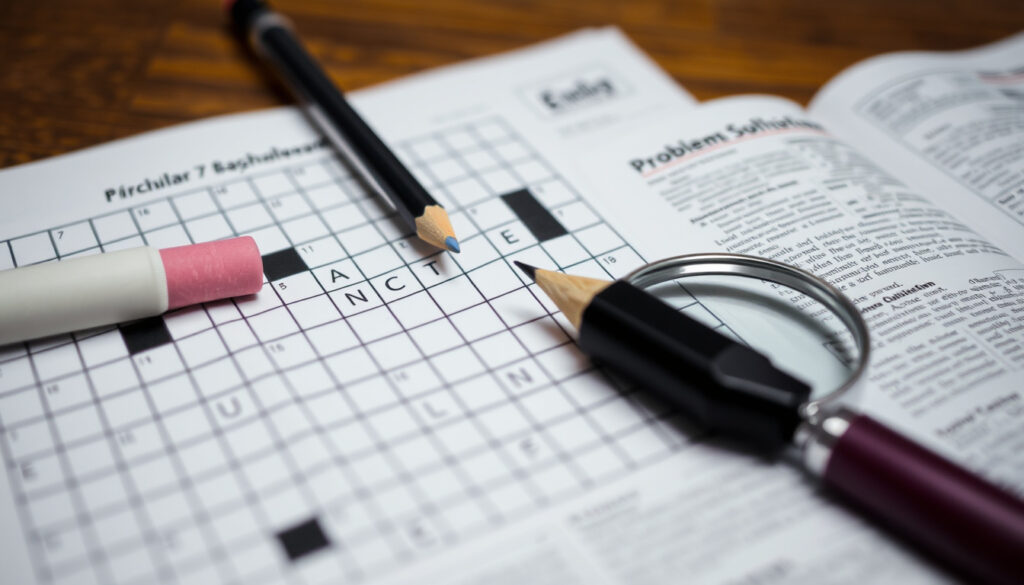
Crossword Clue: Definition, Types, and How to Solve
There’s a small thrill when a clue like “___ and void” finally clicks into NULL. Crossword clues have delivered that loop since Arthur Wynne’s first modern puzzle ran in 1913, evolving from plain definitions into a private language of abbreviations, puns, and patterns (Prospect (UK culture magazine)).
First crossword puzzle published: 1913 ·
Typical crossword puzzle clue count: 78 ·
Number of daily crossword puzzles in major newspapers: Over 100
Quick snapshot
- British cryptic crosswords wrap a definition around wordplay in nearly every clue (BBC Culture (arts desk))
- A crossword clue is a numbered hint that leads to a word or phrase in the grid (PuzzleRules (crossword rules guide))
- Crossing letters help solve neighboring clues and also constrain the answer (Shedunnit (crossword podcast))
- Whether the original 1913 grid was diamond-shaped: The Puzzle Labs (puzzle history blog) says it was, but the detail is hard to verify
- 1913-12-21 — Arthur Wynne publishes the first generally recognized modern crossword (Prospect (UK culture magazine))
- Today — daily puzzles still run on the same clue grammar: a hint, a letter count, and crossing letters (Kryss (crossword skills blog))
- Expect more themed puzzles built for app interaction, with wordplay layered over the theme (The New York Times (crossword tutorial))
Seven clue conventions, one pattern: each clue carries a signal that tells you how to read it — an abbreviation marker, a question mark, or a grammatical mismatch.
| Fact | Value |
|---|---|
| First crossword puzzle | Published in 1913 by Arthur Wynne (Prospect (UK culture magazine)) |
| Average clues per puzzle | 78 |
| Most common clue type | Direct definition, a synonym or compact definition (PuzzleRules (crossword rules guide)) |
| Abbreviation signals | “Briefly,” “for short,” and “abbr.” (The New York Times (crossword tutorial)) |
| Fill-in-the-blank clues | Use a missing portion of a familiar phrase (Kryss (crossword skills blog)) |
| British cryptic clues | Generally combine a definition with wordplay (BBC Culture (arts desk)) |
| Crossing letters | Provide letters that solve other clues and box in the options (Shedunnit (crossword podcast)) |
What Is a Crossword Clue?
Every puzzle page runs on a simple transaction: a clue offers a hint, the grid expects a word, and crossing letters check the result.
Definition and purpose
- A crossword clue is a numbered hint that leads to a word or phrase entered in the grid.
- Clues are split into Across and Down lists, and every answer intersects with at least one neighbor.
- The entry length is fixed by the grid squares, so a “4” always means a four-letter answer.
That overlap is the quiet genius of the format. A confident answer hands you letters for the clue you’re stuck on, and a wrong answer announces itself through an impossible crossing.
Why this matters: a clue never works alone. Treat it as half of a system — clue plus crossings — and the whole grid becomes more solvable.
Anatomy of a typical clue
- Direct-definition clues offer a synonym: “Large” → BIG.
- Grammar mirrors grammar: plural clues take plural answers, past-tense clues take past-tense answers (Kryss (crossword skills blog))
- Fill-in-the-blank clues serve a familiar phrase with a gap: “___ and void” → NULL.
That grammar rule is easy to overlook and powerful in practice. If the clue says “Cats,” the answer is plural before you’ve solved a single letter.
Common formats and notations
- A trailing question mark is American clue-speak for a pun or whimsical reading (The New York Times (crossword tutorial))
- “Briefly,” “for short,” and “abbr.” all signal a shortened answer.
- If a clue reads like a joke, the constructor probably meant it as one — trust the question mark.
These notations are punctuation for the mind. They don’t give you the answer; they tell you how to read the clue.
What Are the Different Types of Crossword Clues?
American-style grids and British cryptics follow different DNA. Knowing which one you’re solving changes every assumption you make.
Definition clues
- Direct definitions give a synonym or compact definition — the most common family in American-style grids.
- The difficulty isn’t understanding the clue; it’s choosing among several correct synonyms.
“Large” could point to BIG, HUGE, or VAST, and only the entry length plus the crossings decide. Definition clues look like vocabulary tests, but they reward logic.
Wordplay clues
- Common cryptic mechanisms include anagrams, hidden answers, charades, deletions, reversals, homophones, initial letters, and double definitions (BBC Culture (arts desk))
- In American-style puzzles, lighter wordplay is usually flagged with a question mark at the end of the clue.
A cryptic clue is a tiny instruction manual: one half defines the answer, the other half tells you what to do with the letters. Beginners see noise; experienced solvers see a procedure.
Cryptic clues look like the hardest kind, but they’re the most mechanical: one half defines, one half instructs. Find the instruction and the difficulty shifts from vocabulary to decoding.
Thematic and cryptic clues
- In many American dailies, theme answers are linked by a unifying concept, often expressed through the longest entries (The New York Times (crossword tutorial))
- British cryptics apply the same two-part machinery to nearly every clue, not just theme entries.
Theme puzzles announce themselves through patterns: a run of long answers sharing a twist, a repeated word, or a family of references. Spot the theme early and it can hand you answers the clues alone wouldn’t.
The trade-off: definition clues reward vocabulary, while wordplay clues reward patience. A complete solver needs a measure of each.
How to Solve a Crossword Clue
Solving well isn’t about knowing more words; it’s about working in an order that lets each answer do double duty.
Start with what you know
- Scan every clue once before writing anything.
- Enter the answers you know with high confidence.
- A recommended beginner workflow: scan all clues once, commit what you’re sure of, then revisit uncertain clues using crossing letters (PuzzleRules (crossword rules guide))
Use the crossings
- Crossing entries provide letters that help solve other clues and also constrain possible answers.
- If two answers intersect, the shared letter must satisfy both clues at once.
This is crossword triangulation. One crossing letter eliminates a dozen wrong synonyms; three crossing letters eliminate almost everything else.
Learn clue patterns and signals
- When stuck, identify the likely clue type before generating candidates, and reject anything that conflicts with entry length, crossing letters, grammar, or clue tense (Kryss (crossword skills blog))
Type recognition changes everything. A question mark means pun, “abbr.” means abbreviation, a plain definition means synonym. Once you know which game you’re playing, the candidate list tightens fast.
A reliable five-step loop keeps most solvers unstuck:
- Read every clue once and mark the ones you know instantly.
- Fill those confident answers first, including every crossing they touch.
- When you hit a blank, name the clue type before guessing.
- Test each candidate against length, crossings, and grammatical agreement.
- Step away for a minute — the letters you need often surface on a second read.
A clue can have many valid-sounding answers; the crossings are the tiebreaker. Without them, every clue is a multiple-choice test with no options listed.
The payoff: most stuck moments aren’t a vocabulary problem — they’re a signal-reading problem. Name the clue type and the grid starts moving again.
How to Use a Crossword Solver
Solver tools are most useful when they support the reasoning instead of replacing it.
Entering clues and patterns
- Crossword solvers accept the clue text plus any letters you already know.
- You can usually specify a pattern of known and unknown letters to fix the entry length.
The best use isn’t cheating the grid — it’s confirming a suspicion after you’ve done the reasoning. Add the clue, add the letters you’re sure of, and see whether your candidate survives the data.
Using anagram solvers
- Anagram solvers rearrange a set of letters into every plausible word.
- They’re most useful when a clue signals an anagram but the fodder isn’t obvious.
Careful: anagram tools can’t read clue intent. They show possibilities, not answers — the clue still decides which possibility is right.
Leveraging online databases
- Clue databases cross-reference past clues and their answers across thousands of puzzles.
- They’re built for questions like “a four-letter word meaning X,” which a dictionary can’t answer.
For casual solvers, that’s where online tools shine: a quick lookup that print references can’t compete with.
Solver tools repeat past clue-answer patterns instead of original thinking. Lean on them too early and you skip the clue-reading step that builds skill.
The trade-off: let a solver finish the whole grid and the puzzle stops being a puzzle. Use it as a safety net, not the main athlete.
Where to Find Free Crossword Clues
Free puzzles are not hard to find; the challenge is finding ones that match your skill level.
Online crossword puzzle sites
- Many newspapers offer free daily crosswords online, including The New York Times with limited free access.
- Specialist crossword sites post several free puzzles a day, often with archives.
The Guardian’s crossword section, along with other major dailies, covers everything from quick warm-ups to themed monsters.
Mobile apps
- Crossword apps bundle clue databases, hint systems, and anagram tools into one screen.
- Most start free, with premium tiers for archives and extras.
Apps are the fastest route for new solvers: instant feedback, built-in thesauruses, and hints that nudge instead of reveal.
Newspaper archives
- Archives give you years of past puzzles, which matters for learning recurring clue patterns.
- Old puzzles are a free way to practice without the pressure of a daily deadline.
Working through a year of back puzzles is like a flight simulator for clue reading: no stakes, steady reps.
The pattern: free access builds the habit; archives build the skill. The clue patterns will repeat more often than you’d expect.
What’s Confirmed and What’s Still Unclear
The sources agree on the foundations, but a few popular details rest on thin paper trails.
What’s unclear
- No reliable global count exists for how many people solve crosswords.
- The origin of some clue conventions, including particular abbreviation styles, is undocumented.
- Whether Arthur Wynne’s original 1913 grid was diamond-shaped rests mostly on a single account (The Puzzle Labs (puzzle history blog))
- Whether any single solving workflow is objectively best — most guidance is informal and experience-based.
What this means: the confirmed facts are the load-bearing parts of crossword culture. The unclear ones are where solver folklore lives — fun to repeat, harder to prove.
Perspectives From Puzzle History
American-style crosswords are typically dominated by direct definitions, general knowledge, abbreviations, wordplay, and themes.
Prospect magazine, on the crossword’s first hundred years
British cryptic crosswords generally combine a definition with wordplay within each clue.
BBC Culture, on the British crossword obsession
The clue and answer generally agree in grammatical number, tense, part of speech, and language.
The New York Times crossword tutorial
Arthur Wynne published what is generally recognized as the first modern crossword in the New York World’s Fun supplement on 1913-12-21.
Prospect magazine, on the crossword’s first hundred years
The pattern: together, these sources illustrate the regional differences in crossword style, from American definition-centric grids to British wordplay-driven cryptics.
The Takeaway
The grid rewards one habit above all: read the clue’s signal before you guess the answer. Casual solvers who learn to spot clue types will find daily puzzles turning from a chore into a five-minute break, while those who lean entirely on solver tools risk losing the small thrill that made the puzzle worth starting. For a beginner picking up their first daily puzzle, the choice is clear: learn to read the clue — or let the app read it for you.
Related reading: trivia questions and examples · Where’s Wally vs Waldo name changes
Frequently Asked Questions
What is the most common crossword clue?
The direct-definition clue — a synonym or compact definition of the answer — is the most frequent type, especially in American-style puzzles.
How many letters in a typical crossword clue?
A typical daily puzzle contains 78 clues on average, and each clue points to an entry whose length is fixed by the number of grid squares.
Can a crossword clue have multiple answers?
Yes. Definition clues often have several valid synonyms; the entry length and crossing letters determine the correct one for a given grid.
What does “abbr.” mean in a crossword clue?
It signals that the answer is an abbreviation. “Briefly” and “for short” do the same job in American-style clues.
Are cryptic crossword clues harder than regular ones?
Usually, because each cryptic clue contains a definition plus a wordplay mechanism. Learn the mechanisms — anagrams, reversals, homophones — and the difficulty shifts from vocabulary to pattern recognition.
How do I find the answer to a crossword clue if I’m stuck?
Identify the clue type first, then check the crossing letters and test candidates against length, grammar, and tense. If nothing clicks, a solver or clue database can suggest candidates.
What is a “dictionary clue” in crosswords?
It’s another name for a direct-definition clue: the clue reads like a dictionary entry, and the answer is a synonym of the word in the clue.
More related posts
 Ni-Ki Enhypen: Profile, Height, Age, and Facts (2025)
 Pascal Siakam: Career, Stats, Trade, and Personal Life
 Rudy Pankow: Outer Banks, Girlfriend, Age & 2026 Plans
 Lisa Bonet: Biography, Relationships, Career Highlights
 Eddie McGuire: Career, Net Worth, and What He’s Doing Now
 Vince McMahon 2026: Net Worth, WWE Ownership & TKO Role
 Patrick Dempsey: Real Facts About McDreamy’s Age, Net Worth, Wife
 Andrew Lincoln: Why He Left The Walking Dead and What’s Next