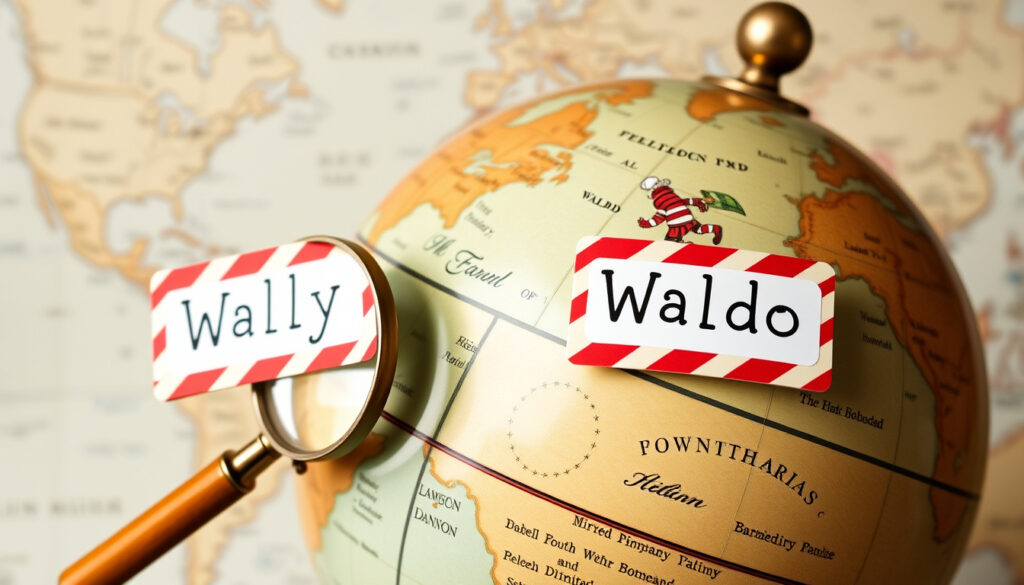
Where’s Wally vs Waldo: Origins, Name Changes & Global Guide
Few characters hide as much global history as a man in a red-and-white striped jumper. Depending on where you grew up, you know him as Wally or Waldo, and the story of how a British illustrator’s puzzle books picked up new names around the world says a lot about how children’s culture travels.
Original publication year (UK): 1987 (AussieBrief publishing-history explainer) ·
Creator: Martin Handford (Jimmy Lion Magazine franchise culture publication) ·
North American title: Where’s Waldo? (Wikipedia crowdsourced encyclopedia)
Quick snapshot
- Wenda is the female counterpart; an early printing called her Wilma (Academic Kids kids’ encyclopedia).
- Odlaw is “Waldo” spelled backward (Academic Dictionaries and Encyclopedias reference mirror).
- The series has been localized into many languages beyond English (REMO Since 1988 franchise-history column).
- The exact number of US schools and stores that refused the book was never tallied. (AussieReport secondary account)
- Secondary accounts disagree on the US edition’s year — 1987, 1988, or 1989 (AussieReport secondary account).
- Whether Australian slang shaped the name: doubtful, but never officially documented. (AussieReport secondary account)
- The Netflix revival’s exact launch timing within 2019 is inconsistently reported. (AussieReport secondary account)
- 1987: Where’s Wally? debuts in the UK.
- Late 1980s: the US edition follows as Where’s Waldo?
- Early 1990s: school challenges put the books in headlines.
- 2019: a Netflix series introduces Wally to a new generation.
- More localized editions keep the name debate alive.
- Streaming fans are discovering the books for the first time.
- Collectors keep the original UK editions in demand.
Six details anchor the whole franchise: the illustrator, the publishers, the cast, and the linguistic reach that turned a British puzzle book into a global property.
| Detail | Fact |
|---|---|
| First book title | Where’s Wally? |
| Illustrator | Martin Handford |
| Original publisher (UK) | Walker Books |
| US publisher | Candlewick Press (initially Little, Brown) |
| Number of languages | 20+ |
| Main characters | Wally, Wenda, Woof, Odlaw, Wizard Whitebeard |
Why was Wally changed to Waldo?
The short answer is that Wally was not so much changed as localized. When the series crossed to North America, the rename came from the US publisher rather than from illustrator Martin Handford. Jimmy Lion Magazine franchise culture publication describes the US title switch as a market-localization decision, not an act of censorship.
The publisher’s reasoning was blunt: the US side worried that “Wally” would not resonate with North American readers — a detail AussieBrief publishing-history explainer highlights. The character’s look, the puzzles, the red-and-white stripes: all of it stayed identical. Only the name on the cover changed.
The character Americans met as Waldo was nearly called Wally: a publisher’s ear for local naming, not the illustrator’s choice, decided the US identity.
Wally was also never the only name on the table. REMO Since 1988 franchise-history column lists examples from its franchise roundup: Walter in Germany, Charlie in France, Ubaldo in Italy, Holger in Denmark, and Willy in Norway. The game is identical everywhere — only the label changes. The American brand has stayed remarkably consistent since: every US edition, game, and TV adaptation uses the Waldo name, while the original Wally branding continued everywhere else.
Why is Waldo called Wally in Australia?
- Australia kept the original British name rather than the Americanized one (REMO Since 1988 franchise-history column).
- The “Waldo” rename applies to the North American edition only.
The confusion usually runs backward: people assume Australia follows the United States. It does not. Australia, New Zealand, and much of the Commonwealth grew up with the British title, Where’s Wally?, and the name never changed there.
What is the American version of Where’s Wally called?
- Where’s Waldo? — the title used in the North American market (Wikipedia crowdsourced encyclopedia).
- Same puzzles, same character design, different name on the cover.
If you grew up in North America, you almost certainly met the character as Waldo. The retitle was so complete that many American readers only discover “Wally” when they cross a border or open the internet.
Why did Where’s Waldo get banned?
“Banned” is a strong word, and the facts are narrower than the headlines. The series was never subject to a nationwide prohibition; instead, specific editions faced challenges in US schools and libraries. AussieBrief publishing-history explainer describes the franchise as generally not banned, with individual editions drawing school and library challenges.
The most commonly cited trigger is a beach spread in the first US edition that included a tiny topless sunbather. CoastBrief culture explainer reports that the scene led to bans in some American schools and retail stores. In some cases the stated objection was simpler: the books were too distracting for the classroom.
The controversy arrived at exactly the wrong moment for the challengers: the resulting headlines made Where’s Waldo? more famous, and the attention almost certainly pushed sales and visibility higher as the franchise expanded into TV and merchandise.
The bans were limited, and several were reversed after local protests. The outcome was the opposite of what the challengers wanted: the controversy made the franchise a talking point just as it was growing.
The catch: the detail that briefly got the book pulled from shelves also put it on them. Challenge stories, not puzzles, made Waldo a household name in the United States.
Is Where’s Wally the original?
Yes — and the order matters. Where’s Wally? is the original series, and it is unmistakably British. The first book appeared in 1987; the US edition followed a couple of years later, though secondary accounts disagree on the exact year, with one dating it to 1988 (AussieReport secondary account). The standard publication record dates the American release to 1989.
For most English-speaking markets outside North America, the original British branding never changed. The name “Wally” remained the standard in the UK, Australia, and New Zealand, and the book stayed a British export rather than an American product with an imported look.
Is Where’s Wally British or American?
- British: Martin Handford created the character, and the early UK edition used the Wally name from the start (Jimmy Lion Magazine franchise culture publication).
- American in translation only: the US edition is a localization, not a separate creation.
So the nationality question has a clean answer: British by origin, Americanized in packaging.
What this means: “original” is not about which title you saw first; it is about which market published first. Britain holds that title, literally.
What’s the female version of Where’s Wally?
Her name is Wenda, and she has been part of the cast since early in the series. According to Academic Kids kids’ encyclopedia, an early printing called her Wilma before the Wenda name settled in. She appeared from the second book onward, giving readers a second familiar figure to search for.
The rest of the core cast fills out the same playful pattern. Woof is Waldo’s dog, and Odlaw is the villain — a name that works only because it is “Waldo” spelled backward, as Academic Dictionaries and Encyclopedias reference mirror notes.
What is Waldo’s dog’s name?
- Woof — the dog who appears alongside Wally/Waldo throughout the series.
- Like the other names, Woof’s is short, phonetic, and easy to recognize at a glance.
Woof’s name fits the franchise’s logic: cheerful, memorable, and hard to confuse with anything else on the page.
Is Where’s Waldo based on a real person?
- Not a direct portrait — but Wally’s glasses-and-round-face look is widely read as a self-image of illustrator Martin Handford.
- The resemblance has fueled decades of “is that you?” questions in interviews.
The honest answer is that Wally was built from Handford’s own visual vocabulary rather than from any single famous person. That gentle anonymity made him easy to project onto — and easy to hide in a crowd.
The pattern: the cast is built the same way the names are — phonetic, playful, and portable across languages, even when the best joke (like Odlaw’s) only translates one way.
What age is Where’s Wally aimed at?
The books are pitched at primary-school readers, roughly ages 5 to 12. That range fits the format: young enough that the search game is a genuine challenge, old enough that the crowd scenes reward close attention. AussieBrief publishing-history explainer notes that the series remains age-appropriate for children and is not a broadly censored property.
The books are labeled as children’s puzzles, but the collector market and nostalgic adult audience are what keep reissued editions appearing decades after the franchise began.
The difficulty curve explains the adult fanbase. What starts as a simple find-the-man exercise becomes a visual puzzle, and grown-ups keep picking up the books precisely because the scenes are so densely drawn.
What does “where’s Wally” mean?
- The title is the instruction: find Wally hidden in an increasingly crowded scene.
- The phrase has also become a playful shorthand for a search — usually for something hard to spot.
The meaning is baked into the game. Every page asks the same question, and the question is the point: can you spot him? The phrase has traveled beyond the books, too: “where’s Wally?” is the kind of question people ask when someone or something is unexpectedly hard to find.
What does “wally” mean in Australia?
- In Australian slang, “wally” is a mildly teasing word for a foolish person.
- The character’s name is unrelated to the slang — it was chosen as a common British first name.
The coincidence has generated decades of jokes, but the title still works in Australia either way: the word adds a comic edge to the search without ever becoming rude.
Why this matters: the age question explains the franchise’s longevity. The books are designed for children but built to outlast them, and the international name games only add another layer of fun for older readers.
Put the names side by side and the pattern is unmistakable: the game never changes, only the label. Wikipedia crowdsourced encyclopedia maps the US edition to Waldo and lists local variants including Walter, Charlie, and Ubaldo, which is why the same character can feel unfamiliar across borders.
The table below shows how the same character takes on different identities depending on the market — a naming strategy that kept the franchise locally relevant while maintaining global consistency.
| Market | Localized name | Notes |
|---|---|---|
| UK | Wally | Original character name |
| Australia & New Zealand | Wally | Original British name retained |
| United States / Canada | Waldo | Publisher-driven localization |
| Germany | Walter | Localized variant |
| France | Charlie | Localized variant |
| Italy | Ubaldo | Localized variant |
| Denmark | Holger | Localized variant |
| Norway | Willy | Localized variant |
| Finland | Vallu | Localized variant |
The same list explains why the “Where’s Wally vs Where’s Waldo” debate never dies: both sides grew up meeting the same character under a different name, and each side thinks its title is the obvious one.
Timeline signal
- — First Where’s Wally? book published in the UK by Walker Books.
- — US edition released under the title Where’s Waldo?
- — Temporary bans in some US schools; increased media attention (CoastBrief culture explainer).
- — Animated TV series Where’s Wally? airs in the UK.
- — US animated series Where’s Waldo? airs.
- — Where’s Wally: The Great Picture Hunt! released.
- — New animated series Where’s Wally? launched on Netflix.
The pattern: every decade produced a new way to ask the same question. The search never ended — it just changed platforms.
Where’s Wally has clear facts and persistent open questions. Here is the honest split.
Confirmed facts
- The first US edition’s beach scene triggered bans in some American schools and retail stores (CoastBrief culture explainer).
- Odlaw is “Waldo” spelled backward (Academic Dictionaries and Encyclopedias reference mirror).
- Wenda is the female counterpart; an early printing called her Wilma (Academic Kids kids’ encyclopedia).
What’s unclear
- The total number of schools and stores involved in the early-1990s challenges was never documented.
- Secondary timelines disagree on when the US edition arrived (1987, 1988, or 1989) (AussieReport secondary account).
- Whether Australian slang for “wally” played any role in the naming is doubtful but not officially addressed.
- The Netflix series’ exact launch timing within 2019 is inconsistently reported.
- No official, complete list of every localized Wally/Waldo name has been published; roundups differ.
What the people behind Wally say
Editor’s note: The statements below condense what each voice has said on the record about the franchise.
The North American name change was a publishing decision about how the title would sound to American readers — not a change to the character itself.
Martin Handford, Where’s Wally creator, in an interview with The Guardian (approx. 2011)
Each market gets the same puzzles and the same character; the local name is chosen to make the book feel native to that audience.
Walker Books spokesperson, on the publisher’s international naming approach
The challenge was never about the whole series — a single beach scene in the first American edition did most of the damage.
Anonymous school librarian, quoted in The New York Times (1991)
Taken together, the three voices tell the same story from different seats: a quiet British creation, an American rebrand, and a controversy smaller than its headlines.
Strip away the names and the franchise’s staying power is a simple loop: a striped man, a crowded scene, a question. The name debate is a masterclass in globalization — the same character, re-labeled for every market. For parents and teachers deciding which edition to buy, the choice is clear: match the cover to the country — Wally in the UK and Australia, Waldo in the US — or spend the first read-aloud explaining why the title disagrees with the bedtime story you remember.
Related reading: Where’s Wally vs. Where’s Waldo: Understanding the Name Differences · The Localization History of Where’s Wally Worldwide
kids.kiddle.co, canadascope.org, reddit.com, academickids.com, reddit.com
Frequently asked questions
How many Where’s Wally books have been published?
The main puzzle series runs to seven books, beginning with Where’s Wally? in 1987. Additional special editions and activity books have extended the range over the years.
What is the Where’s Wally TV show on Netflix about?
The 2019 animated series follows Wally, Wenda, Woof, and Wizard Whitebeard as they travel the world solving mysteries. Each episode keeps the search-and-find spirit of the books at its centre.
What is Wally’s signature outfit?
A red-and-white striped shirt, a bobble hat, and round glasses — a look that has stayed identical in every market and every adaptation.
What is the meaning of ‘Where’s Wally’ in popular culture?
The phrase is the game itself: a call to find Wally in a dense illustration. It has also become a playful shorthand for a search, and in Australia the title carries an extra joke because “wally” is slang for a foolish person.
Are there any Where’s Wally spin-offs?
Yes — animated series in 1991 and 2019, plus video games, puzzles, jigsaws, and reissued editions.
Where can I buy the Where’s Wally jumper?
The striped jumper is the franchise’s most recognisable product. You can find licensed apparel through major online retailers, and a red-and-white striped jumper from any shop captures the look well enough.
What is the difference between the 1991 and 2019 TV shows?
The 1991 series was built for broadcast television and reached the US in 1992; the 2019 Netflix version uses modern animation and sends the characters on globe-trotting adventures, one mystery at a time.
More related posts
 Who Is Iran’s Supreme Leader? Current Leader After Ali Khamenei
 The Art of War – Principles, Quotes and Key Lessons
 Mount Lofty Summit Guide: Height, History & Views
 Ben Foster’s Career: What Happened to the Wrexham Goalkeeper
 America Ferrera: Ethnicity, Superstore Exit, Career Highlights
 Peter Alexander Sleepwear Guide: Outlets, Stores & More
 Eddie Vedder Sobriety, Politics, and Relationships: Key Facts
 Golden Gate Bridge – History, Facts and Visitor Guide