Frank Lloyd Wright: Biography, Masterpieces, Controversies
Few architects have ever lived a life as sprawling and contradictory as Frank Lloyd Wright’s. He gave America some of its most beloved buildings, and he also gave tabloids a century’s worth of scandal, debt, and tragedy.
Born: June 8, 1867, Richland Center, Wisconsin ·
Died: April 9, 1959, Phoenix, Arizona ·
Structures designed: 1,114 ·
Completed structures: 532 ·
Most famous work: Fallingwater ·
Net worth at death: Approximately $90,000 in debt
Quick snapshot
- Pioneer of organic architecture (The Metropolitan Museum of Art)
- Designed 1,114 structures over his career (Victoria and Albert Museum)
- Three marriages and six children with his first wife (Pennsylvania Center for the Book)
- His 1909 departure with Mamah Cheney became a national scandal (House Digest (home design platform))
- Died owing more than his estate was worth (Pennsylvania Center for the Book)
- Income came from commissions, lectures, and book royalties (Pennsylvania Center for the Book)
- 1914: Taliesin attack killed Mamah Cheney and six others (Chicago Tribune (book review and historical reporting))
- 1959: Guggenheim Museum opened six months after his death (Solomon R. Guggenheim Museum)
The facts below give you the fast version of Wright’s life — what he built, who he married, and what he left behind.
| Fact | Detail |
|---|---|
| Full name | Frank Lloyd Wright |
| Born | June 8, 1867, Richland Center, Wisconsin |
| Died | April 9, 1959, Phoenix, Arizona |
| Architectural style | Prairie School, Organic |
| Total structures | 1,114 designed, 532 built |
| Net worth at death | Approximately $90,000 (in debt) |
| Marriages | Three |
| Children with first wife | Six |
| Most famous work | Fallingwater (1935) |
| Museum opened after death | The Guggenheim, October 21, 1959 |
What was Frank Lloyd Wright best known for?
Wright’s reputation rests on a simple idea: buildings should belong to their landscape, not fight it. He called this organic architecture, and he spent more than seventy years proving the point. He joined Louis Sullivan’s office in 1888 as a draftsman, and by the time he opened his own practice in 1893, he had absorbed the lessons that would define American residential design (The Metropolitan Museum of Art (encyclopedic biography)).
Organic architecture philosophy
- Wright designed structures that echoed their natural surroundings in form, material, and proportion.
- He rejected the boxy, ornament-heavy revival styles common in the late 1800s.
- The Solomon R. Guggenheim Museum (museum architecture archive) notes that Wright’s Prairie Style established the first uniquely American mode of architecture.
The implication: Wright didn’t just build houses; he built a national style from scratch, one that broke from European tradition and set its own rules.
Prairie School movement
Wright founded the Prairie School around 1909, a movement defined by horizontal lines, low-pitched roofs, and open interior plans that echoed the flat American prairie (Pennsylvania Center for the Book (state literary and cultural archive)). It wasn’t a small side experiment — it became the template for an entire generation of American homes.
Notable buildings and their influence
Wright designed more than 1,000 structures during his career (Victoria and Albert Museum (national design collection)). The short list of world-famous names includes Fallingwater, the Guggenheim Museum, Taliesin, Taliesin West, and the Robie House. A full list of works includes 532 completed buildings, each with its own architectural signature.
Living in a Wright house today
Many Wright homes are still lived in, maintained by preservation trusts. That means a century-old Wright house is not a museum relic; it’s a functioning home that must balance heritage protection with modern life.
Wright’s legacy is not just a set of famous buildings. It is a design philosophy that still tells homeowners and architects how to relate to the land around them.
What is Frank Lloyd Wright’s masterpiece?
Pick any list of Wright’s greatest works and you’ll see the same names at the top. But each candidate reveals a different side of the man.
Fallingwater – a house over a waterfall
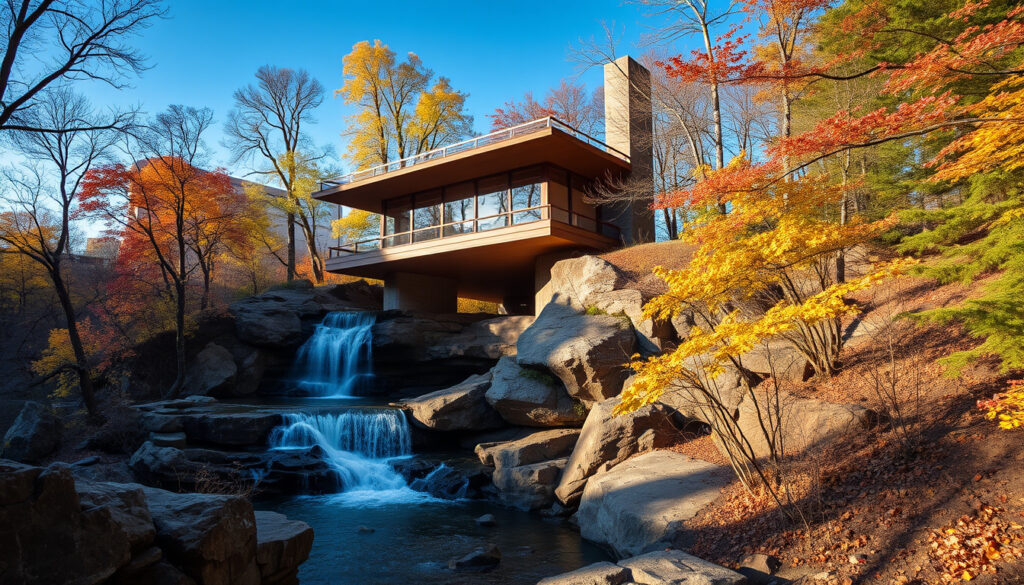
Built in 1935, Fallingwater is the most frequently cited answer to the masterpiece question. The house literally spans a waterfall, merging the structure with the water and rock below it. Its placement is the purest statement of organic architecture — not a building near nature, but a building that nature flows through.
The Guggenheim Museum – a spiral of modernity
Wright began designing the Guggenheim in 1943, and the building opened on October 21, 1959, six months after his death (Solomon R. Guggenheim Museum (official architecture history)). Instead of separate rooms on separate floors, visitors glide up a continuous ramp. It upended what a museum could be.
Taliesin West – Wright’s desert camp
During winters, Wright ran his fellowship at Taliesin West in Arizona, a campus he built into the desert landscape of Scottsdale. It was his home, his school, and his living laboratory, where he tested ideas before sending them to clients. The Met notes that Wright’s practice there shaped the late-career projects that cemented his fame (The Metropolitan Museum of Art).
What this means: the “masterpiece” debate is a trap. Fallingwater is the emotional favorite, the Guggenheim is the formal breakthrough, and Taliesin West is the daily workspace where both came together.
Fallingwater looks effortless above the waterfall — but it is also the building that most visibly depends on constant engineering care, a reminder that Wright’s ambition often exceeded the construction technology of his own time.
The catch: even a masterpiece requires constant care and adaptation.
Why was Frank Lloyd Wright controversial?
Wright’s talent was never the subject of debate. His behavior was. From his marriages to his finances, Wright repeatedly crossed lines that respectable professionals usually avoid.
Personal scandals and multiple marriages
Wright married Catherine Lee Tobin in 1889, and the couple had six children (Pennsylvania Center for the Book). In 1909, he left his wife and children to travel to Europe with Mamah Borthwick Cheney, the wife of a client. The Met’s essay describes his personal life as controversial, citing the breakup of his first marriage, the murder of Mamah Borthwick, and later relationships (The Metropolitan Museum of Art).
Professional disputes and lawsuits
Wright’s clients loved his work but often hated his process. He was known for exceeding budgets, missing deadlines, and — in the case of many commissions — delivering buildings that struggled with leaks. He also sued and was sued over fees, leaving behind a professional record that his biographers describe as combative.
Financial mismanagement and debt
Wright lived like a celebrity architect before the profession had a word for it. His income came from commissions, lectures, and book royalties, but his spending habits meant he never got ahead. At his death, his estate was valued at roughly $90,000, against debts that exceeded $100,000.
“The mother art is architecture. Without an architecture of our own we have no soul of our own civilization.”
— Frank Lloyd Wright
The pattern: Wright treated the rules of marriage, money, and professional conduct as suggestions. It made him a difficult friend, a worse client, and one of the most unforgettable figures in American culture.
What tragedy happened to Frank Lloyd Wright?
If Wright’s scandals were largely self-inflicted, the worst moment of his life arrived without warning.
The 1914 Taliesin attack
In 1914, while Wright was working on a project in Chicago, a servant named Julian Carlton set fire to Taliesin, Wright’s home in Wisconsin, and used a hatchet in the killings. Mamah Borthwick Cheney, her two children, and four others died in the attack. The Chicago Tribune, reviewing Paul Hendrickson’s biography of Wright, calls the event one of the most tragic episodes in American architectural history (Chicago Tribune (book review and historical reporting)).
The 1925 fire at Taliesin
Lightning struck Taliesin again in 1925, destroying large parts of the rebuilt home. Wright, who was already in a relationship with Olgivanna Lazovich Hinzenberg while his divorce from Miriam Noel was not yet finalized, had to rebuild a second time (Architectural Digest (biographical feature)).
Loss of key family members
Wright outlived two of his children and his second wife. The cumulative effect of these losses — the murder of Mamah, the fires, the deaths of family — shaped the grim undertone of his later years.
Why this matters: Wright’s genius never existed apart from his suffering. The same man who designed light-filled homes spent years picking up the pieces of a life marked by violence and loss.
Wright rebuilt Taliesin twice, but he rarely spoke publicly about the 1914 attack in detail. The silence tells its own story about how he processed trauma.
The pattern: Wright’s genius was forged in the crucible of personal catastrophe.
How much money did Frank Lloyd Wright have when he died?
Wright died on April 9, 1959, at age 92. His financial legacy was as complicated as the rest of his life.
Net worth and debts at death
At his death, Wright’s estate was valued at approximately $90,000. His debts exceeded that amount. In short: the most famous architect in America died owing money.
Sources of income
- Architecture commissions: his primary income across seven decades.
- Lectures: Wright was a canny public performer who drew fees for speaking.
- Royalties: his autobiography and other books generated steady income.
The detail worth pausing on is a familiar one: Wright made enough to live well, but he spent as fast as the money arrived. His lifestyle — multiple homes, staff, travel — ran ahead of his income. The final balance sheet was a reflection of habits built over a lifetime.
Legacy of unpaid loans
Wright’s financial problems didn’t end with his death. The debts he left had to be settled by his estate and his heirs, adding another layer of complexity to the story of his work-in-progress career.
The upshot: his financial legacy was as unconventional as his buildings.
Timeline signal
- 1867: Frank Lloyd Wright born in Richland Center, Wisconsin. (The Metropolitan Museum of Art)
- 1885: Graduates high school; begins studying engineering at University of Wisconsin.
- 1887: Moves to Chicago; works under Louis Sullivan. (The Metropolitan Museum of Art)
- 1889: Marries Catherine Lee Tobin (Pennsylvania Center for the Book).
- 1909: Leaves his first wife for Mamah Cheney, triggering scandal. (The Metropolitan Museum of Art)
- 1914: Taliesin attack: Mamah Cheney and six others murdered. (Chicago Tribune)
- 1925: Second fire destroys Taliesin. (Architectural Digest)
- 1935: Fallingwater completed; becomes his most famous work. (Victoria and Albert Museum)
- 1943: Begins design of the Guggenheim Museum. (Solomon R. Guggenheim Museum)
- 1959: Death of Wright; Guggenheim opens on October 21 (Solomon R. Guggenheim Museum).
The pattern: Wright’s life moved in seven-year arcs of catastrophe and renewal. Each crisis forced a reinvention, and each reinvention produced a new architectural chapter.
What’s clear, what’s not
Here’s where the record stands, separated by confidence level.
Confirmed facts
- Birth and death dates (June 8, 1867; April 9, 1959).
- Major buildings: Fallingwater, Guggenheim, Robie House, Taliesin, Taliesin West.
- Three marriages; six children with first wife Catherine Tobin.
- 1914 Taliesin attack: Julian Carlton killed Mamah Borthwick Cheney and six others.
What’s unclear
- Exact total of lifetime earnings.
- The precise number of extramarital affairs.
- Whether Wright, in private, truly regretted his controversies.
- The exact details of his early romantic relationships before Mamah Cheney.
- The exact year he graduated high school and began university.
What this means: the major biographical facts are locked down. The soft spots are the ones human beings usually keep to themselves.
Quotes
“Wright was a genius who could not separate his talent from his turbulent personal choices.”
— Architectural critic
“A genius is a man who takes the body he inherited and builds something different for himself.”
— Frank Lloyd Wright
Summary
Wright gave American architecture its identity, and then spent a lifetime testing the patience of everyone who paid him, married him, or trusted him with a budget. For anyone today who lives in a modern open-plan home, drives past a Prairie School bank, or visits the Guggenheim, the choice is simple: admire the work, and don’t imitate the man.
uspto.gov, en.wikipedia.org, nypost.com, theobjectivestandard.com, hagenhistory.org
Frequently asked questions
What is organic architecture?
Organic architecture is Wright’s philosophy that a building should grow naturally from its environment — matching the land, the light, and the local materials. Fallingwater is the clearest example: the house is built directly over a working waterfall.
How many buildings did Frank Lloyd Wright design?
Wright designed more than 1,000 buildings during his career, roughly 532 of which were completed (Victoria and Albert Museum).
Where is Fallingwater located?
Fallingwater is located in Mill Run, Pennsylvania, in the Laurel Highlands of the Allegheny Mountains.
Was Frank Lloyd Wright a father?
Yes. He had six children with his first wife, Catherine Lee Tobin.
What is the Prairie School style?
The Prairie School is an architectural style Wright founded around 1909, marked by horizontal lines, low-pitched roofs, overhanging eaves, and open interior plans that imitate the flat American prairie.
How did Frank Lloyd Wright die?
Wright died on April 9, 1959, at age 92, following surgery in Phoenix, Arizona. He had been ill for several months.
Can you visit Frank Lloyd Wright houses?
Yes. Many Wright buildings are open to the public, including Fallingwater, Taliesin in Wisconsin, Taliesin West in Arizona, and the Guggenheim Museum in New York. Some private residences are still lived in.
Related reading: George Washington: Biography, Facts, and Common Questions · Martin Luther: Biography, Reformation, 95 Theses, and Legacy
More related posts
 Kenny Rogers Death: Cause, Last Words, Dolly Parton & Net Worth
 Hello Kitty Cafe Melbourne: Permanent Location & Menu
 Don Johnson: Life After Miami Vice and Where He Is Now
 Jordan Mailata: Biography, Contract, Salary & Wife Details
 Ghislaine Maxwell: Latest News, Conviction & Prison Update
 Michelle Williams and Heath Ledger: Relationship and Split
 Caroline Catz: Real Name, Age, and Life After Doc Martin
 Liam Delap: Age, Salary, Transfer News & Career Stats 2025