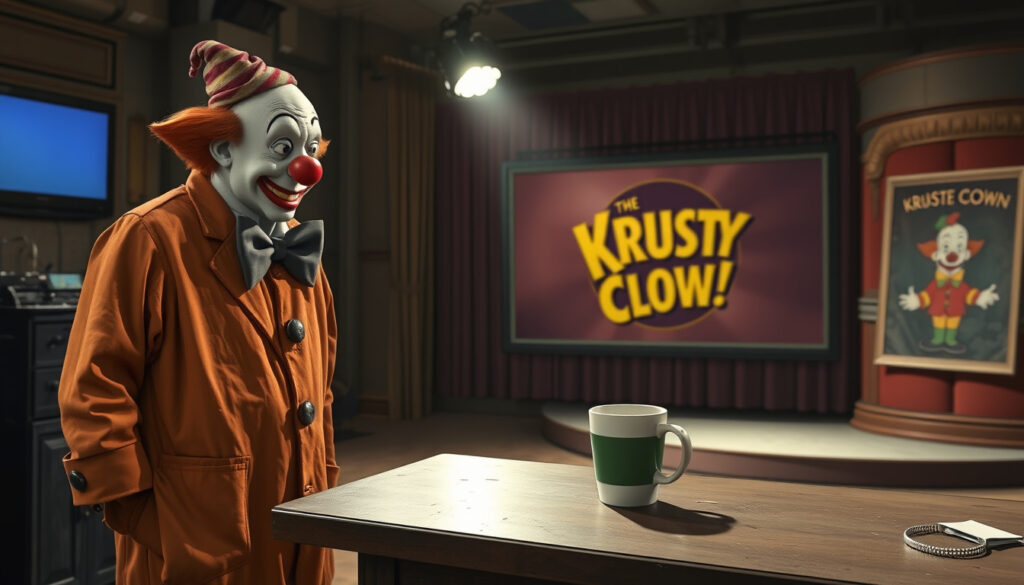
Krusty the Clown: Real Name, Backstory & Character Analysis
Few fictional clowns carry as much emotional baggage as Springfield’s favorite children’s entertainer. Krusty the Clown has been a recurring presence on The Simpsons since his 1989 debut, voiced by Dan Castellaneta — the same actor behind Homer Simpson (Wikipedia’s Krusty the Clown entry). Under the green wig and greasepaint is a character with a biblical-length real name, a strained relationship with his rabbi father, and a moral record that’s complicated at best. Here’s what the show has actually established about him, and what fans still argue about.
First appearance: “The Telltale Head” (1989) ·
Voiced by: Dan Castellaneta ·
Number of episodes: Over 100 ·
Full name: Herschel Shmoikel Pinchas Yerucham Krustofsky
Quick snapshot
- Middle-name spelling varies (Pinchas vs. Pinkus) (Simpsons Wiki)
- Whether he is Israeli or simply Jewish-American (CBR)
- Exact birth date and real age are never established (Wikipedia)
- Total episode count depends on how cameos are counted (Simpsons Wiki)
- : first appears in “The Telltale Head” (Wikipedia)
- : “Like Father, Like Clown” reveals his father is a rabbi (Wikipedia)
- : “Homie the Clown” builds an episode around his Homer resemblance (Wikipedia)
- : marries Princess Penelope in “The Frying Game” (Wikipedia)
- Krusty remains a recurring presence in The Simpsons’ ongoing run (Wikipedia)
- Fan wikis continue to log every new appearance and backstory detail (Simpsons Wiki)
- The Homer-resemblance gag keeps fueling fresh fan discussion (Looper)
Eight facts, one pattern: Krusty’s biography mixes explicitly confirmed canon — the name, the voice, the job — with details that shift depending on which source you read.
| Fact | Details |
|---|---|
| Full name | Herschel Shmoikel Pinchas Yerucham Krustofsky (Wikipedia) |
| Occupation | Clown and children’s television host (Wikipedia) |
| Voiced by | Dan Castellaneta (Wikipedia) |
| First appearance | “The Telltale Head,” 1989 (Wikipedia) |
| Notable catchphrase | “Hey, hey, hey!” (Simpsons Wiki) |
| Family | Father: Rabbi Hyman Krustofsky; daughter: Sophie (Spanish Wikipedia, Simpsons Wiki) |
| Ethnicity | Jewish (Wikipedia) |
| Show | The Krusty the Clown Show (Simpsons Wiki) |
What is Krusty the Clown’s name?
Real name and full name
- Herschel Shmoikel Pinchas Yerucham Krustofsky is the canonically cited full name, per Wikipedia’s Krusty the Clown entry.
- The fan wiki documents a variant spelling — Pinkus instead of Pinchas — which suggests writers adjusted the name over time (the Simpsons Wiki).
- The elaborate version was expanded in the episode “Today I Am a Clown” (Simpsons Wiki).
On paper, Krusty’s name is a mouthful — and that’s the joke. The character was born into a strict Jewish household, and the name reads like a roll-call of that world: Herschel, Shmoikel, Pinchas, and Yerucham are all traditional Hebrew names. Looper’s backstory analysis argues that the birth name and the stage persona are two separate layers of the character, which is exactly how the show treats them (Looper’s backstory analysis).
Stage name origin
- “Krusty” is a showbiz shortening of Krustofsky — the last name survives in reduced form (Wikipedia’s Krusty the Clown entry).
- His father, Rabbi Hyman Krustofsky, is identified by name in the Spanish-language Wikipedia summary (Spanish Wikipedia).
- The French Wikipedia entry likewise describes Krusty as Jewish and identifies his father as a rabbi (English Wikipedia).
So the stage name does double duty: it is easier for children to say, and it lets Krusty leave the family name — and the family’s expectations — far behind.
Is Krusty Israeli?
Jewish identity and Israeli nationality are different claims. The show establishes the first clearly; it never explicitly addresses the second.
This is where sources get noisy. The Russian Wikipedia lists Krusty’s nationality as Jewish (English Wikipedia), and the Portuguese Wikipedia says he was born into a traditional Jewish family (English Wikipedia). But “Jewish” is an ethnicity and faith, not a passport. Nothing in the cited canon makes Krusty an Israeli character, and fan discussions tend to treat his heritage as the established fact, not his citizenship.
The implication: Krusty’s name is less a biography than a joke about show-business reinvention — the more elaborate the birth name, the harder the character works to outrun it.
The double name structure underscores how the character defines himself against his origins.
Is Krusty the Clown just Homer?
Physical resemblance
- Both characters share the same round head, heavy stubble, and deadpan features — Looper notes that Krusty’s visual design was inspired by Homer Simpson (Looper’s backstory analysis).
- Both are voiced by Dan Castellaneta, which doubles the confusion for casual viewers (the Simpsons Wiki).
Put a wig and makeup on Homer and you’d get something close to Krusty’s silhouette. The show has leaned into this gag more than once — most famously in the 1995 episode “Homie the Clown,” when Homer impersonates Krusty and no one can tell the difference (Wikipedia’s Krusty the Clown entry).
Why they are different characters
- The fastest way to see the split is side by side.
Six rows, one pattern: the resemblance is visual, while every biographical detail pushes the two characters apart.
| Attribute | Krusty the Clown | Homer Simpson |
|---|---|---|
| Role in The Simpsons | Recurring character; host of The Krusty the Clown Show (Wikipedia) | Main protagonist; family man (Wikipedia’s Homer Simpson entry) |
| Full name | Herschel Shmoikel Pinchas Yerucham Krustofsky (Wikipedia) | Homer Simpson (Wikipedia) |
| Family background | Jewish; son of Rabbi Hyman Krustofsky (Spanish Wikipedia) | American everyman raised in Springfield (Wikipedia) |
| Voice actor | Dan Castellaneta (Simpsons Wiki) | Dan Castellaneta — the same performer |
| Driving motivation | Fame, money, validation (CBR’s character explainer) | Comfort, family, and a quiet life (Wikipedia) |
| Behind the makeup | A cynical, insecure performer hiding personal history (Looper’s backstory analysis) | A sincere, impulsive father who wears his heart on his sleeve (Wikipedia) |
Krusty is a character with a secret biography; Homer is a character with no secrets at all. The show uses their identical faces to create mistaken-identity plots, but it never confuses their inner lives.
The original concept
- Early on, the writers reportedly considered making Krusty Homer’s alter ego — Homer in clown makeup — before splitting him into a separate character (Wikipedia’s Krusty the Clown entry).
- The Simpsons Wiki frames the final version as a distinct personality with his own family, history, and career (the Simpsons Wiki).
That origin explains a lot. Homer’s face was the cheapest and quickest way to design a new character, so the animators reused it — then the writers built a completely different man underneath (per Looper’s backstory analysis).
What this means: the Homer resemblance is an in-joke the show can play precisely because the two characters are, in every meaningful way, opposites.
The visual shortcut has become one of the series’ longest-running gags.
Why is Krusty a Clown?
Krusty’s career path
- Krusty left his father’s religious household and drifted into show business as a young man (Looper’s backstory analysis).
- Before the clown act, he struggled as a straight comedian and found the persona paid better (Looper’s backstory analysis).
- The Simpsons Wiki places his upbringing in a Jewish community on Springfield’s Lower East Side (the Simpsons Wiki).
Clowning, in other words, was not a calling. It was a practical exit from a home where his father, a rabbi, had no patience for entertainment (per Spanish Wikipedia).
His motivation
Krusty keeps performing because fame is the only identity he has; when the cameras are off, he has no idea who he is — a pattern Looper traces back to his break with his father (Looper’s backstory analysis).
That reading turns the character from a simple money-grubber into something sadder: a man who needs the applause because the man behind the makeup was never allowed to exist at home.
How he became a clown
- The stage name Krusty is a commercial shortening of Krustofsky (Wikipedia’s Krusty the Clown entry).
- His father’s disapproval made the clowning an act of rebellion as much as a career (English Wikipedia).
- Once the show-within-a-show took off, Krusty became Springfield’s most famous entertainer — and the person underneath the greasepaint became harder to find (the Simpsons Wiki).
The irony is textbook: a character desperate to be loved became a character incapable of believing any love is real.
The catch: Krusty became a clown to escape one identity and ended up trapped inside another.
What race is Krusty the Clown?
Krusty’s ethnicity
- The character is consistently described as Jewish across multiple language editions of Wikipedia (English Wikipedia, Spanish Wikipedia, English Wikipedia).
- The Portuguese-language summary says Krusty was born into a traditional Jewish family (English Wikipedia).
- The Russian-language entry lists his nationality as Jewish (English Wikipedia).
Among the facts fans repeat about Krusty, this is one of the most stable: the writers did not leave his background ambiguous.
Jewish heritage
“Krusty is the estranged son of Rabbi Hyman Krustofsky, raised in a Jewish community on Springfield’s Lower East Side.”
Simpsons Wiki on the character’s canon backstory
The season 3 episode “Like Father, Like Clown” made this explicit: it reveals Krusty’s father is a rabbi and dramatizes the family rift (Wikipedia’s Krusty the Clown entry).
That episode is the turning point for the character’s identity. Before it, Krusty was a generic celebrity parody; after it, he was specifically a Jewish one.
Is Krusty Israeli?
Jewish heritage and Israeli citizenship are not the same thing. Krusty’s Jewish identity is established; his Israeli nationality is not.
Search results sometimes blur the two, but the cited sources do not support an Israeli Krusty. CBR’s character explainer summarizes him as Jewish in origin without claiming Israeli nationality (CBR’s character explainer), and the language-specific Wikipedia editions follow the same line.
The pattern: the more language editions you check, the more consistent the answer — Krusty’s Jewish identity is one of the few Simpsons facts that survives translation.
Is Krusty the Clown good or bad?
Morally ambiguous character
Krusty is a children’s entertainer who routinely exploits children — and he is still one of the show’s most sympathetic figures, because the writers make his failures so human.
CBR’s character explainer describes him as a figure whose selfishness is played for comedy rather than malice (CBR’s character explainer). That distinction is the whole key to the character.
Examples of bad deeds
- He treats his young audience as a revenue stream, hawking merchandise over actual entertainment (CBR’s character explainer).
- His fallout with former sidekick Sideshow Bob is a central part of both characters’ histories, and it began with Krusty’s dismissive treatment of him (the Simpsons Wiki).
- Chronic insecurity and self-sabotage have wrecked his relationships, his finances, and his health across the series’ run (Looper’s backstory analysis).
Examples of good deeds
- In “Like Father, Like Clown,” he reconciles with his father — a rare moment of genuine emotional honesty (Wikipedia’s Krusty the Clown entry).
- He shows real, if reluctant, affection for Bart, his most devoted fan (the Simpsons Wiki).
- Later episodes build a genuine bond with his estranged daughter Sophie (the Simpsons Wiki).
Fan perception
- On fan wikis, Krusty is treated as an antihero, not a villain — a man who does bad things but is never beyond redemption (the Simpsons Wiki).
Fan discussions typically land in the same place: Krusty is a bad person by most measures, but a great character, which is why The Simpsons keeps him around. The show’s writers have never tried to clean him up, and fans have rewarded that honesty for decades.
Upsides
- Reconciles with his father in “Like Father, Like Clown” (Wikipedia)
- Shows genuine loyalty to Bart, his biggest fan (Simpsons Wiki)
- Later episodes reveal a real bond with his daughter Sophie (Simpsons Wiki)
Downsides
- Treats his child audience as a revenue stream (CBR)
- Dismissive and cruel to sidekicks like Sideshow Bob (Simpsons Wiki)
- Self-sabotage and insecurity undermine every success (Looper)
“Hey, hey, hey!”
Krusty the Clown — sign-off from The Krusty the Clown Show
“Krusty is the estranged son of Rabbi Hyman Krustofsky, raised in a Jewish community on Springfield’s Lower East Side.”
Simpsons Wiki on the character’s canon backstory
“Krusty’s visual design was inspired by Homer Simpson.”
Looper on the Krusty-Homer connection
The trade-off: a reformed Krusty would stop being funny, and a fully evil Krusty would stop being watchable. The show keeps him in the middle, and that ambiguity is exactly why he has lasted.
The show’s refusal to resolve this ambiguity is what makes Krusty worth revisiting.
Krusty works because The Simpsons never lets him off the hook. He is a greedy, insecure, self-sabotaging performer who occasionally stumbles into decency, and that tension has kept him relevant for more than three decades. For anyone revisiting Springfield, the answer to the good-or-bad question is the contradiction itself: Krusty is both, and he never pretends otherwise. For critics weighing The Simpsons’ legacy, Krusty settles the argument — the show endures because it treats even its most cynical characters with enough honesty to be worth revisiting.
If you enjoyed this character guide, see Peter Griffin: Disability, Ethnicity, Famous Lines & More and Danny Phantom: Cancellation, Age Rating, and Streaming Guide.
southerncurrent.net, no.wikipedia.org, eveningledger.uk, simpsons.fandom.com, fr.wikipedia.org, nl.wikipedia.org, pl.wikipedia.org
Frequently asked questions
What is Krusty the Clown’s catchphrase?
“Hey, hey, hey!” is his signature sign-off, used on The Krusty the Clown Show (Wikipedia’s Krusty the Clown entry).
Who voices Krusty?
Dan Castellaneta, the same actor who voices Homer Simpson (Wikipedia’s Krusty the Clown entry).
How many episodes has Krusty appeared in?
Sources commonly say more than 100, but there is no single official count, and fan tallies vary depending on whether cameos count (the Simpsons Wiki).
What is Krusty’s relationship with his father?
Estranged for years. His father is Rabbi Hyman Krustofsky, and the two reconcile in the season 3 episode “Like Father, Like Clown” (Wikipedia’s Krusty the Clown entry, Spanish Wikipedia).
What is the name of Krusty’s show?
The Krusty the Clown Show, a children’s TV program inside The Simpsons (the Simpsons Wiki).
Is Krusty based on a real clown?
Not confirmed. His visual design reportedly grew out of Homer Simpson’s look rather than a real entertainer (Looper’s backstory analysis).
Does Krusty have any children?
Yes — a daughter named Sophie, introduced in later episodes (the Simpsons Wiki).
More related posts
 Peter Siddle: Wife, Vegan Diet, Retirement and Fastest Ball
 Anthony Mackie: Controversy, Wife, LGBTQ Stance, and 8 Mile Role
 Janice Dickinson: First Supermodel? Relationships, Ethnicity
 How to Translate English to Thai: Free Tools, Apps & Tips (2025)
 Best Time to Buy a Used Car in Ireland: Key Months
 Jennifer Capriati Now: Life After Tennis
 Jordan Belfort: Stratton Oakmont Rise, Fall and Life Today
 Alexandra Saint Mleux: Art Historian & Charles Leclerc’s Fiancee