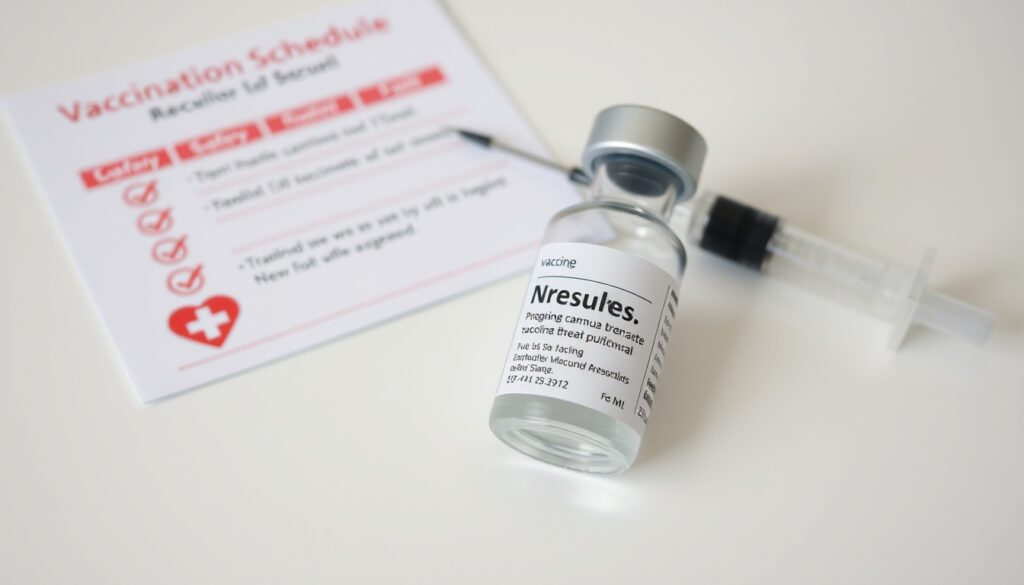
Measles Vaccination: Schedule, Safety, and Booster Guide
If you’re a parent in Ireland trying to make sense of the MMR vaccine schedule, you’re not alone: the first dose is given at 12 months, with a second at 4 to 5 years (HSE – Ireland’s health service). This guide covers the evidence on booster needs, lifetime protection, and safety, drawing on official guidance from the HSE and CDC.
MMR doses recommended for children: 2 ·
Year first measles vaccine licensed in the U.S.: 1963 ·
Effectiveness of two doses against measles: 97% ·
Year MMR vaccine introduced in Ireland: 1988
Quick snapshot
- Two doses of MMR provide 97% protection against measles (WHO)
- MMR vaccine does not cause autism (CDC)
- Most people born before 1957 are immune due to natural infection (CDC Travel)
- How long immunity lasts after a single dose (but known to be long-lasting) (HSE)
- Exact risk of breakthrough infection after vaccination (CDC Travel)
- HSE launched a measles MMR catch-up programme in October 2024 (HSE news)
Four key facts, one pattern: the schedule is consistent across countries, with slight variations in timing.
| Fact | Value |
|---|---|
| MMR vaccine introduced in Ireland | 1988 |
| Recommended number of doses | 2 |
| Effectiveness after two doses | 97% |
| First measles vaccine licensed | 1963 (U.S.) |
Do adults need a measles booster?
Who should consider a booster?
- Adults with only one documented dose of MMR may need a second if they are at increased risk — for example, healthcare workers, international travellers, or students in post-secondary institutions (CDC).
- Irish guidance from the HSE states that two doses of MMR are considered full protection for most adults (NIAC Measles).
Evidence from CDC and HSE
- The CDC recommends two doses for adults at risk, including those who work in healthcare settings, plan international travel, or are in an outbreak zone (CDC Travel).
- In Ireland, the HSE’s catch-up programme (launched October 2024) makes MMR vaccines available free of charge from GPs for people under 18, and from community clinics for those aged 5 and over (HSE news).
Most adults are covered by two doses. For those with only one dose and a risk of exposure, a second dose is a low-cost, high-benefit move.
The implication: the evidence consistently points to two doses as protective for the majority, with clear guidance for higher-risk groups.
Does the measles vaccine last for life?
Long-term immunity from MMR
- Two doses of MMR are considered to provide lifelong protection for the vast majority of people (CDC).
- Studies show that immunity wanes very slowly; most people retain protective antibodies for decades after vaccination (WHO).
When immunity may wane
- Breakthrough infections are rare but possible, especially in settings of high viral exposure (CDC Travel).
- No routine booster is recommended for the general population by either the CDC or the HSE (HSE).
For adults who received both doses as children, there is no evidence that a booster is needed. The two-dose regimen is designed to last a lifetime.
The pattern: vaccination provides durable protection; waning is slow and booster campaigns are not needed for the general population.
At what age is the measles vaccine given?
Standard childhood schedule
- In Ireland, the first dose of MMR is given at 12 months of age, and the second dose at 4 to 5 years (junior infants) (HSE).
- The minimum interval between two MMR doses is at least four weeks (NIAC).
Catch-up vaccination for older children and adults
- If urgent protection is needed and the person is aged 12 months or older, the second MMR dose can be given as early as four weeks after the first and counts as valid (NIAC Measles).
- Infants aged 6 to 12 months can receive an additional MMR dose before travel outside Ireland, and this extra dose is free through the HSE (HSE campaign pack).
Children who receive MMR before their first birthday need two further doses: a repeat at 12 months and another at 4–5 years (HPSC).
What this means: early doses require careful follow-up; the schedule ensures full protection by school entry.
Is the measles vaccine available in Ireland?
Where to get the MMR vaccine in Ireland
- The MMR vaccine is part of the Irish childhood immunisation programme and is available free through the HSE (HSE news).
- Adults can get the vaccine from their GP, and the catch-up programme (started October 2024) provides free access for eligible groups (HSE news).
Cost and eligibility
- For children and adults under 18, the vaccine is free of charge from GPs. For those aged 5 and over, HSE community clinics also offer it free (HSE news).
- If vaccination records are missing, the HSE says it will not harm someone to receive the MMR vaccine again (NIAC).
The pattern: free access through multiple channels removes cost barriers, and safety net provisions allow repeat vaccination without concern.
Can I still get measles if I have been vaccinated?
Breakthrough infections explained
- Two doses reduce the risk of measles by 97% (CDC).
- Breakthrough cases are typically milder and less contagious than infections in unvaccinated individuals (WHO).
Risk factors for vaccine failure
- Primary vaccine failure (no immune response) occurs in about 3% of people after one dose and about 1% after two doses (CDC Travel).
- Vaccinated individuals who do get measles are unlikely to spread the virus to others (CDC Travel).
The implication: while not 100% effective, vaccination dramatically reduces severity and transmission; the residual risk is very low.
Why do people born before 1966 not need MMR?
Natural immunity assumption
- The CDC recommends that people born before 1957 are considered immune because measles was so widespread that nearly everyone had the disease by that age (CDC Travel).
- In Ireland, the birth year cutoff is 1966 for the assumption of natural immunity, though the exact year varies by country (HSE).
Exceptions for certain groups
- People born before 1966 who are healthcare workers, international travellers, or in an outbreak setting should still receive two doses of MMR (CDC).
- If vaccination status is uncertain, Irish guidance says it is preferable to give MMR rather than risk exposure (NIAC).
What this means: the cutoff reflects historical disease prevalence, but it is not a blanket exemption for high-risk roles.
What are the negative side effects of the measles vaccine?
Common side effects
- Fever, mild rash, and sore arm are common and resolve within a few days (HSE).
- About 5–15% of children develop a fever after MMR; paracetamol can help (CDC).
Rare but serious adverse events
- Severe allergic reactions (anaphylaxis) occur in about 1 in 1,000,000 doses (WHO).
- Febrile seizures can occur in about 1 in 3,000 children, but they do not cause long-term harm (CDC Travel).
- Multiple large studies have found no link between MMR and autism (WHO).
The HSE advises against MMR for people with a weak immune system (e.g., chemotherapy patients) or those with a severe allergy to gelatin or neomycin (HSE).
The pattern: side effects are common but mild; the very rare serious events are far outweighed by the benefits of preventing measles.
Upsides
- 97% reduction in measles risk after two doses
- Long-lasting immunity, likely lifelong
- Safe – serious side effects are extremely rare
- Free in Ireland through the HSE for eligible groups
Downsides
- Mild side effects (fever, rash) are common
- Rare risk of allergic reaction or febrile seizure
- Not suitable for people with certain severe allergies or weakened immune systems
- Breakthrough infections possible, though rare
Steps to get the MMR vaccine in Ireland
- Check your records – Confirm which doses you or your child have received. The HSE advises that if you cannot find records, it is safe to receive the vaccine again (NIAC).
- Contact your GP – Most GPs offer the MMR vaccine. Under the catch-up programme, it is free for children and adults under 18 (HSE news).
- Visit a HSE community clinic – For those aged 5 and over, HSE community clinics provide free MMR vaccination (HSE news).
- Plan ahead for travel – Infants aged 6–12 months can receive an extra free MMR dose before travelling outside Ireland (HSE campaign pack).
What the evidence shows
Confirmed facts
- Two doses of MMR provide 97% protection against measles (CDC).
- MMR vaccine does not cause autism (WHO).
- Most people born before 1957 are immune due to natural infection (CDC Travel).
- If vaccination records are lost, repeating the MMR vaccine is safe (NIAC).
What’s unclear
- How long immunity lasts after a single dose — but it is known to be long-lasting.
- Exact risk of breakthrough infection after vaccination — but it is known to be very low.
- Whether additional booster doses may be needed in the future.
“Two doses of MMR vaccine are recommended by doctors as the best way to protect against measles, mumps, and rubella.”
— CDC official page
“The MMR vaccine is a safe and effective combined vaccine. It protects against 3 serious conditions called measles, mumps and rubella.”
— HSE Ireland
For parents in Ireland, the choice is clear: get the recommended two doses, or risk a preventable disease that can cause serious complications. The HSE and CDC have made the vaccine readily available and free for those who need it. The evidence overwhelmingly supports vaccination as the safest, most effective way to protect yourself and your community.
citizensinformation.ie, hse.ie, www2.hse.ie, about.hse.ie, mercersmedicalcentre.com, nio-news.com
Frequently asked questions
Can measles vaccine be given to pregnant women?
The HSE advises avoiding pregnancy for one month after MMR vaccination. The vaccine is not recommended during pregnancy (HSE).
What should I do if I miss a dose?
Contact your GP or HSE community clinic. The dose can be given at any time, and the minimum interval between doses is four weeks (NIAC).
Is the MMR vaccine safe for people with egg allergy?
Yes, the MMR vaccine is safe for people with egg allergy. The vaccine is grown in chick embryo cells, but the amount of egg protein is negligible (CDC).
How long does it take for the MMR vaccine to work?
Protective antibodies appear within 2-3 weeks after the first dose. The second dose boosts immunity to near-complete levels (WHO).
Can the MMR vaccine cause measles?
No, the MMR vaccine contains a weakened, non-infectious virus. It cannot cause measles in a healthy person (CDC Travel).
Is there a separate measles vaccine?
In most countries, including Ireland, the measles vaccine is only available as the combined MMR (measles, mumps, rubella) vaccine. There is no single-antigen measles vaccine in routine use (HSE).
What is the difference between MMR and MMRV?
MMRV is a combination vaccine that also includes varicella (chickenpox). In Ireland, the MMR vaccine is used; MMRV is not part of the routine schedule (CDC).
The implication: common concerns are addressed by official sources; no evidence supports claims that MMR causes autism or measles.
Related reading
- Booster Seats Ireland: Age, Law & Safety Guide – Ireland-focused child safety guide.
- Smart Watches 2024: Best Picks, Costs & FAQs (Ireland) – Informational guide for Ireland.
More related posts
 Nike Pegasus 40 Review: Comparisons, Specs & Guide
 Ezra Mam Car Accident, Drug Test, Salary & Biography
 Rio Tinto: British or Australian? A Complete Guide
 Idi Amin: Biography, Atrocities, and Timeline of His Reign
 Rain Jackets: Best Waterproof Picks for Ireland’s Weather
 Kitty Flanagan: Biography, Age, Family, and Career Facts
 America Ferrera: Ethnicity, Superstore Exit, Career Highlights
 Theo James: Biography, Movies, Personal Life & Facts