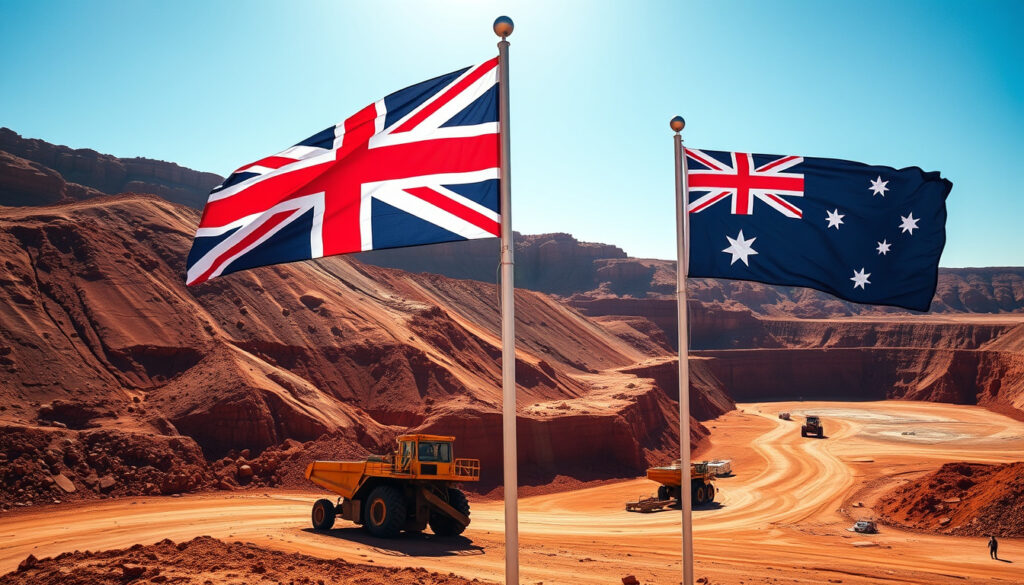
Rio Tinto: British or Australian? A Complete Guide
If you have ever looked up a mining giant and wondered whether it is British or Australian, you are not alone. Rio Tinto belongs to two countries at once — and its dual-listed structure, with roots in Spain and headquarters in both London and Melbourne, makes it a fascinating case study in corporate identity.
Founded: 1873 ·
Headquarters: London, UK; Melbourne, Australia ·
Global Workforce: Approximately 50,000 employees ·
Key Commodities: Iron ore, aluminum, copper, diamonds ·
Market Capitalization: Around £90 billion (2025)
Quick snapshot
- Rio Tinto is a dual-listed British-Australian multinational mining company (IDE-JETRO (Japanese external trade organisation)).
- Headquartered in London, England, and Melbourne, Australia (Wikipedia (online encyclopedia)).
- World’s largest iron ore producer, with 287.7 million tonnes produced in 2024 (Global Banking & Finance (financial news service)).
- Copper production reached 872,000 tonnes (mined and refined) in 2024 (Global Banking & Finance).
- Whether a future merger deal with Glencore will ever happen after three failed attempts (Reuters (news agency)).
- 1873: Company founded in Huelva, Spain (Wikipedia (online encyclopedia)).
- 2014: Rio Tinto rejected a merger approach from Glencore (Global Banking & Finance (financial news service)).
- 2024: Another round of discussions ended without a deal (Global Banking & Finance).
- January 2026: Rio Tinto initiated preliminary talks to acquire Glencore (Reuters (news agency)).
- 5 February 2026: Rio Tinto walked away from the deal for the third time (Global Banking & Finance).
- Rio Tinto continues to expand its copper portfolio, especially at Oyu Tolgoi (per company annual report). (Glencore (corporate website))
- Glencore will publish its 2025 Annual Report (already released on 10 March 2026) (Glencore (corporate website)).
The following table provides a quick reference to core corporate facts.
| Attribute | Value |
|---|---|
| Founded | 1873 (Wikipedia (online encyclopedia)) |
| Headquarters | London, England & Melbourne, Australia (Wikipedia (online encyclopedia)) |
| Stock Exchange Listings | London Stock Exchange (RIO) & Australian Securities Exchange (RIO) (IDE-JETRO) |
| Primary Commodities | Iron ore (world’s largest producer), copper (Global Banking & Finance) |
Is Rio Tinto British or Australian?
The answer is both. Rio Tinto operates as a dual-listed company: Rio Tinto plc in London and Rio Tinto Limited in Melbourne. The group’s registered headquarters are in London, England, and its operational headquarters are in Melbourne, Australia (IDE-JETRO). This structure allows it to be legally British and Australian simultaneously — a rare corporate setup that gives access to both markets.
What are the headquarters locations of Rio Tinto?
- London: 6 St James’s Square, London SW1Y 4AD, England.
- Melbourne: 120 Collins Street, Melbourne, Victoria 3000, Australia (Wikipedia (online encyclopedia)).
What is the corporate structure of Rio Tinto?
The group is composed of two separate legal entities: Rio Tinto plc (UK) and Rio Tinto Limited (Australia), linked by a dual‑listed company agreement that equalises shareholder rights (IDE-JETRO). Investors can buy shares on either the London Stock Exchange or the Australian Securities Exchange.
For investors, the dual structure means dividend payments and voting rights are identical across both listings — but corporate tax obligations and regulatory oversight differ between the UK and Australia.
The implication: dual‑listed structures allow companies to tap into two capital markets but can complicate governance.
What is Rio Tinto famous for?
Rio Tinto’s reputation rests on two pillars: scale and geography. It is the world’s dominant iron ore supplier, extracting most of its ore from the Pilbara region in Australia (Global Banking & Finance). Beyond iron ore, the company is a significant copper producer — 872,000 tonnes in 2024 — and has growing assets in aluminum and diamonds.
What are Rio Tinto’s main products?
- Iron ore — 287.7 million tonnes produced in 2024 (Global Banking & Finance).
- Copper — 872,000 tonnes (mined and refined) in 2024 (Global Banking & Finance).
- Aluminum (through bauxite mining and refining).
- Diamonds (Argyle mine in Australia, now closed; remaining stockpile).
Which mining operations is Rio Tinto known for?
The company’s flagship megamines are the Pilbara iron ore complex in Western Australia and the Oyu Tolgoi copper‑gold mine in Mongolia. Both operations are central to its revenue: iron ore alone accounts for roughly 60% of group earnings, according to its 2025 annual report (Rio Tinto (corporate investor relations)).
A downturn in Chinese steel demand — which consumes about 70% of seaborne iron ore — would hit Rio Tinto harder than diversified miners like BHP or Glencore, whose revenue streams are more balanced across commodities and trading.
The pattern: Rio Tinto’s high exposure to iron ore makes it vulnerable to shifts in Chinese demand.
Who owns most of Rio Tinto?
As a publicly traded company listed on both the London Stock Exchange and the Australian Securities Exchange, Rio Tinto’s equity is widely held. No single entity owns a majority stake. Institutional investors — including BlackRock, The Vanguard Group, and State Street Global Advisors — are among the largest shareholders, though exact percentages change regularly (Rio Tinto annual report — ownership disclosure).
The implication: management is accountable to a diffuse base of global investors rather than a controlling shareholder, which can make long‑term strategic shifts — like major acquisitions — subject to intense proxy scrutiny.
Is Rio Tinto the largest mining company in the world?
By market capitalization, Rio Tinto typically ranks in the top three globally, alongside BHP and Glencore. In January 2026, its market cap was about $142 billion, compared to Glencore’s $65 billion (Reuters). By iron ore production alone, it is the world’s largest. However, when measured by revenue or employee count, companies like BHP and Glencore can be larger.
The catch: “largest” depends on the metric. Rio Tinto leads in iron ore volume but trails Glencore in revenue because Glencore’s trading business inflates its top line.
Who is bigger, Glencore or Rio Tinto?
A direct comparison reveals two very different business models. Rio Tinto is a pure‑play miner; Glencore combines mining with a massive commodity trading operation. The table below highlights key differences.
| Metric | Rio Tinto | Glencore |
|---|---|---|
| Market Capitalization (Jan 2026) | ~$142 billion (Reuters) | ~$65 billion (Reuters) |
| 2024 Copper Production | 872,000 tonnes (Global Banking & Finance) | 951,600 tonnes (Global Banking & Finance) |
| Business Focus | Mining (iron ore, copper, aluminum) (Global Banking & Finance) | Mining & commodity trading (Global Banking & Finance) |
Rio Tinto’s higher market cap reflects investor preference for its pure mining earnings, while Glencore’s lower valuation is partly due to the volatile margins of its trading arm. For a shareholder seeking commodity price exposure without trading risk, Rio Tinto has been the traditional choice.
Timeline: Rio Tinto’s key milestones and merger attempts
- 1873: Company founded in Huelva, Spain (Wikipedia (online encyclopedia)).
- 2014: Rio Tinto rejects a merger approach from Glencore, saying it is not in shareholders’ best interests (Global Banking & Finance).
- 2024: Another round of discussions with Glencore ends without a deal (Global Banking & Finance).
- January 2026: Rio Tinto initiates preliminary talks to acquire Glencore, aiming to create the world’s largest mining company by market value (Reuters).
- 5 February 2026: Rio Tinto walks away from the deal for the third time (Global Banking & Finance).
Rio Tinto’s board has twice determined that combining with Glencore would destroy shareholder value. Yet the company’s dependence on iron ore — a single‑commodity risk — may eventually force a different calculus. For investors watching the sector, the next attempt is not a matter of if, but when.
What this means: the repeated failed merger attempts reflect a deep strategic divergence between the two companies.
What we know and what remains uncertain
The confirmed facts about Rio Tinto are solid: its dual nationality, its iron ore dominance, its copper production, and its repeated rejection of Glencore. What remains uncertain is the future of its ownership structure — institutional stakes shift weekly — and whether the company can diversify its revenue beyond iron ore before the next commodity cycle turns.
“Rio Tinto is a leading global mining group that focuses on finding, mining and processing the Earth’s mineral resources.”
— Rio Tinto official website (Rio Tinto (corporate site))
“Rio Tinto is a dual-listed British-Australian multinational mining company.”
— Wikipedia (online encyclopedia)
For anyone tracking global mining power, the real story is not just the numbers — it is the geopolitical balancing act of being simultaneously British and Australian while competing against trading‑focused rivals like Glencore. The next chapter will be written in boardrooms, not just in quarterly production reports.
Related reading: Nelson Peltz: How He Built His Billion-Dollar Family Empire · Jordan Belfort: Stratton Oakmont Rise, Fall and Life Today
glencore.com, comparably.com, sec.gov, ebsco.com, spglobal.com
Frequently asked questions
What are Rio Tinto’s main products?
Iron ore (world’s largest producer), copper, aluminum, and diamonds. Iron ore alone accounted for about 60% of group earnings in 2025 (Rio Tinto annual report).
Where does Rio Tinto mine iron ore?
The primary location is the Pilbara region in Western Australia, with multiple mines and port facilities (Rio Tinto annual report).
How does Rio Tinto make money?
By extracting and selling iron ore, copper, aluminum, and other commodities. Revenue is driven by commodity prices and production volumes.
What is the market cap of Rio Tinto?
As of January 2026, approximately $142 billion (Reuters).
Does Rio Tinto pay dividends?
Yes, Rio Tinto has a long history of paying dividends, typically semi‑annually. The payout fluctuates with earnings (Rio Tinto investor relations).
What is Rio Tinto’s stock symbol?
On the London Stock Exchange: RIO. On the Australian Securities Exchange: RIO.
Is Rio Tinto involved in any controversies?
The company has faced criticism over its Juukan Gorge heritage site destruction in Australia (2020) and water pollution issues in various operations. Investigations are ongoing.
The takeaway: these common questions address the core aspects of Rio Tinto’s business model and market position.
More related posts
 Peter Falk: Cause of Death, Lost Eye, Columbo & Real Life
 Tyler Herro: Ethnicity, Contract, Trade Rumors
 Chloe Parker: Age, TikTok, Acting Career & Relationship Facts
 Harrison Ford: Biography, Relationships, Net Worth, and Career
 Johnny Knoxville: Injuries, Career, and the Bam Margera Feud
 Rebecca Vallance: Biography, Age, Husband & Brand Overview
 Mandarin to English – Accurate Translation Guide
 Triangle of Sadness: Plot, Cast, Reviews & Where to Watch