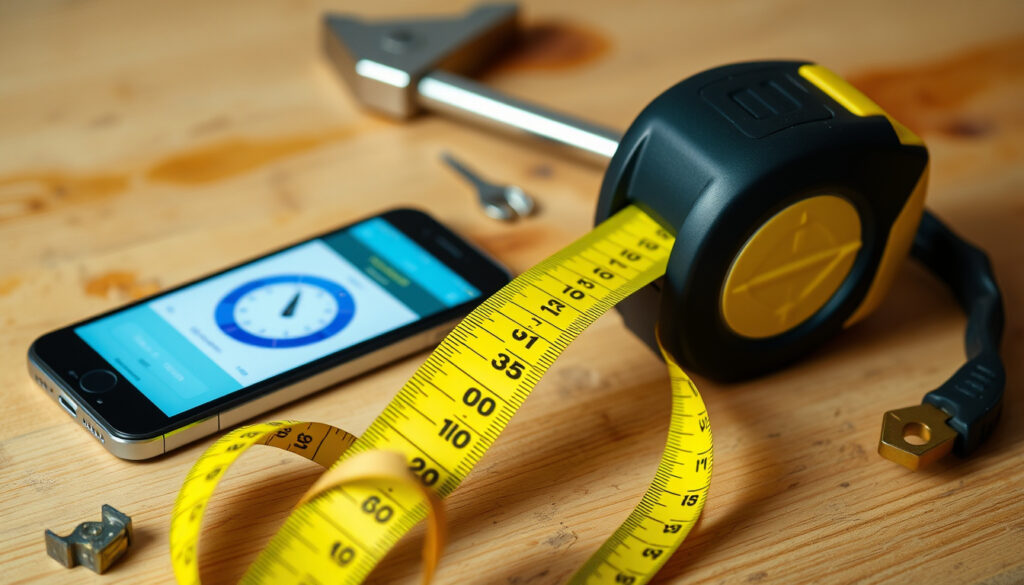
Measuring Tape: How to Read, Phone Apps & Where to Buy
You’re probably here because you’ve grabbed a tape measure and wondered what all those little lines mean — or because your phone is the only ruler you have handy. This guide bridges both worlds: it shows you how to read a physical tape measure accurately, tells you where to buy one (yes, Tesco sells them), and walks through the best smartphone apps for measuring distance, area, and more.
Standard tape measure length: 5 meters (16 feet) ·
Typical accuracy: ±1 mm for metric ·
iPhone Measure app accuracy: Within a few centimeters on average
Quick snapshot
- Apple Measure app is free (Apple iOS documentation)
- Google Maps can measure straight-line distance (Google Maps Help)
- Tesco sells a 5M measuring tape (Tesco UK grocery retailer)
- AR Ruler app exists on Google Play (Google Play Store listing)
- Accuracy of all phone measurement apps is variable (Lumberama tool authority)
- Best app depends on user needs and device (Lumberama tool authority)
- No major timeline event identified
- AR-based measurement tools continue to improve with each phone generation
| Property | Value |
|---|---|
| Standard tape measure length | 5m (16 ft) |
| Typical accuracy (physical tape) | ±1 mm metric |
| iPhone Measure app accuracy | Within a few cm |
| Tesco measuring tape price | Approx. £3.50 |
| Number of measurement apps on Google Play | 200+ |
How do we read measuring tape?
Understanding the markings on a tape measure
- A tape measure has a metal hook at the end that shifts slightly to account for its own thickness, ensuring a zero starting point whether you hook it or butt it. Lumberama tool reference guide explains that you hook the end tab over the material edge or press it against an inside corner, then extend the tape along the surface.
On the blade you’ll see long lines for whole units, shorter lines for fractions. Metric tapes show millimetres (the smallest lines) and centimetres (numbered); imperial tapes show inches divided into 1/16 or 1/32 increments. Professional tapes often carry both scales — Starrett precision tool manufacturer offers models with English and metric graduations side by side.
The implication: reading a tape measure is straightforward once you know which unit system your tape uses and which marks correspond to which fractions.
Metric vs imperial measurements
Most UK and European tapes use metric as the primary scale, while US-centric brands favour imperial. The European Committee standards divide tape measures into three accuracy classes (EC Class I, II, III), each with a permitted deviation at various distances — for instance, EC Class I allows a maximum error of 1.1 mm over 10 metres (RS Online industrial component supplier). For everyday DIY, a standard Class II tape is more than adequate.
Metric tapes win on simplicity — no fractions — but if you’re following an imperial plan, you’ll need to read eighths or sixteenths. A dual-scale tape removes the guesswork.
Do Tesco sell measuring tapes?
Tesco measuring tape product details
Yes, Tesco stocks a own-brand retractable 5-metre (16‑foot) tape measure, typically priced around £3.50. It’s a basic model with metric markings, suitable for household tasks. The product is available both in larger Tesco superstores and via Tesco Grocery online.
Alternative retailers for measuring tapes
If you need a sturdier, professional-grade tape, other retailers offer more variety. Screwfix trade supplier and Toolstation hardware chain carry Stanley, Bosch, and own-brand tapes in 5m, 8m, and longer lengths. Grainger industrial distributor also lists tapes for workshop and construction use.
Why this matters: The Tesco tape is fine for measuring furniture or a window — but if you’re laying out wall studs or cutting timber, a tape with a stronger blade stand-out and a visible hook is worth the extra few pounds.
The pattern: your choice of retailer should match the job’s precision demands, not just the price tag.
Can I measure something with my phone?
Using your phone’s built‑in features
Yes — most modern smartphones come with a preloaded measurement tool. iPhones running iOS 12 or later have the Measure app, which uses ARKit to estimate distances and rectangular areas. Android devices can install Google’s Measure app (discontinued but still available) or rely on third‑party AR apps.
Popular measurement apps
- AR Ruler – available on Google Play; uses the camera to measure tape‑style lengths, angles, and areas.
- Measure (by Google) – originally pre‑loaded on some Android phones, now replaced by more targeted tools.
- Geo Measure Area Calculator – uses GPS to calculate larger land areas.
Google Play store page of AR Ruler shows millions of downloads, but reviews vary on accuracy.
Accuracy considerations
Phone‑based measurements are convenient but less precise than a physical tape. A study by Lumberama tool authority notes that lighting, camera quality, and the angle at which you hold the phone all affect results. Under good conditions, an AR app can be within a few centimetres — acceptable for furniture placement, not for cutting wood to exact length.
Your phone’s ruler is a rough‑and‑ready tool. For any job where a centimetre matters, keep a physical tape handy.
The implication: phone-based measurement is a convenience feature, not a replacement for precision instruments.
What is the best measure app for iPhone?
Comparison of top rated apps
Apple’s own Measure app is free, pre‑installed, and covers the basics — distance, automatic rectangle detection, and a level. Third‑party apps like AR Ruler (also on iOS) offer more features such as area of irregular shapes and volume estimation. Another option is Moasure, which uses the phone’s motion sensors to measure distance, height, and angles without needing to point the camera at the surface.
Features to look for
- Automatic calibration and zero‑point setting
- Ability to save measurements with notes
- AR overlay showing real‑time numbers on the camera view
Free vs paid
The iPhone Measure app is completely free and requires no subscription. AR Ruler has a free tier with ads and a paid version that removes them. For occasional use, the built‑in app is sufficient. For regular work (e.g., interior designers), a dedicated app with export features may justify the small cost.
The pattern: your measurement habits dictate which app makes sense — occasional users get everything they need from Apple’s free offering.
How to measure area using mobile?
Using GPS for land area
For outdoor spaces like gardens or plots of land, GPS-based apps such as Mapulator and Geo Measure let you walk the perimeter or tap points on a map to calculate area. Mapulator free GPS land measurement app supports multiple units and can export results.
Calculating area from photos
SketchAndCalc is a unique tool that calculates area from any image — upload a photo of a floor plan or an irregular shape, calibrate with a known length, and it draws the area perimeter. This is useful when you only have a picture and no access to the physical space.
Best free area measurement apps
- iPhone Measure app – area detection for rectangles
- Mapulator – GPS land area
- Geo Measure Area Calculator – another GPS option with saved polygons
The implication: area measurement via mobile has evolved from rough estimates to surprisingly usable tools for real-world planning.
Comparison: Physical Tape vs Digital Measurement Tools
Three measurement approaches show a clear pattern: each excels in a specific context.
| Feature | Physical Tape Measure | Phone AR App | Laser Distance Measurer |
|---|---|---|---|
| Accuracy | ±1 mm (Class II) | ±several cm | ±2 mm |
| Range | Up to 8m (typical) | Limited by camera view | Up to 50m+ |
| Power needed | None | Phone battery | Batteries |
| Cost | £3–£20 | Free | £30–£150 |
| Best for | DIY, woodworking | Quick checks, furniture layout | Large rooms, construction |
The pattern: the physical tape measure still dominates for precision work, while digital tools excel in convenience and reach.
Step-by-Step Guide: How to Read a Tape Measure
- Hook the end – Place the metal end tab over the edge of the workpiece or press it into an inside corner.
- Extend the blade – Let out the tape along the surface, keeping it straight and taut.
- Lock the blade – Push the lock button to hold the measurement.
- Read the number – Identify the largest unit (feet or metres), then count the smaller marks. For inches, each mark = 1/16 inch on most UK tapes.
- Add the fractions – If the line falls between two inch marks, add the fraction (e.g., ¼ inch = 4/16).
- Record the measurement – Write it down or snap a photo.
Lumberama tool reference guide recommends hooking, extending, and reading consistently. Practice on a scrap piece of wood until you can read the markings without counting each time.
The implication: reading a tape measure is a skill that improves with deliberate practice, not just theory.
Confirmed facts
- Apple Measure app is free and pre‑installed on iPhones
- Google Maps can measure distance between two points
- Tesco sells a 5M measuring tape for about £3.50
- AR Ruler app is available on Google Play
- Physical tape measures have accuracy class ratings (EC I, II, III)
What’s unclear
- Which phone measurement app is “best” varies by use case and device
- Accuracy of AR apps in low‑light conditions is unpredictable
- No consensus on whether GPS‑based land apps are reliable for small plots
lixertools.com, stanleytools.com, mcmaster.com, uk.rs-online.com, uk.rs-online.com, pim-resources.coleparmer.com, images.thdstatic.com
Frequently Asked Questions
Can I measure a room with my phone?
Yes. The iPhone Measure app can measure wall‑to‑wall distances and automatically detect rectangular areas. For irregular rooms, use an app like AR Ruler. Accuracy is around 2–5 cm, good for furniture layout but not for cutting materials.
How accurate is a traditional tape measure?
A standard Class II tape measure has a maximum permissible error of 2.3 mm over 10 metres (from RS Online industrial component supplier). Higher‑end Class I tapes are accurate to 1.1 mm over the same distance.
What is the best measuring tape for body measurement?
A soft, flexible sewing tape (150 cm / 60 inch) is best for body measurement because it conforms to curves. Retractable metal tapes are not suitable for body circumference.
Are AR ruler apps reliable?
They are reliable for rough estimates but not for precision work. Lighting and device calibration play a major role. Always double‑check critical measurements with a physical tool.
How to calibrate iPhone Measure app?
No manual calibration is exposed to users. The app uses the device’s AR system, which self‑calibrates when you move the phone around. For best results, ensure good lighting and hold the phone steady.
Can I use Google Maps for real‑time measurement?
Not in real‑time, but you can right‑click (desktop) or tap points on the map in the mobile app to measure a straight line or a path. It works for pre‑planned routes, not live tape‑style use.
What is the difference between metric and imperial tape measures?
Metric tapes show millimetres and centimetres (1 cm = 10 mm). Imperial tapes show inches divided into fractions (1/16, 1/8, 1/4, etc.). Dual‑scale tapes include both, making them versatile.
For anyone tackling a DIY project or just measuring up for a new sofa, the choice between a physical tape measure and a phone app comes down to context. The physical tape wins on precision and zero‑battery dependence; the phone wins on convenience and the ability to capture area automatically. Keep both within reach. For the UK DIYer, the clear takeaway: grab a Tesco tape for a quid, but download the Measure app for the digital backup. The smart move is to let each tool do what it does best.
More related posts
 John Cena: Health, Career, Family & Net Worth 2025
 Robots.txt Generator by Alaikas: Free SEO Tool Guide
 Darth Vader: Villain or Hero? His Story & Redemption
 Tom Berenger: Scarred Career, Private Life
 Money Heist: Season 6, Cast, Language & More
 The Terminal List: Dark Wolf Guide: Prequel, Watch Order, Season 2
 English Mastiff: Temperament, Size & Family Fit
 Lance Armstrong Now: What Happened, What He Does, Net Worth