Flint and Steel: Real-Life Fire Starting Guide & Tips
Few survival skills feel as immediately rewarding as coaxing a flame from nothing but a sharp rock and a piece of steel. If you’ve ever tried it, you know the frustration of a spark that fizzles or a stack of tinder that just won’t catch. The good news: flint and steel fire starting isn’t magic—it has clear mechanics, specific requirements, and a learning curve that flattens fast once you understand what the sparks actually need to ignite.
Historical Method: Used for centuries · Components: Flint rock + high-carbon steel · Spark Mechanism: Shaves metal particles · Modern Variants: Ferrocerium rods · Primary Use: Primitive fire starting
Quick snapshot
- Sparks from metal shaving ignite tinder (Human Kinetics)
- Works wet or dry if tinder is dry (Backpacking Light Forum)
- Exact phrase origins of “flint and steel” idioms
- Precise spark temperatures produced
- Ötzi the Iceman (5300 years ago) carried flint and tinder kit (Science Museum)
- Iron Age fire steels invented around 1200 BC (Sacred Hearth)
- Practice builds muscle memory for striking angle
- Modern ferrocerium rods simplify the technique
The table below summarizes the core specifications that determine whether a flint-and-steel kit will perform reliably in the field.
| Aspect | Detail |
|---|---|
| Definition | Tool for creating sparks to ignite tinder |
| Mechanism | Flint shaves steel particles |
| Durability | Steel lasts 10,000+ strikes |
| Conditions | Works wet or dry |
| Key materials | Flint, high-carbon steel, char cloth, tinder nest |
| Success factor | Dry tinder + correct striking angle |
What is Flint and Steel?
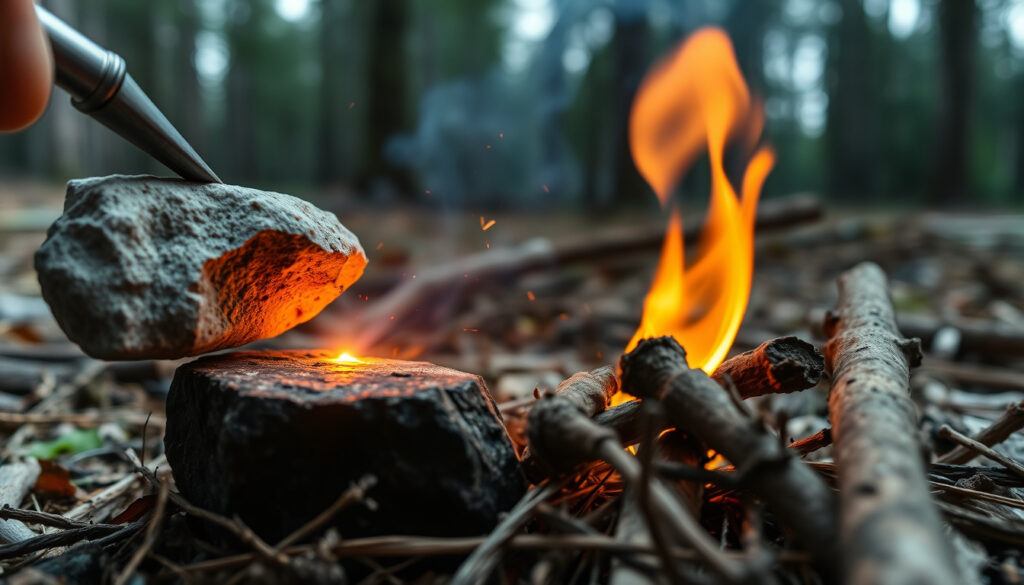
Flint and steel fire starting works by striking high-carbon steel against a hard stone—flint, quartz, agate, chert, or jasper—to produce hot sparks that ignite tinder (Human Kinetics (Survival Guide Publisher)). The steel peels tiny heated pieces when struck by flint, and sparks are directed into prepared tinder.
Components of Flint and Steel
Four items form a complete flint-and-steel kit: a piece of flint (or equivalent hard rock), a high-carbon steel striker, a spark-catcher (char cloth works best), and a dry tinder nest of fine material (Men’s Journal (Bushcraft Authority)).
- Flint: A hard, siliceous rock with a sharp edge that shaves steel
- Steel striker: High-carbon metal; produces hotter sparks than iron pyrite (OCNJ Daily (Historical Analysis))
- Char cloth: Burned cotton fabric that catches and holds sparks
- Tinder nest: Fine, dry material (grass, bark, jute twine)
Difference from Modern Fire Starters
Modern ferrocerium rods produce larger, more consistent sparks with less skill. Flint and steel requires practice but works when wet—if your tinder stays dry (Backpacking Light Forum (Expert Users)). The flint-and-steel principle also evolved into flintlock rifles and modern butane lighters (Flint and Steel (Specialist Publication)).
Ferrocerium rods are essentially a modernized version of the steel striker. They replace flint with synthetic ferrocerium, which sheds sparks far more readily. The core mechanism—shaving hot metal particles—remains identical.
For practitioners who master flint and steel, the skill transfers directly to understanding any spark-based fire starter, including modern lighters.
Do Flint and Steel Work in Real Life?
Absolutely. Flint and steel produces reliable sparks in conditions where friction methods fail—damp environments, cold weather, and wind. Percussion fire starting was preferred over friction methods for speed and reliability throughout pre-modern history (Crazy Crow (Historical reenactment source)).
Real-World Effectiveness
The method is straightforward: strike a rock with a piece of high-carbon steel, creating sparks that land on charred material, blow into an ember, then nurture flame. Tested repeatedly in survival scenarios, it outperforms matches in wet conditions (Survival Common Sense (Field-tested Blog)).
- Works reliably in moisture, cold, and wind (Flint and Steel (Specialist Publication))
- Lasts longer than matches—steel striker handles 10,000+ strikes
- Requires less physical effort than friction methods
Common Misconceptions
“A flint/steel is just more bothersome than a match, but the advantage is that the flint/steel will work when wet,” noted Backpacking Light Forum experts (Backpacking Light Forum). The real barrier isn’t the technique—it’s dry tinder logistics.
The disadvantage of flint and steel is that steel is difficult to find in the wild—you need to carry or source a striker. Ferrocerium rods solve this portability problem, which is why many modern survival kits include both.
How to Start a Fire Using Flint and Steel
The technique has three phases: preparation, striking, and ember cultivation. Each phase has specific requirements that determine success or failure.
Preparation Steps
- Gather dry tinder: fine grass, bark shavings, char cloth, or jute twine
- Hold the steel striker in one hand and flint in the other
- Scrape flint shavings into a nickel-sized pile in the tinder bed (Instructables (DIY Guide))
- Place charred cloth under thumb against flint or directly in tinder bundle
Striking Technique
Kneel with the tinder bundle before you. Strike downward powerfully, using a sharp edge of flint against the steel. The motion should scrape the flint edge across the steel at an acute angle, directing sparks into the tinder (Human Kinetics (Survival Guide Publisher)). Move the flint rather than the striker for better control.
“The technique is simple: strike a rock with a piece of high carbon steel, creating sparks.”
— Survival Common Sense (Survival Common Sense)
Tinder Choices
- Char cloth: Burn cotton fabric before your trip; catches sparks instantly
- Jute twine: Char by holding near flame until blackened but not burning
- Dry grass: Must be fine and completely dry
- Birch bark: Contains natural oils; works even when slightly damp
Why is it So Hard to Start a Fire with Flint and Steel?
Most failures trace to three problems: damp tinder, wrong striking angle, or insufficient practice. The mechanics sound simple, but the timing and coordination require muscle memory.
Common Challenges
- Sparks miss the tinder entirely due to incorrect angle
- Tinder absorbs moisture from air or ground contact
- Striking too gently—requires firm, decisive motion
- Flint edge dulls after repeated use
Tips to Overcome Difficulties
Scrape 10-12 times slowly to create a “firestick” material before attempting sparks (Backpacking Light Forum). Pack the tinder nest tightly. Test rock hardness by striking wet stones—quartz and chert work well if they produce sparks when struck against steel (Survival Common Sense (Field-tested Blog)).
Sparks need good tinder. No amount of perfect striking technique compensates for damp material. Protect your tinder in a waterproof container—inside a zip-lock bag, for instance—while carrying your flint and steel separately.
What this means for beginners: invest in quality char cloth and practice in dry conditions before relying on the technique in wet weather.
Historical Use of Flint and Steel for Fire Starting
Fire-making through percussion spans tens of thousands of years. Even Ötzi the Iceman—dated to 3350-3100 BC—carried flint, iron pyrites, and tinder plants in his kit, indicating that percussion fire-making was already established 5,300 years ago (Science Museum (Primary Institution)).
Stone Age Methods
The Neolithic period (starting 10,000 BC) saw flint and iron pyrite used for percussion sparks. Before the Iron Age introduced dedicated steel strikers, people struck hard rocks against iron pyrite—a lower-temperature spark source than high-carbon steel (Sacred Hearth (Fire History Archive)).
- Neolithic percussion: flint against iron pyrite or marcasite
- Regional variations: hand drill in Africa 200,000 years ago, bamboo fire saw in Asia 115,000 years ago (Sacred Hearth (Fire History Archive))
300 Years Ago Techniques
During the Iron Age (1200 BC), dedicated fire steels were invented and became the primary fire-starting method until matches became common in the mid-1800s (Crazy Crow (Historical reenactment source)). The Celts used fire steels from 700 BC to 40 AD; Romans and Vikings adopted the technique throughout Europe.
“Even ‘Ötzi’, the natural mummy of a man who lived 5300 years ago… was found with flint, iron pyrites, and a collection of different plants for tinder.”
— Science Museum (Science Museum (Primary Institution))
Fire steels were stored in tinderboxes across Europe. Tibetans and Mongolians carried the kit in a leather “chuckmuck” pouch. In Japan, practitioners substituted agate or quartz for flint (Crazy Crow (Historical reenactment source)).
The implication: before matches simplified fire-starting in the 1850s, percussion methods dominated because they worked when friction methods failed in damp conditions.
The Four Principal Fire Methods: A Comparison
Four principal fire methods exist: friction methods (bow drill, hand drill, fire plough) and percussion (flint and steel). Friction requires skill, fitness, and environmental knowledge; percussion delivers faster, more reliable results in damp conditions (TOTA.world (Global Fire Methods)).
| Method | Speed | Reliability in damp | Skill required | Era dominant |
|---|---|---|---|---|
| Flint and steel | Fast | High | Moderate | Iron Age to 1850s |
| Bow drill | Slow | Low | High | Ancient worldwide |
| Hand drill | Moderate | Low | High | Africa, Americas |
| Fire plough | Slow | Low | High | Pacific, Australia |
The pattern reveals that for survival practitioners today, flint and steel remains the most practical percussion choice when conditions turn wet.
How to Choose and Maintain Your Flint and Steel Kit
A quality flint-and-steel kit requires minimal maintenance but benefits from informed selection. The steel striker outlasts everything else—rated for 10,000+ strikes. Flint edges dull and need resharpening or replacement.
Choosing Your Steel Striker
- Look for high-carbon steel (tool steel, file, or dedicated striker)
- Ferrocerium rods offer easier sparks but wear faster than traditional steel
- The striker’s edge must be sharp—dull edges produce no sparks
Testing Rock Suitability
Any hard siliceous rock works: flint, quartz, chert, agate, jasper. Test by striking against your steel near water—rocks that spark when wet will work in field conditions (Survival Common Sense (Field-tested Blog)).
Carrying Your Kit
- Store steel separately from flint to prevent edge damage
- Keep char cloth and tinder in a waterproof container
- Protect flint in a leather pouch or wrapped in cloth
Teaching survival skills for decades, one of the most rewarding experiences is watching someone light their first fire with flint and steel. The kit itself never wears out—the striker handles over 10,000 strikes, flint reshapes with sharpening, and char cloth is easily made fresh before each trip.
What this means for long-term users: a well-maintained flint-and-steel kit represents essentially a lifetime investment with minimal replacement costs.
Related reading: camping stores · Hilux GR Sport
Frequently asked questions
What tinder works best with flint and steel?
Char cloth offers the highest success rate, catching sparks immediately. Jute twine charred to a blackened state works nearly as well. Dry grass, birch bark, and cotton balls are reliable alternatives when conditions are dry.
Can flint and steel start a fire in the rain?
Yes—if your tinder stays dry. Keep tinder in a waterproof container (zip-lock bag or sealed tin). The steel striker works regardless of rain; the limiting factor is whether your tinder absorbs moisture.
How do you sharpen a flint striker?
Resharpen the steel striker’s edge using a file or grinding stone. For flint, use another harder stone or a sharpening steel. A sharp edge is essential—dull steel produces no sparks.
Is flint and steel legal for wilderness use?
In most jurisdictions, flint and steel is treated like any fire-starting tool. Some protected wilderness areas restrict open fires regardless of ignition source. Always check local regulations before use.
What is the difference between flint steel and ferro rod?
Flint and steel uses a rock striking high-carbon steel. A ferro rod (ferrocerium) is a synthetic material that sheds sparks when scraped—the flint is built into the system. Ferro rods produce larger sparks with less skill but wear faster.
How long does a flint and steel kit last?
Steel strikers last 10,000+ strikes—essentially a lifetime of regular use. Flint edges dull but can be resharpened. Char cloth and tinder are consumable and require replenishing.
Can kids use flint and steel safely?
With supervision and proper safety briefing, children can learn flint and steel technique. The primary hazard is the sharp steel edge. Teach the striking motion away from the tinder first, then combine elements once fundamentals are understood.
The Verdict on Flint and Steel
Flint and steel fire starting rewards patience and practice with a skill that works reliably in conditions where modern methods fail. The mechanism is ancient, the materials are durable, and the technique transfers to understanding any spark-based fire starter—including modern lighters.
For wilderness travelers and survival enthusiasts: carry a dedicated steel striker and practice your technique before you need it. The investment in practice pays off when matches fail in a downpour and the group depends on a fire that actually catches.
More related posts
 Eddie Vedder Sobriety, Politics, and Relationships: Key Facts
 Sigourney Weaver: Biography, Name Origin & Career Facts
 Aitana Bonmatí: Salary, Ballon d’Or Wins & Net Worth
 Jamie Kah: Name Change, Net Worth, and Career Milestones
 Ozzy Osbourne Cause of Death: What We Know About His Passing
 USD to AUD Conversion: Live Rates, Calculator & Forecast
 Wu-Tang Clan Members’ Net Worth: Inside Hip-Hop’s Elusive Empire
 Live AFL Score – Real-Time Updates, Ladder & Matches