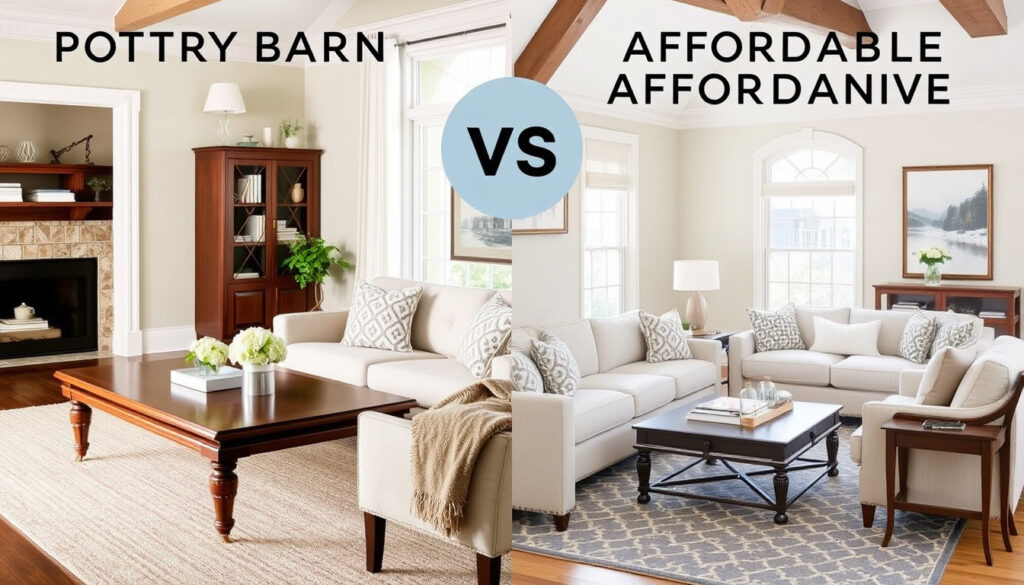
Pottery Barn vs Alternatives: Is It Worth the Price
Anyone who’s ever shopped for a sofa knows the feeling: you want something that looks timeless, feels sturdy, and doesn’t cost a month’s rent. Pottery Barn has built a reputation on exactly that promise — classic American furniture that’s as much about style as it is about durability. But with prices that sit above IKEA and below high-end custom makers, the real question is whether you’re paying for quality or just the name.
Founded: 1949 ·
Parent company: Williams-Sonoma, Inc. ·
Number of stores: 200+ (US, Canada, Mexico, UK) ·
Style: Classic American ·
Price range: Mid-to-high ($$-$$$)
Quick snapshot
- Pottery Barn is owned by Williams-Sonoma, Inc. (Williams-Sonoma, Inc. – Pottery Barn)
- Founded in 1949 (Wikipedia)
- Ships to the UK via its dedicated UK website (Pottery Barn UK)
- Exact percentage of items manufactured in China is not publicly disclosed
- Subjective quality comparison with West Elm varies by product line
- Precise number of stores worldwide is not officially listed
- 1949 – Pottery Barn founded (Williams-Sonoma, Inc.)
- 1986 – Acquired by Williams-Sonoma, Inc. (Williams-Sonoma, Inc.)
- 2020s – Expanded UK presence with dedicated e-commerce site (Williams-Sonoma, Inc.)
- Continued UK market growth with more local fulfilment options (IKEA UK – £117m price investment)
- Increasing focus on sustainable materials and supply chain transparency (IKEA UK – £117m price investment)
- Potential price adjustments as competitors invest in lower prices (IKEA UK – £117m price investment)
| Label | Value |
|---|---|
| Founded | 1949 |
| Parent company | Williams-Sonoma, Inc. |
| Number of stores | 200+ (US, Canada, Mexico, UK) |
| Price range | $$-$$$ |
| Style | Classic American |
| Manufacturing | Global (China, Vietnam, India, etc.) |
| Return policy | 30-day return window |
What brand is comparable to Pottery Barn?
Pottery Barn sits in a competitive space alongside West Elm, Crate & Barrel, and IKEA. Each brand targets a different price bracket and aesthetic, but all three are often mentioned in the same breath when shoppers compare style and value.
Is Pottery Barn like IKEA?
Not really. IKEA is known for flat-pack furniture, budget-friendly prices, and a Scandinavian design ethos. Pottery Barn, by contrast, sells mostly pre-assembled furniture with a classic American look. A typical IKEA sofa might cost £500, while a comparable Pottery Barn sofa can run £1,500–£2,500. According to IKEA UK (the Swedish furniture retailer), the company invested £117 million in price cuts in 2024, making its offerings even more accessible. Pottery Barn, on the other hand, rarely discounts beyond seasonal sales.
- IKEA: lower prices, self-assembly, modern Scandinavian
- Pottery Barn: higher prices, ready-to-assemble or fully assembled, classic American
Is West Elm or Pottery Barn better quality?
Both are owned by Williams-Sonoma, Inc. (the parent company), so they share similar supply chains and quality standards. West Elm leans modern and minimalist, while Pottery Barn is more traditional. Customer reviews on Wikipedia note that durability varies by product line, but general consensus is that both offer mid-to-high quality. The choice often comes down to aesthetics rather than construction.
West Elm buyers get a modern look; Pottery Barn buyers get a classic one. Quality is comparable, but the price tag is similar on both, so pick the style that fits your home.
Is Pottery Barn overpriced?
Compared to IKEA, Target, and Wayfair, Pottery Barn is expensive. But compared to high-end custom furniture, it’s mid-range. The real question is whether the higher price means better value.
What is a cheaper alternative to Pottery Barn?
If you’re after a similar look for less, consider:
- IKEA – lowest prices, basic assembly required
- Target – affordable home decor with a contemporary spin
- Wayfair – massive selection across all price points, frequent sales
According to IKEA UK (the retailer’s customer service page), parcel delivery starts at £5 and truck delivery at £25, making it far cheaper to get furniture delivered than Pottery Barn’s flat rate of £30–£50 for standard delivery. Shoppers who prioritize price over brand name will find substantial savings with these alternatives.
Pottery Barn is not overpriced for what it is — a mid-to-high brand with classic styling and durable construction. But if you’re on a tight budget, the savings from IKEA or Wayfair are hard to ignore.
Are Pottery Barn items made in China?
Many Pottery Barn products are manufactured in China, along with other countries like Vietnam and India. The parent company, Williams-Sonoma, Inc. (the global home goods conglomerate), sources globally to manage costs while maintaining quality control standards. Pottery Barn does not publicly disclose the exact percentage of Chinese-made items, but third-party audits and product labels confirm a significant portion of its furniture and decor originate from Asia.
This global sourcing strategy is common among mid-to-high furniture brands. The trade-off: lower manufacturing costs, but less transparency about labour and environmental practices. For shoppers concerned about ethical production, Pottery Barn offers some collections with sustainable certifications, but the majority of its line remains conventional.
Can Pottery Barn ship to the UK?
Yes — Pottery Barn has a dedicated UK website at potterybarn.co.uk that ships to addresses across the UK. According to Pottery Barn Kids UK (the brand’s shipping policy page), delivery for in-stock items typically takes 5–7 business days, with 8–9 business days for the Highlands and Islands. Home-delivery bookings are usually 7–21 days from booking, depending on geography.
For customers outside the UK, the US site offers international shipping to many countries, but additional duties and fees apply. This can add 20–30% to the total cost, so UK buyers should always use the local site to avoid surprises.
What is Pottery Barn known for?
Pottery Barn is best known for its classic American style — think rolled-arm sofas, rustic wooden tables, and neutral-toned decor. The brand’s look is often described as “traditional with a modern twist,” and it has become a staple in suburban homes across the US, Canada, and increasingly the UK.
What is Pottery Barn style called?
The style is commonly called “classic American” or “traditional transitional.” It blends timeless silhouettes with contemporary fabrics and finishes, making it versatile enough to fit both period homes and modern apartments. Wikipedia notes that the brand “focuses on a classic American style that is both timeless and accessible.”
What company owns Pottery Barn?
Pottery Barn is owned by Williams-Sonoma, Inc. (the parent company of Pottery Barn, West Elm, and Williams Sonoma). The acquisition took place in 1986, and since then Pottery Barn has grown from a single store in San Francisco to a global brand with over 200 locations.
Four brands, one pattern: price and style dictate the buyer’s choice.
| Brand | Price range | Style | Delivery (UK) | Assembly |
|---|---|---|---|---|
| Pottery Barn | $$-$$$ | Classic American | 5–7 days (UK site) | Ready-to-assemble or fully assembled |
| West Elm | $$-$$$ | Modern / Mid-century | Available via UK site | Ready-to-assemble |
| IKEA | $-$$ | Scandinavian modern | From £5 (parcel), £25 (truck) | Flat-pack, self-assembly |
| Crate & Barrel | $$-$$$ | Contemporary / Classic | Limited UK shipping | Ready-to-assemble |
Upsides
- Timeless design that doesn’t go out of style
- Durable construction for the price point
- Dedicated UK website with local delivery
- Free interior design services available
Downsides
- Higher prices than IKEA, Target, Wayfair
- Limited international shipping outside UK
- Manufacturing in China reduces transparency
- Return window only 30 days
“Pottery Barn is a classic American furniture brand known for its timeless style and quality craftsmanship.”
Wikipedia (the free encyclopedia)
“We offer a carefully curated collection of furniture, decor, and accessories that reflect a classic American aesthetic.”
For UK buyers, the choice is clear: Pottery Barn delivers style and durability, but at a price. If you’re after a classic look and can afford the premium, it’s a solid investment. If you’re watching your budget, IKEA and Wayfair offer similar aesthetics for a fraction of the cost. The pattern is consistent across all comparisons: Pottery Barn is a premium brand that delivers on its promise, but it’s not for everyone.
ikea.com, investopedia.com, furnituretoday.com, airtasker.com, youtube.com, laborhutt.com, reddit.com, williams-sonomainc.com
For a deeper look at what you’re actually paying for, the Pottery Barn quality and ownership guide breaks down the brand’s manufacturing and materials.
Frequently asked questions
Does Pottery Barn have sales?
Yes, Pottery Barn runs seasonal sales, typically around holidays like Memorial Day, Labor Day, and Black Friday. Discounts range from 10–30% off select items. Signing up for the newsletter provides early access.
What is Pottery Barn’s return policy?
Pottery Barn offers a 30-day return window for most items. Furniture and large items may incur a restocking fee. Returns must be in original condition. Check the official returns page for details.
Can I use Pottery Barn gift cards at West Elm?
No. Pottery Barn gift cards are only redeemable at Pottery Barn, Pottery Barn Kids, and Pottery Barn Teen. They cannot be used at West Elm or Williams Sonoma, even though all are under the same parent company.
How do I care for Pottery Barn furniture?
Most Pottery Barn furniture comes with care instructions. For wood pieces, dust regularly and avoid direct sunlight. For upholstery, spot clean with mild soap and water. Professional cleaning is recommended for stains.
Where are Pottery Barn stores located?
Pottery Barn has over 200 stores in the US, Canada, Mexico, and the UK. In the UK, stores are in London, Birmingham, and Manchester. Use the store locator on the UK site.
Does Pottery Barn offer interior design services?
Yes, Pottery Barn offers free interior design consultations both in-store and online. Customers can book a virtual appointment or visit a store to get personalised advice.
More related posts
 Daryl McCormack: Biography, Age, Ethnicity, Wife & Career
 Eddie Guerrero Death: Cause, Legacy & Last Match
 Atom Eve: Powers, Relationships, Comic vs Show
 Woodside Share Price ASX: WDS Live Quote, Forecast & Dividend
 John Lithgow: Height, Harry Potter Facts & Rowling Comments
 Miss Moni: Age, Nationality & Husband – Is She Good for Kids
 Donovan Mitchell: Height, 71-Point Game, and NBA Legacy
 Cynthia Erivo: Age, Biography, and Wicked Role