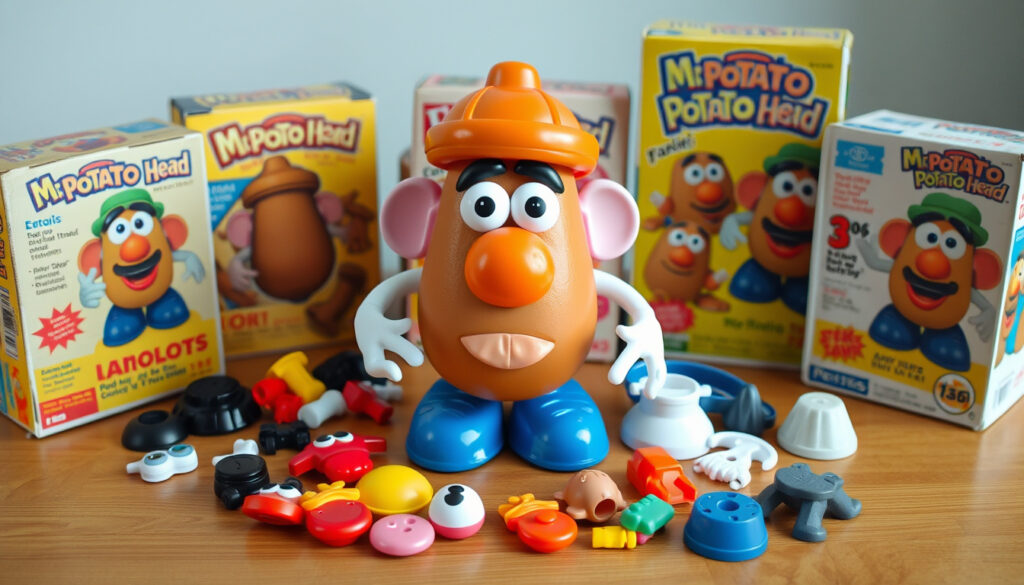
Mr Potato Head – History Invention Evolution Legacy
Mr. Potato Head stands as one of the most recognizable toys in American history, beginning as a simple set of plastic facial features designed to transform ordinary vegetables into playful characters. Since its debut in 1952, this beloved toy has captivated generations of children while evolving from a vegetable-based craft activity into a multimedia franchise featured in blockbuster films. Understanding its origins, cultural significance, and enduring appeal reveals why Mr. Potato Head remains a cornerstone of playtime creativity more than seven decades after its introduction.
The toy originated from the creative mind of Brooklyn toymaker George Lerner, who conceived the design in 1949 as a set of plastic pushpin parts that could be inserted into fruits and vegetables. What began as an unconventional toy concept eventually became the first toy ever advertised on television, fundamentally changing how toys were marketed to American families. Today, Mr. Potato Head occupies a permanent place in the National Toy Hall of Fame and continues to inspire imaginative play through modern iterations from Hasbro.
This comprehensive exploration traces the toy’s remarkable journey from its humble beginnings to its status as a pop culture icon, examining the innovations, cultural milestones, and creative adaptations that have kept Mr. Potato Head relevant for generations of families around the world.
What Is Mr. Potato Head?
Mr. Potato Head is a mix-and-match toy consisting of plastic facial features and accessories designed to be attached to various objects, traditionally vegetables like potatoes. The concept revolutionized toy design by placing creative control directly in the hands of children, allowing them to assemble and customize characters according to their imagination. Unlike rigid dolls or action figures with fixed appearances, Mr. Potato Head encourages open-ended play through its interchangeable components.
The toy’s core appeal lies in its simplicity and versatility. Children receive a collection of eyes, ears, mouths, noses, hats, glasses, and other features that attach via small plastic pushpins. This modular approach means no two potato characters need look alike, fostering creativity and personal expression from an early age. The basic premise has remained remarkably consistent since the 1950s, though the materials and presentation have evolved significantly over the decades.
1949
1952
1995
Inducted
- Pioneered the concept of modular, interchangeable toy parts for creative assembly
- Became the first toy to be advertised on American television in 1952
- Featured in Pixar’s Toy Story franchise, voiced by legendary comedian Don Rickles
- Recognized for its cultural and historical significance by the National Toy Hall of Fame
- Hasbro has maintained continuous production since acquiring rights in 1952
- Expanded into numerous themed sets including Star Wars, Marvel, and DC franchises
| Fact | Detail |
|---|---|
| Inventor | George Lerner |
| Original Maker | Hasbro (formerly Hassenfeld Brothers) |
| First Television Advertisement | 1952 |
| Toy Story Films | All four installments (1995-2019) |
| Voice Actor | Don Rickles |
| Current Status | In continuous production |
Original Design and Parts
The original 1952 kit contained only plastic parts without any body or vegetable included, requiring families to supply their own potatoes or other produce. The package included various facial features such as eyes with different expressions, multiple mouth shapes, noses, ears, and an array of accessories including hats, glasses, and moustaches. Each piece featured small plastic pushpins on the back that could be firmly pressed into fruits or vegetables, creating secure attachments that withstood children’s play.
Parents initially provided the potatoes and other vegetables that served as the body for their Mr. Potato Head creations. This design choice reflected post-war resource consciousness and kept production costs minimal, making the toy accessible to a wide range of families. The requirement for vegetables also added an element of parental involvement and supervision, as younger children needed help preparing produce for toy assembly.
The 1952 release deliberately omitted potatoes from the packaging, requiring families to supply their own vegetables. This unconventional approach proved successful, with the toy selling over a million units in its debut year and becoming the most popular toy of 1952.
Who Invented Mr. Potato Head and What Is Its History?
Brooklyn native George Lerner developed the concept for Mr. Potato Head around 1949, drawing inspiration from multiple childhood and family experiences. Sources suggest several possible influences: his own childhood play with garden potatoes, watching his sisters play with dolls, observing his children’s arrangements of food items, and noticing his wife’s nephew inserting items into vegetables. These varied inspirations converged into Lerner’s innovative design for a modular facial assembly toy that could transform ordinary produce into characters.
Lerner initially called his creation the “Funny Face Man” and partnered with Julius Ellman in 1951 to prototype the concept under the Lernell Company banner. Despite the apparent appeal of the idea, major toy manufacturers rejected the concept amid post-World War II food rationing concerns. Companies worried that encouraging children to use food as toys might conflict with broader societal efforts to reduce food waste during the post-war period of resource scarcity.
Invention and Early Milestones
The breakthrough came when Post Cereals purchased the rights in 1951, repurposing Lerner’s design as a premium item included in cereal boxes. The initial version featured a strip of attached plastic pieces designed as a cereal box giveaway, and this format proved immediately popular with children who received them. However, the cereal company lacked the infrastructure to fully develop and distribute the toy as a standalone product.
Hassenfeld Brothers, the Rhode Island-based company that would later become Hasbro, recognized the toy’s potential and convinced Lerner to repurchase the rights from Post Cereals. The company repositioned the product for its 1952 retail release, packaging it with a small Styrofoam head suggestion (still maintaining the connection to real vegetables while providing a cleaner alternative) and featuring only the plastic parts in the box. The toy launched with no potatoes included, requiring families to supply their own produce for assembly.
The launch strategy proved visionary. Hassenfeld Brothers created a groundbreaking television advertisement showing children actively assembling their Mr. Potato Head creations, demonstrating the toy’s interactive nature directly to families watching at home. This approach revolutionized toy marketing and established television advertising as the primary channel for reaching young audiences and their parents.
First Television Advertisement
The 1952 television commercial for Mr. Potato Head represented a pivotal moment in American toy marketing history. Rather than simply showing the finished product, the advertisement depicted children assembling their toys on screen, allowing viewers to witness the creative process that made the toy unique. This innovative approach connected with parents and children alike, emphasizing the interactive nature of play rather than just the final appearance of the product.
The commercial’s success demonstrated the enormous potential of television as a marketing medium for toys. Within its debut year, Mr. Potato Head became the best-selling toy of 1952, with over a million units sold. The advertising approach established a template that toy companies would follow for decades, with television commercials showing children actively engaged with products becoming standard marketing practice across the industry.
Mr. Potato Head became the first toy ever advertised on American television in 1952. This pioneering marketing approach proved so successful that the toy sold over a million units in its first year, forever changing how toy companies would market their products to children and families.
How Has Mr. Potato Head Evolved Over Time?
The evolution of Mr. Potato Head reflects changing attitudes toward toy safety, manufacturing innovation, and consumer expectations. When the toy launched in 1952, the design relied entirely on children supplying their own vegetables for the body, typically potatoes. This approach worked well initially but created practical challenges that accumulated over time, eventually necessitating fundamental changes to the toy’s design philosophy.
Complaints from parents about rotting vegetables became increasingly common, particularly as the toy grew more popular and children repeatedly used the same produce. Additionally, safety regulations in the 1960s raised concerns about sharp pushpin elements that could pose injury risks. These combined pressures prompted Hasbro to introduce a reusable plastic potato body in 1964, marking a significant departure from the original design concept while preserving the core appeal of mix-and-match facial features.
Modern Versions and Availability
Today’s Mr. Potato Head products bear little resemblance to the original 1952 kit beyond the fundamental concept of interchangeable parts. The plastic potato body has become the standard foundation, eliminating concerns about rot and simplifying storage and cleanup for families. Modern sets include substantially more pieces than early versions, with elaborate kits featuring dozens of accessories, multiple body types, and themed collections spanning diverse interests.
Hasbro has expanded the Mr. Potato Head brand into numerous themed lines that appeal to contemporary interests. Children can now find sets featuring popular franchises including Star Wars, Marvel, and DC Comics characters, allowing young fans to create their favorite heroes and villains using the familiar Mr. Potato Head format. Vehicle sets, playsets, and multi-pack collections featuring entire families of potato characters have broadened the brand’s appeal across different age groups and interest areas.
The product line remains in continuous production through Hasbro, which has grown to become the world’s third-largest toy company. Unlike many toys that fade after brief popularity spikes, Mr. Potato Head has maintained market presence for over seven decades through careful brand management and willingness to adapt while preserving core elements that made the original concept successful. Families can still purchase basic starter kits alongside premium collections, maintaining accessibility for new customers while offering expanded options for collectors and enthusiasts.
What Is Mr. Potato Head’s Role in Toy Story?
Mr. Potato Head achieved renewed cultural prominence through its appearance in Pixar’s Toy Story franchise, which debuted in 1995. The character received a distinctive personality transplant, becoming a sarcastic, somewhat vain figure who provides comic relief throughout the series. This animated incarnation introduced the beloved toy to entirely new generations of children while adding dimensional character traits that distinguished it from the simple assembly toy parents remembered from their own childhoods.
The character’s transformation from a silent toy into a talkative, opinionated personality proved remarkably successful, helping establish Toy Story’s ensemble cast as memorable figures in animation history. Mr. Potato Head’s role as the resident curmudgeon with a hidden soft side resonated with audiences, and his relationship with Mrs. Potato Head provided ongoing character development throughout the franchise’s four films spanning 1995 to 2019.
Voice Actors and Appearances
Legendary comedian Don Rickles provided the voice for Mr. Potato Head throughout the Toy Story films, bringing his distinctive rapid-fire delivery and sharp wit to the character. Rickles, known for his appearances on talk shows and his acclaimed stand-up comedy career, perfectly captured the gruff-but-lovable personality that made the animated Mr. Potato Head memorable. His performance balanced the character’s sarcastic exterior with underlying warmth and loyalty to his fellow toys.
Following Rickles’ death in 2017, subsequent Toy Story projects have continued to feature Mr. Potato Head, with actor Joe Pantoliano taking over voice duties for the character in later productions. This continuity ensures the character remains part of the franchise while respecting the legacy established by Rickles’ iconic original performance. Mr. Potato Head appears in all four Toy Story films, Toy Story 2 (1999), Toy Story 3 (2010), and Toy Story 4 (2019), maintaining a consistent presence throughout the series.
The Toy Story connection dramatically expanded Mr. Potato Head’s cultural visibility, particularly among audiences who might not have encountered the physical toy otherwise. Children who grew up watching the films often sought out the actual toys, creating a bridge between the animated representation and the physical product that strengthened both brand recognition and sales. This synergy between media representation and product availability exemplifies how modern entertainment and toy marketing can reinforce each other effectively.
Why Is Mr. Potato Head in the National Toy Hall of Fame?
The National Toy Hall of Fame in Rochester, New York, recognizes toys that have demonstrated exceptional staying power, innovation, and cultural significance over time. Mr. Potato Head’s induction into this prestigious institution reflects its remarkable seven-decade history and fundamental influence on how children play and create. The Hall of Fame selection committee evaluates toys based on their originality, cultural impact, longevity, and ability to inspire imaginative play.
Mr. Potato Head represents one of the earliest examples of toys designed to encourage creativity rather than prescribe specific play patterns. Unlike dolls with fixed identities or games with predetermined outcomes, Mr. Potato Head provides a framework for open-ended imaginative play that changes with each assembly. This emphasis on child-driven creativity anticipated developments in educational philosophy that would become standard considerations in toy design decades later.
Cultural Significance and Awards
The toy’s cultural significance extends beyond its commercial success to encompass broader influences on toy design, marketing practices, and play culture. Mr. Potato Head’s pioneering use of television advertising demonstrated new possibilities for reaching consumers and established templates that remain relevant in contemporary marketing. The toy’s modular design philosophy influenced subsequent toy lines that adopted similar approaches to customizable play experiences.
Throughout its history, Mr. Potato Head has maintained relevance by adapting to changing times while preserving essential elements that define its identity. The transition from vegetable bodies to plastic replicas reflected practical considerations but didn’t diminish the toy’s fundamental appeal. Similarly, expansion into licensed themes and connection to the Toy Story franchise demonstrated the brand’s ability to remain current without abandoning its core identity as a creative assembly toy.
The Hall of Fame recognition acknowledges Mr. Potato Head’s role as a cultural artifact that connects generations. Parents who played with early versions of the toy have shared the experience with their children and grandchildren through updated versions, creating continuity across family lineages. This multigenerational appeal distinguishes Mr. Potato Head from toys that capture momentary cultural trends without achieving lasting significance.
Mr. Potato Head Timeline
Understanding the sequence of milestones helps contextualize Mr. Potato Head’s development from simple toy concept to cultural icon. The following chronological overview highlights key moments that shaped the toy’s history and established its enduring place in American play culture.
- 1949: George Lerner conceives the original concept for plastic facial parts designed for attachment to vegetables
- 1951: Lernell Company prototypes the “Funny Face Man”; Post Cereals acquires rights for cereal box premiums
- 1952: Hassenfeld Brothers (later Hasbro) releases Mr. Potato Head as first television-advertised toy; sells over one million units
- 1953: Mrs. Potato Head introduced, along with family members Brother Spud and Sister Yam
- 1964: Hasbro introduces plastic potato body in response to rot complaints and safety regulations
- 1995: Mr. Potato Head appears in Pixar’s Toy Story, voiced by Don Rickles
- 2010: Featured in Toy Story 3; franchise expansion continues
- 2019: Final theatrical appearance in Toy Story 4
- Present: Continuous production maintained with diverse themed collections
What Is Confirmed and Uncertain About Mr. Potato Head’s History?
While Mr. Potato Head’s basic history is well-documented through multiple sources, certain details remain somewhat unclear or vary depending on the reference consulted. Acknowledging what we know with confidence versus what remains uncertain provides a more honest picture of this toy’s development and helps readers understand the limitations of available historical records.
| Established Information | Uncertain or Varied Information |
|---|---|
| George Lerner invented the concept around 1949 | Specific inspiration sources for Lerner’s concept |
| First television-advertised toy in 1952 | Exact sales figures in early years (estimates only) |
| Sold over one million units in 1952 | Precise details of Post Cereals partnership timeline |
| Plastic body introduced in 1964 | Specific National Toy Hall of Fame induction year |
| Don Rickles voiced character in Toy Story films | Complete list of all themed sets produced |
Mr. Potato Head’s Place in Toy History
Mr. Potato Head occupies a unique position in the history of American toys, representing both a product of its era and an enduring concept that transcends specific historical moments. When the toy launched in 1952, it arrived during a period of rapid economic growth and suburban expansion that fundamentally changed American family life. Post-war prosperity meant more families had disposable income for recreational purchases, and the emergence of television as a dominant medium created new possibilities for marketing consumer products directly to children.
The toy’s original design reflected post-war sensibilities about resourcefulness and practical value. By requiring families to supply their own vegetables, the product avoided the appearance of extravagance while encouraging creativity and family participation in play. This approach resonated with cultural values emphasizing imagination over material consumption, positioning Mr. Potato Head as a wholesome, accessible option for families seeking constructive entertainment for their children.
Over subsequent decades, Mr. Potato Head demonstrated remarkable adaptability, evolving from a vegetable-based craft toy into a plastic product line featuring licensed characters from major entertainment franchises. This transformation reflects broader changes in the toy industry, where licensed properties increasingly dominate shelf space and where nostalgia-driven marketing connects adult collectors with childhood memories. The toy’s ability to navigate these changes while maintaining its core identity speaks to the strength of its fundamental concept.
What Do Experts and Institutions Say About Mr. Potato Head?
Institutional recognition of Mr. Potato Head’s significance comes from multiple authoritative sources within the toy industry and cultural institutions. These endorsements provide external validation of the toy’s historical importance and help contextualize its enduring appeal within broader frameworks of play and childhood development.
The National Toy Hall of Fame recognizes toys that have inspired creative play and influenced generations of children. Mr. Potato Head’s modular design encouraged children to use their imagination to create characters, establishing principles that continue to influence toy design today.
— National Toy Hall of Fame
Hasbro, as the current rights holder, describes Mr. Potato Head as an iconic brand that has delighted generations of families through creative play experiences. The company’s official materials emphasize the toy’s role in fostering imagination and providing children with tools for self-expression through customizable character creation.
Historical accounts from sources including the Smithsonian Institution have examined Mr. Potato Head’s evolution as an example of successful product adaptation and marketing innovation. These scholarly treatments situate the toy within broader narratives about American consumer culture, toy industry development, and the changing nature of childhood play experiences across the twentieth and twenty-first centuries.
The Enduring Legacy of Mr. Potato Head
Mr. Potato Head’s journey from Brooklyn workshop to international icon demonstrates the power of simple, flexible ideas that adapt to changing times while maintaining core appeal. The toy’s success cannot be attributed to technological complexity or elaborate marketing campaigns alone, but rather to a fundamental insight about children’s creative capacities and the value of open-ended play experiences that put imagination in control.
More than seven decades after its introduction, Mr. Potato Head continues to inspire new generations of children while maintaining connections to adults who remember the toy from their own childhoods. This multigenerational appeal represents a rare achievement in the toy industry, where products typically target specific age ranges and fade quickly as children’s interests evolve. Mr. Potato Head’s ability to transcend generational boundaries while adapting to contemporary preferences ensures its place in play culture for years to come.
For families seeking gifts that encourage creativity and imaginative play, Mr. Potato Head offers a proven option with demonstrated appeal across generations. Similar gift ideas that emphasize open-ended play and personal expression can complement the Mr. Potato Head experience and provide children with diverse opportunities for creative development.
Frequently Asked Questions
When was Mr. Potato Head first advertised on television?
Mr. Potato Head became the first toy ever advertised on American television in 1952. The groundbreaking commercial showed children assembling the toy on screen, and the product went on to sell over one million units that year, becoming the most popular toy of 1952.
Who voiced Mr. Potato Head in Toy Story?
Comedian Don Rickles provided the voice for Mr. Potato Head throughout the Toy Story franchise. Rickles’ distinctive delivery and sharp wit shaped the character’s sarcastic personality. Following Rickles’ death in 2017, other actors have continued voicing the character in subsequent productions.
Is Mr. Potato Head still being made?
Yes, Hasbro has maintained continuous production of Mr. Potato Head since acquiring the rights in 1952. The product line remains active with modern versions including plastic bodies, diverse themed sets, and accessories. Families can find current products through major retailers and the official Hasbro website.
Who invented Mr. Potato Head?
Brooklyn toymaker George Lerner invented Mr. Potato Head around 1949. Lerner conceived the design as a set of plastic facial parts with pushpins that could be inserted into fruits and vegetables. He initially partnered with Post Cereals for cereal box premiums before Hassenfeld Brothers (later Hasbro) acquired rights for the 1952 retail release.
What were the original Mr. Potato Head parts?
The original 1952 kit included separate plastic pushpin parts such as eyes, ears, mouths, noses, and accessories like hats and glasses. Notably, no potato or body was included in the packaging—families supplied their own vegetables. The plastic pieces attached via small pushpins that could be inserted into fruits and vegetables to create characters.
Why is Mr. Potato Head in the Toy Hall of Fame?
Mr. Potato Head was inducted into the National Toy Hall of Fame in recognition of its cultural significance, innovative design, and enduring appeal. The selection committee noted the toy’s role in pioneering modular, creativity-focused play experiences and its influence on subsequent toy design. The Hall of Fame celebrates toys that have inspired generations of children.
What happened to the vegetable bodies?
Hasbro introduced plastic potato bodies in 1964 after parents complained about rotting vegetables and safety regulations raised concerns about sharp pushpin elements. The plastic bodies provided a durable, reusable alternative while maintaining the core Mr. Potato Head experience of interchangeable facial features.
What themed sets are available for Mr. Potato Head?
Mr. Potato Head has expanded into numerous themed collections featuring franchises including Star Wars, Marvel, and DC Comics. These sets allow children to create characters from their favorite entertainment properties using the familiar Mr. Potato Head format. The brand continues to introduce new themed sets reflecting current entertainment trends.
More related posts
 Ozzy Osbourne Cause of Death: What We Know About His Passing
 Pascal Siakam: Career, Stats, Trade, and Personal Life
 Flower Delivery Sydney: Best Same Day & Cheap Options
 English to Tagalog Translator – Best Tools Compared
 Nicola Peltz: Wealth, Age, Ethnicity & Beckham Comparison
 Caroline Catz: Real Name, Age, and Life After Doc Martin
 Cleetus McFarland: Real Name, Net Worth, Wife & Freedom Factory
 Rolls-Royce Ghost 2026: Price, Specs & Phantom Comparison