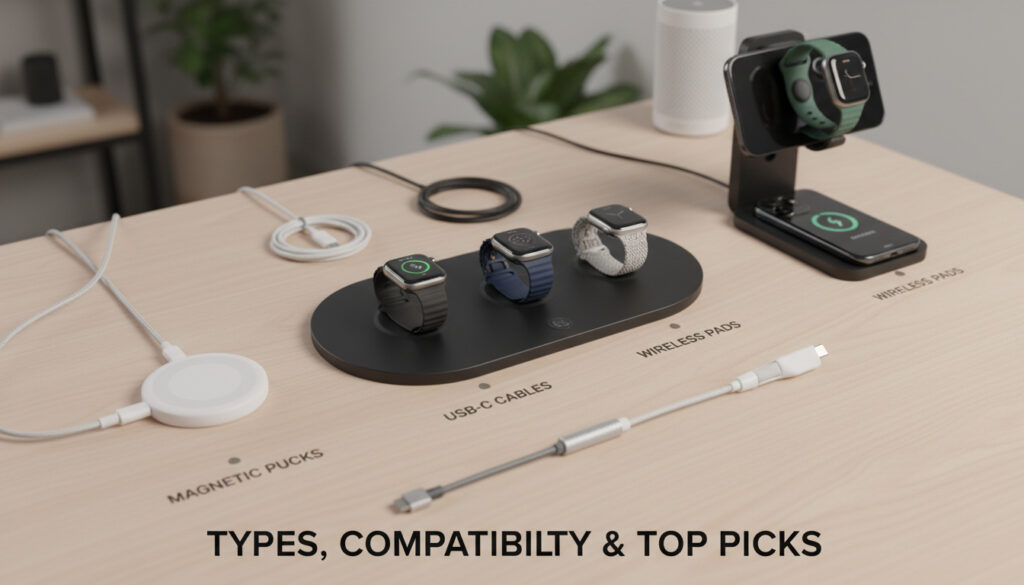
Apple Watch Charger – Types, Compatibility and Best Picks
Apple Watch charging technology shifted fundamentally in 2024. Current Series 10, Ultra 2, and subsequent models now employ magnetic fast wireless chargers terminated with USB-C cables, departing from previous USB-A configurations. This transition enables rapid power delivery, achieving an 80 percent charge in approximately 30 minutes for flagship models when paired with adequate power adapters.
The proprietary magnetic puck design remains consistent—aluminum housings with automatic alignment magnets—though cable construction now features woven nylon for enhanced durability. Official hardware supports USB Power Delivery standards, requiring specific adapter wattage to unlock fast-charging capabilities. Earlier Series 7 through 9, Ultra 2, and SE 3 models achieve comparable 80 percent charge levels in roughly 45 minutes under identical conditions.
Manufacturers no longer include charging cables within retail packaging. Consumers must acquire official or certified third-party cables separately, with pricing starting near $39 for first-party options. This purchasing requirement has expanded the aftermarket ecosystem, generating compatibility questions regarding third-party magnetic cables, Qi wireless pad compatibility, and cross-device functionality with iPhone charging systems.
What Type of Charger Does the Apple Watch Use?
Apple Watch utilizes a proprietary magnetic wireless charging system distinct from standard Qi or MagSafe iPhone charging. The current official cable—Model A2515—terminates in USB-C and features a woven sheath surrounding the aluminum magnetic puck. Magnets automatically align the puck to the watch’s rear sensors, initiating charging without precise manual positioning.
| Type | Price Range | Compatibility | Charge Time (0-80%) | Key Pros/Cons |
|---|---|---|---|---|
| Official USB-C | ~$39 | Series 1-10, Ultra, SE | 30-45 min* | Reliable, MFi-certified, expensive |
| Magnetic Cable (WPT) | ~$39 | Regulated regions only | Standard speed | Compliant, no fast charge |
| Fast Wireless (Official) | ~$39 | Series 7-10, Ultra 2/3 | 30-45 min | Optimal speed, requires 20W+ adapter |
| Budget Third-Party | $10-20 | Series 1-10, Ultra 2 | Unverified | Affordable, variable reliability |
*Charge times require 20W+ USB-C Power Delivery adapter. Source: Apple Support
Key Insights
- USB-C adoption began with Series 10 and Ultra 2 models, replacing previous USB-A cables
- Fast charging demands 20W or greater USB-C Power Delivery adapters; standard adapters provide slower charge rates
- Retail packaging excludes charging cables necessitating separate purchases
- MFi certification indicates official Made for iPhone/iPad/Apple Watch program compliance
- WPT-labeled cables comply with regional wireless power transfer regulations but disable fast-charging functionality
- Magnetic alignment remains proprietary; standard Qi pads function but without optimal positioning geometry
- Power consumption peaks at approximately 5W, though adapter headroom prevents thermal throttling
| Specification | Detail |
|---|---|
| Connector Type | USB-C (Series 10+); USB-A (legacy) |
| Cable Length | 1 meter (standard) |
| Fast Charge Series 10 | ~30 minutes (0-80%) |
| Fast Charge Ultra 2/3 | ~45 minutes (0-80%) |
| Required Adapter | 20W+ USB-C PD for fast charge |
| In-Box Inclusion | None (separate purchase) |
| WPT Compliance | Disables fast charging when present |
| Third-Party Price Range | $10-27 depending on configuration |
Can You Use a USB-C Charger for Apple Watch?
Current Apple Watch models explicitly require USB-C connectivity for optimal charging performance. The Apple Watch Magnetic Fast Charger to USB-C Cable represents the standard first-party solution, utilizing USB-C’s Power Delivery protocol to achieve accelerated charging velocities unavailable through legacy USB-A connections.
USB-C Compatibility by Model
Series 10, Ultra 2, Ultra 3, and SE 3 models utilize the USB-C magnetic fast charger as their primary charging method. These devices support rapid charging from 0 to 80 percent in 30 to 45 minutes when connected to compatible power sources. Regional regulatory variations exist—specifically WPT (Wireless Power Transfer) compliant cables marked with “WPT” labeling function identically for standard charging but deliberately disable fast-charging capabilities to satisfy specific electromagnetic compliance requirements.
Power Requirements
Apple specifies 18W to 140W USB-C power adapters for official charging hardware, though third-party USB-PD adapters delivering 5W or greater provide basic functionality. Fast charging strictly requires 20W or greater Power Delivery capacity; lesser adapters charge devices fully but extend duration significantly. Apple Support documentation confirms that charge times vary based on environmental temperature, active applications, and battery health conditions.
WPT-compliant charging cables feature distinct labeling on the magnetic puck surface. These regulatory variants charge Apple Watch devices reliably but exclude fast-charging functionality entirely, regardless of adapter wattage.
What Are the Best Apple Watch Chargers?
Selection criteria prioritize charging velocity, build integrity, and certification status. The official Apple cable maintains superior reliability standards, though budget-conscious consumers increasingly utilize third-party alternatives for travel or secondary charging locations. Best Travel Credit Cards No Fees may complement portable charging investments for frequent travelers seeking compact power solutions.
Official Apple Options
The Magnetic Fast Charger to USB-C Cable (Model A2515) provides 1-meter woven construction with aluminum puck housing. Priced at approximately $39, this MFi-certified cable delivers confirmed fast-charging support for compatible Series 7 and later devices. Fifteen minutes of charging yields approximately eight hours of typical usage, according to manufacturer specifications.
Top Third-Party Picks
Budget alternatives populate major retail platforms. Walmart listings and AliExpress vendors offer “2025 Upgraded” magnetic cables priced $10-20, claiming compatibility across Series 10 through legacy Series 1 devices, including Ultra 2. These typically feature USB-A and USB-C termination options.
UltraSupplyCo manufactures keychain-sized USB-C compact chargers specifically targeting Ultra and Series 10 devices, priced near $20. These portable pucks connect via iPhone 15, MacBook, or USB-C power banks. Multi-device 2-in-1 USB-C wall chargers from various specialized retailers combine 15W Watch charging with iPhone charging capabilities, ranging $20-27.
Achieving advertised 30-minute 0-80% charge rates requires dedicated 20W or greater USB-C Power Delivery adapters. Lesser adapters function but extend charging durations significantly.
How to Replace an Apple Watch Charger Cable?
Replacement becomes necessary when cables fray, magnetic connections weaken, or charging intermittency develops. Users seeking Gold Cross Necklace Guide may appreciate the precision engineering similarities between jewelry clasps and Apple’s magnetic alignment systems—both requiring clean, undamaged contact surfaces for optimal function.
Official Replacements
Apple retail channels and authorized resellers stock Model A2515 replacement cables. Purchasing through official channels guarantees MFi certification, ensuring proper handshake protocols between charger and watch. Third-party replacement cables lack standardized quality control, with manufacturing tolerances affecting magnetic alignment precision and charging consistency.
Troubleshooting Tips
Slow charging often stems from insufficient adapter wattage, protective case interference, or contaminated puck surfaces. Removing cases and cleaning the magnetic surface with lint-free cloths restores optimal conductivity. Intermittent charging typically indicates cable degradation requiring replacement.
Budget cables from major retail marketplaces claim Series 10 and Ultra 2 compatibility yet present risks including inconsistent charging speeds, thermal runaway, or MFi authentication failures. Official Apple hardware maintains superior long-term reliability.
How Has Apple Watch Charging Technology Evolved?
- — Original Apple Watch debuts with proprietary magnetic charging cable utilizing USB-A termination and plastic cable sheathing
- — Series 3 maintains identical charging hardware while introducing cellular models requiring identical power profiles
- — Series 7 introduces fast charging capability with updated magnetic module design, reducing 0-80% times significantly
- — Series 10 and Ultra 2 adopt USB-C cables replacing USB-A, enabling higher power delivery throughput and faster charge rates
- — WPT-compliant variants introduced for regulated markets sacrificing fast charge for electromagnetic compliance
- — Current standard establishes 30-minute 0-80% charging for Series 10 and 45-minute targets for Ultra 2/3 through USB-C PD architecture
Sources: Apple Support Documentation, Apple Store Product Specifications
What Is Definitively Known About Apple Watch Charging?
| Established Information | Information That Remains Unclear |
|---|---|
| Series 10+ requires USB-C magnetic fast charger for optimal speeds | Exact thermal throttling thresholds for third-party cables |
| 0-80% charge times: 30 min (Series 10+), 45 min (Ultra 2/3) | Long-term durability statistics for budget third-party options |
| No charging cable included in retail packaging since recent generations | Comprehensive MFi certification compliance rates across aftermarket manufacturers |
| WPT-labeled cables explicitly disable fast charging | Precise Qi2 wireless charging performance metrics for Apple Watch specifically |
| 20W+ USB-C PD adapter required for fast charging | Comparative failure rates between official and third-party magnetic pucks |
| Proprietary magnetic alignment system incompatible with standard Qi pads | Future wireless charging standards adoption timelines beyond current USB-C implementation |
Why Did Apple Shift to USB-C for Apple Watch Charging?
Regulatory pressure primarily motivated the transition. European Union mandates requiring universal charging standards for electronic devices compelled Apple to abandon proprietary Lightning and legacy USB-A connections across product lines. The iPhone 15’s USB-C adoption in 2023 established precedent for the Apple Watch’s 2024 cable revision.
Technical advantages accompanied compliance benefits. USB-C Power Delivery supports higher wattage transmission with superior thermal management compared to USB-A architectures. This capability enabled the 30-minute fast charging benchmarks now standard for Series 10 devices. Ecosystem alignment additionally simplified consumer accessory management, allowing single-adapter charging for iPhone 15, MacBook, and Apple Watch devices.
What Do Official Sources Say About Apple Watch Charging?
Apple Watch Series 10 and Apple Watch Ultra 2 and later use the Apple Watch Magnetic Fast Charger to USB-C Cable (model A2515) or Apple Watch Magnetic Fast Charger to USB-C Cable (WPT) (model A2874) to fast charge. Fast charging requires an Apple 18W, 20W, 30W, 35W, 67W, 70W, 96W, 100W, or 140W USB-C Power Adapter or an equivalent third-party USB-C power adapter that supports USB Power Delivery (USB-PD) at 5W or greater.
— Apple Support, 2024
Independent testing corroborates manufacturer claims. Video benchmark analysis confirms that Qi2-enabled power banks achieve sustained 12W+ wireless output with active cooling, though Apple Watch-specific charging rates remain unverified through third-party testing protocols.
Key Takeaways on Apple Watch Charging
Contemporary Apple Watch charging necessitates USB-C connectivity for Series 10 and Ultra models, delivering 30 to 45-minute 80-percent charge times with proper 20W adapters. While official cables provide guaranteed reliability and MFi certification, budget alternatives present viable secondary options despite variable performance characteristics. Consumers prioritizing charging speed must verify adapter wattage and avoid WPT-compliant cables where fast charging remains essential. The magnetic puck design persists as a proprietary constant across all generations, ensuring backward compatibility while embracing modern USB-C power delivery standards.
Frequently Asked Questions
Does the Apple Watch charger fit the iPhone?
No. Apple Watch chargers utilize proprietary magnetic pucks incompatible with iPhone MagSafe or Qi charging requirements. iPhone devices require dedicated MagSafe or Qi2 chargers. Multi-device 2-in-1 chargers charge both simultaneously through separate internal circuits.
How can I charge an Apple Watch without the original cable?
Third-party magnetic USB-C cables or compact portable pucks provide charging capability. Qi-compatible charging pads function but deliver slower speeds without optimal magnetic alignment. Power banks with USB-C PD output connected to compatible Watch cables enable mobile charging.
Can any USB-C cable charge an Apple Watch?
No. Standard USB-C cables lack the magnetic puck component necessary for Apple Watch charging. Only cables specifically terminating in Apple Watch magnetic pucks can charge the device. The USB-C end connects to power; the magnetic end connects exclusively to Watch.
Why is my Apple Watch charging slowly?
Insufficient adapter wattage, protective case interference, or WPT-compliant cable usage disable fast charging. Ensure 20W+ USB-C PD adapters, remove cases, clean the puck surface, and verify non-WPT cable labeling for optimal speeds.
Is the Series 10 charger different from Series 9?
Yes. Series 10 utilizes USB-C terminated cables; Series 9 used USB-A. Both employ magnetic pucks, but Series 10 achieves faster 30-minute 80-percent charging versus Series 9’s 45-minute rate due to enhanced power delivery protocols.
Do Apple Watches come with a charger in the box?
No. Current Apple Watch retail packaging excludes charging cables. Consumers must purchase the Magnetic Fast Charger to USB-C Cable separately, priced approximately $39 through official channels.
More related posts
 Isabelle Kelly: Bio, Injury, Career & Personal Life
 Nicola Peltz: Wealth, Age, Ethnicity & Beckham Comparison
 Ozzy Osbourne Cause of Death: What We Know About His Passing
 Zoe Daniel: Former Journalist, Independent MP & Current Role
 Holiday Inn Express Adelaide: Parking & Breakfast Info
 English to Tagalog Translator – Best Tools Compared
 Missing You Meaning: John Waite’s 1984 Hit and More
 Zeynep Sonmez: Biography, Ranking & Personal Life