The Art of War – Principles, Quotes and Key Lessons
Sun Tzu’s The Art of War stands as one of history’s most enduring strategic treatises. Attributed to the Chinese general Sun Tzu (also known as Sunzi), this ancient text dates to approximately the 5th century BCE and distills military wisdom into thirteen concise chapters. Unlike tactical manuals focused on weaponry or formations, the work emphasizes psychological warfare, strategic deception, and the efficient achievement of objectives without unnecessary conflict.
The treatise has transcended its martial origins to influence fields ranging from corporate boardrooms to sports coaching. Its core philosophy—that victory belongs to those who understand themselves, their opponents, and the terrain of engagement—remains as relevant today as during China’s Warring States period. The text advocates for bloodless triumphs through superior intelligence and positioning rather than brute force.
What is The Art of War?
The Art of War comprises a systematic approach to conflict resolution and strategic planning. Written in Classical Chinese, the text organizes military wisdom into thematic chapters addressing everything from espionage to terrain analysis. Its influence spans millennia, offering frameworks for competition that apply equally to ancient battlefields and modern marketplaces.
| Aspect | Details | Significance |
|---|---|---|
| Author | Sun Tzu (Sunzi) | Attributed strategist from Qi state |
| Date | ~5th century BCE | Warring States period composition |
| Structure | 13 chapters | Thematic essays on warfare aspects |
| Influence | Military, business, philosophy | Global strategic textbook |
The text’s enduring power lies in its fundamental principles:
- Intelligence Superiority: Foreknowledge through espionage trumps brute strength
- Self-Knowledge: Understanding one’s own capabilities prevents defeat
- Strategic Deception: Appearing weak when strong, and strong when weak
- Efficient Victory: Breaking enemy resistance without fighting
- Terrain Mastery: Using environmental factors as force multipliers
- Resource Conservation: Quick, decisive action prevents exhaustion
- Adaptability: Tactics must flow like water according to circumstances
| Fact | Value |
|---|---|
| Original Language | Classical Chinese |
| Chapters | 13 |
| First Western Translation | 1772 (French) |
| Popular English Editions | Lionel Giles (1910), Thomas Cleary |
| Historical Period | Warring States (475–221 BCE) |
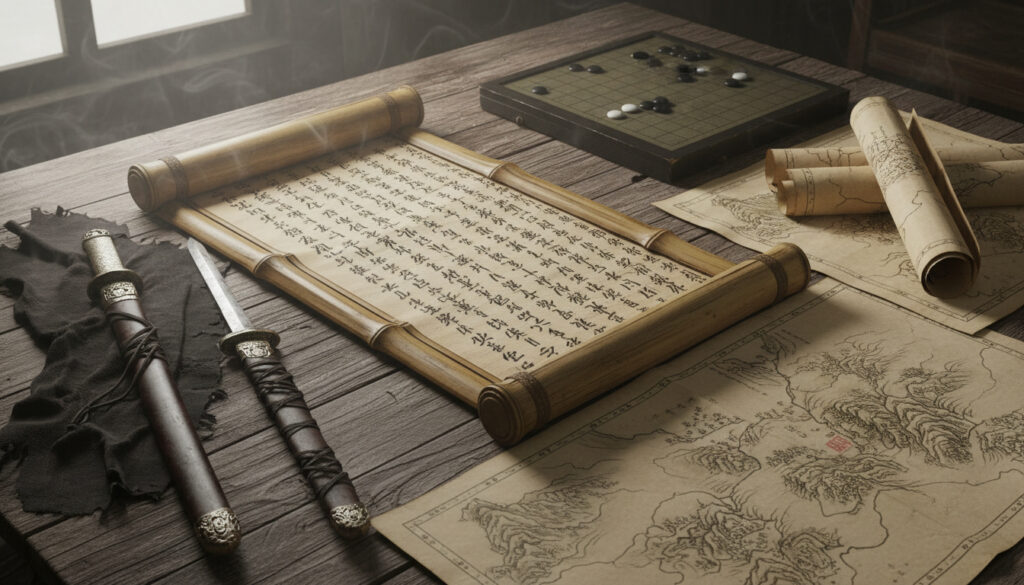
| Discovery | Bamboo slips (Eastern Han dynasty) |
Who Wrote The Art of War and What is Its History?
The origins of The Art of War remain intertwined with both historical fact and scholarly debate. Traditional accounts credit the work to Sun Tzu, a military strategist allegedly serving King Helü of Wu during the turbulent Warring States period. However, the sparse historical record from this era leaves room for uncertainty regarding the author’s exact identity and the text’s compilation timeline.
The Historical Figure
According to tradition, Sun Tzu hailed from the state of Qi before offering his strategic services to Wu. The text itself suggests an author steeped in practical military command, offering specific advice on troop movements, supply lines, and intelligence operations that imply firsthand battlefield experience. Britannica’s historical analysis maintains that while Sun Tzu’s existence is traditionally accepted, specific biographical details remain scarce.
Questions of Authorship
Modern scholarship debates whether Sun Tzu represents a single historical individual or a composite figure representing collective military wisdom compiled over generations. Some theorists suggest the text may have been assembled later than the 5th century BCE, though archaeological discoveries of bamboo slips from the Eastern Han dynasty confirm the text’s ancient origins. SparkNotes analysis notes that debates focus on compilation history rather than outright rejection of the text’s antiquity.
While the exact dating and single authorship remain subjects of academic discussion, the cohesive strategic philosophy and historical manuscript evidence confirm The Art of War as an authentic ancient Chinese military manual transmitted through both oral and written traditions.
What Are the Main Principles and Chapters?
The Art of War organizes its teachings into thirteen distinct chapters, each addressing specific facets of military operations. The progression moves from strategic planning through tactical execution to intelligence gathering, creating a comprehensive framework for warfare.
The 13 Chapters
The text begins with “Laying Plans,” establishing five fundamental factors: Moral Law, Heaven, Earth, Commander, and Method/Discipline. Chapter summaries indicate this section introduces the famous maxim that all warfare is based on deception. Subsequent chapters cover resource management (“Waging War”), strategic attack methods (“Attack by Stratagem”), and tactical positioning (“Tactical Dispositions”).
Later sections address specific operational concerns: “Energy” discusses resource management through direct and indirect tactics, while “Weak Points and Strong” emphasizes striking vulnerabilities rather than strengths. The final chapters progress through terrain analysis (“Terrain,” “The Nine Situations”), specific tactics (“The Attack by Fire”), and culminate in “The Use of Spies,” which details five categories of intelligence agents: local, inward, converted, doomed, and surviving.
Core Strategic Doctrines
Several unifying principles emerge across the chapters. The hierarchy of engagement prioritizes disrupting enemy plans over direct confrontation, with sieges representing the least desirable option. Numerical superiority guidelines suggest specific ratios: ten-to-one for surrounding, five-to-one for attacking, and two-to-one for dividing forces. Detailed chapter analysis confirms the text consistently returns to the superiority of intelligence and preparation over mere troop numbers.
Chapter Three establishes five prerequisites for success: knowing when to fight and when not to fight; understanding how to handle superior and inferior forces; cultivating unity of spirit throughout ranks; preparing adequately while waiting for the enemy; and preventing sovereign interference in field command.
What Are Famous Quotes from The Art of War?
The text’s aphoristic style has produced numerous quotations that resonate beyond military contexts. These passages emphasize strategic thinking over violent confrontation.
“If you know the enemy and know yourself, you need not fear the result of a hundred battles. If you know yourself but not the enemy, for every victory gained you will also suffer a defeat. If you know neither the enemy nor yourself, you will succumb in every battle.”
— Chapter 3, Attack by Stratagem
“Supreme excellence consists in breaking the enemy’s resistance without fighting.”
— Chapter 3, Attack by Stratagem
“All warfare is based on deception.”
— Chapter 1, Laying Plans
Additional strategic insights include the directive to “begin by seizing something which your opponent holds dear,” and the observation that “the skillful leader subdues the enemy’s troops without fighting.” Strategic summaries highlight these quotes as central to the text’s philosophy of efficient victory.
While often quoted in aggressive contexts, Sun Tzu’s text actually advocates for avoiding battle when possible. The “Art of War” is fundamentally about deterrence and bloodless strategic victory rather than mere combat prowess.
Is The Art of War Still Relevant Today?
The treatise’s influence extends far beyond ancient Chinese military history. Its principles have been applied to Vietnam War tactics, corporate competition strategies, and athletic coaching methodologies. The text’s translation into dozens of languages since Lionel Giles’ 1910 English version has cemented its status as a global strategic manual.
Military and Political Influence
Military leaders continue studying the text for asymmetric warfare applications. The emphasis on intelligence, deception, and exploiting enemy weakness rather than engaging strength aligns with modern guerrilla and cyber warfare tactics. Political strategists reference the work’s guidance on alliance formation and timing. Historical influence records document its use across multiple continents and centuries.
Business and Leadership Applications
Corporate strategists treat market competition through Sun Tzu’s framework. “Spies” translate to market research; “terrain” becomes market positioning; “deception” manifests as competitive misdirection regarding product launches. Business adaptation studies show how avoiding direct price wars (“costly battles”) while seizing key market assets aligns with the text’s resource conservation principles.
The treatise also influences leadership philosophy, particularly regarding the George of the Jungle – Iconic Cartoon’s Enduring Appeal concept of knowing one’s environment, though applied to strategic rather than comedic contexts. For those studying value acquisition in competitive environments, the Gold Cross Necklace – Authentic 14k Buying Guide offers insights into assessing valuable assets—skills equally applicable to strategic resource evaluation in commerce.
When Was The Art of War Written and How Did It Spread?
The text’s journey from ancient China to global prominence follows a trajectory spanning over two millennia.
- : Original composition during China’s Warring States period, traditionally attributed to Sun Tzu’s service under King Helü of Wu.
- : Archaeological discovery of bamboo slip versions confirms the text’s early transmission and authenticity.
- : First Western translation into French by Jesuit missionary Jean Joseph Marie Amiot, introducing European audiences to Chinese strategic thought.
- : Lionel Giles publishes the first complete English translation, establishing the standard reference for Anglophone readers.
- : Widespread adoption in military academies and subsequent application to business strategy during the corporate expansion era.
- : Continued relevance in cybersecurity, sports psychology, and competitive gaming strategies.
What Do We Know for Certain About The Art of War?
Separating established fact from scholarly debate helps readers understand the text’s historical position.
| Established Information | Information That Remains Unclear |
|---|---|
| The text consists of 13 chapters covering military strategy | Whether Sun Tzu was a single historical individual or a composite figure |
| Written in Classical Chinese during the Warring States period | Exact date of composition (ranges from 6th to 4th century BCE) |
| Bamboo slip manuscripts confirm ancient origins | Extent of later editorial additions or compilations |
| First Western translation appeared in 1772 | Specific biographical details of the attributed author |
| Widely accepted as authentic ancient military philosophy | Original oral vs. written transmission methods |
Why Did Sun Tzu Write The Art of War?
The text emerged during the Warring States period (475–221 BCE), an era characterized by constant military conflict between rival Chinese kingdoms. This context of sustained warfare necessitated sophisticated strategic thinking beyond mere tactical instruction. The treatise provided commanders with frameworks for achieving decisive victories while minimizing resource depletion and troop casualties—critical concerns for states engaged in prolonged multi-front conflicts.
Philosophically, the work reflects Daoist and Legalist influences prevalent during this period, emphasizing harmony with natural conditions (terrain, weather) and the strict discipline of command structures. The text was written not merely as a combat manual, but as a guide for statecraft and survival in an environment where military defeat meant annihilation.
Where Does Our Knowledge Come From?
Contemporary understanding of The Art of War derives from multiple source categories. Archaeological discoveries, particularly the Eastern Han dynasty bamboo slips, provide physical evidence of the text’s ancient transmission. The MIT Classics Archive hosts the public domain Lionel Giles translation, while Project Gutenberg offers accessible digital versions.
“The Art of War is of vital importance to the State. It is a matter of life and death, a road either to safety or to ruin. Hence it is a subject of inquiry which can on no account be neglected.”
— Opening lines, Chapter 1
Modern scholars also reference Chinese Text Project archives for original language analysis and comparative manuscript studies.
What Are the Essential Lessons from The Art of War?
The Art of War offers a strategic paradigm emphasizing preparation over confrontation, intelligence over assumption, and adaptation over rigidity. Its thirteen chapters provide a framework for analyzing competitive environments, whether military, commercial, or personal. The text’s ultimate lesson—that the highest form of victory requires no battle—challenges contemporary notions of zero-sum competition. Gold Cross Necklace – Authentic 14k Buying Guide readers might recognize parallel principles in evaluating precious commodities: knowledge of authenticity markers prevents costly errors, mirroring Sun Tzu’s emphasis on foreknowledge.
Frequently Asked Questions
Where can I read The Art of War online?
Complete English translations are available through Project Gutenberg, the MIT Classics Archive, and the Chinese Text Project. These sources offer the Lionel Giles translation and original Classical Chinese texts.
What are key takeaways from The Art of War?
Prioritize intelligence over force, understand yourself and your opponent thoroughly, choose battles carefully, use deception strategically, and aim for bloodless victories through superior positioning.
Is Sun Tzu a real historical person?
Tradition holds Sun Tzu was a general from Qi who served King Helü of Wu around the 5th century BCE. While his historical existence is widely accepted, specific biographical details remain uncertain due to limited contemporary records.
How long is The Art of War?
The text comprises thirteen concise chapters. Most complete English translations span approximately 60-100 pages, depending on annotation and commentary included.
Can The Art of War be applied to everyday life?
Yes. The text’s principles regarding preparation, understanding competition, conserving resources, and strategic positioning apply to career development, negotiations, and personal goal achievement beyond military contexts.
More related posts
 Nancy Drew: Story, Fame, Age Appropriateness & More
 Jessica Jones Powers, Origin & Strength Comparisons
 François Arnaud: Relationship Rumors, Unfollow Drama, and Career
 Ni-Ki Enhypen: Profile, Height, Age, and Facts (2025)
 Caitlin Foord: Age, Height, Partner, Arsenal Stats
 Nelson Peltz: How He Built His Billion-Dollar Family Empire
 Thomas Frank: Tottenham Exit, Salary & Future Plans
 Peter Griffin: Disability, Ethnicity, Famous Lines & More