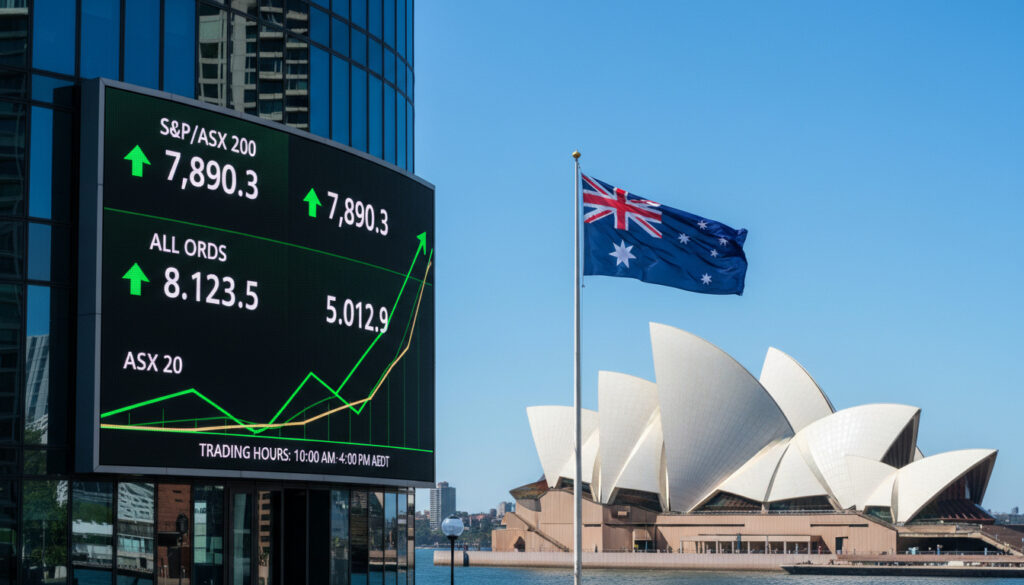
Australian Stock Markets – ASX Guide, Indices and Hours
The Australian Securities Exchange operates as the nation’s primary venue for equity trading, providing fully integrated access to equities, derivatives, and fixed income instruments. With approximately 2,000 listed entities spanning mining, banking, and resources sectors, it serves as the central hub for domestic and international capital allocation in the Asia-Pacific region.
Market participants track performance through two dominant benchmarks: the S&P/ASX 200, which captures large-cap movements, and the broader All Ordinaries Index. Regulatory oversight from the Australian Securities and Investments Commission ensures compliance with disclosure and auditing standards, while trading sessions follow strict temporal protocols designed to balance accessibility with market stability.
What is the Australian Stock Market and the ASX?
ASX Limited
S&P/ASX 200
~2,000+ companies
10am–4pm AEST
- The ASX functions as Australia’s sole primary securities exchange, facilitating trade in equities, derivatives, and fixed income products through a fully integrated electronic platform.
- The S&P/ASX 200 represents approximately 80% of Australia’s equity market capitalization, utilizing float-adjusted weighting to determine constituent rankings.
- The All Ordinaries Index provides broader market exposure, tracking the top 500 companies and requiring audited financial disclosures for inclusion.
- ASIC maintains comprehensive regulatory oversight, enforcing strict disclosure rules, auditing standards, and investor protection protocols.
- Sector composition differs significantly from U.S. markets, with heavy weighting toward materials and financials rather than technology.
- Listing requirements mandate minimum market capitalization thresholds (A$15 million for certain tiers), shareholder spread of 300+ holders, and profitability testing.
| Metric | Value | Source |
|---|---|---|
| Open Hours | 10:00 AM – 4:00 PM AEST/AEDT | Market Operations |
| Major Index | S&P/ASX 200 | S&P Global |
| Secondary Index | All Ordinaries (Top 500) | Academic Research |
| Regulator | ASIC | Official Registry |
| Market Coverage | ~80% large-cap capitalization | Index Methodology |
| Listed Entities | 2,000+ companies | Exchange Data |
| Minimum Market Cap | A$15 million (certain tiers) | Listing Requirements |
| Primary Sectors | Mining, Banking, Resources | Market Analysis |
| Trading Currency | Australian Dollar (AUD) | ASX Official |
| Auction Periods | 10 min pre-market, 10 min close | Trading Protocols |
What Are the Major Australian Stock Indices?
The S&P/ASX 200 Benchmark
Launched in 2000, the S&P/ASX 200 serves as the primary institutional benchmark for Australian equity performance. The index tracks the 200 largest companies ranked by float-adjusted market capitalization, meaning only shares available for public trading count toward weightings. This methodology prevents distortion from tightly held corporate stakes.
Constituents undergo quarterly rebalancing to reflect changes in market value and liquidity. The index covers approximately 80% of total Australian equity market capitalization, providing concentrated exposure to the nation’s economic drivers while excluding smaller speculative listings.
The All Ordinaries Index
Established in 1980 as the top 300 companies and later expanded to 500, the All Ordinaries utilizes a price-weighted methodology rather than float-adjustment. This broader index captures mid-cap opportunities often excluded from the ASX 200, though it requires constituents to meet stringent disclosure standards including audited financials and analyst coverage metrics.
Investors seeking large-cap stability typically reference the S&P/ASX 200, while those requiring broader diversification across mid-tier enterprises utilize the All Ordinaries. Both indices exclude companies failing to maintain continuous disclosure obligations enforced by ASIC.
ASX Trading Hours and How to Get Started Investing
Standard Trading Sessions
The exchange operates Monday through Friday, excluding national public holidays, from 10:00 AM to 4:00 PM Sydney time. Sessions commence with a 10-minute pre-market auction beginning at 10:00 AM, facilitating price discovery before continuous trading begins. The closing auction runs from 4:00 PM to 4:10 PM, establishing final daily prices through consolidated order matching.
Accessing Markets for Beginners
New participants typically access ASX-listed securities through online brokerage platforms offering execution in exchange-traded funds tracking the S&P/ASX 200 or individual equities. Entry requirements include opening a CHESS-sponsored brokerage account, understanding basic terminology regarding share units versus derivatives, and monitoring economic indicators including Reserve Bank cash rate decisions.
Index-tracking products allow beginners to mimic broad market performance without selecting individual securities, reducing concentration risk in volatile sectors like mining or energy. Educational resources emphasize fundamental analysis of company disclosures and macroeconomic trends before deploying capital.
Continuous trading occurs between the opening and closing auctions, though order modification capabilities remain available during auction periods. Time zone variations require international investors to convert AEST/AEDT to local time, particularly during daylight saving transitions affecting Sydney clocks.
Current Performance and Regulation of Australian Markets
Recent Market Conditions
Recent volatility stems from imported energy inflation pressures, Reserve Bank monetary policy adjustments following quarterly CPI releases, and global commodity price fluctuations. The Federal Reserve’s maintained rate position at 3.50%–3.75% creates cross-border capital flow implications for Australian dollar-denominated assets. Market focus has shifted from speculative technology valuations toward industrial resilience and return-on-equity metrics among established listings.
ASIC Oversight and Compliance
The Australian Securities and Investments Commission enforces continuous disclosure regimes requiring immediate reporting of material price-sensitive information. Listed entities must submit annual and interim financial reports meeting Auditing and Assurance Standards Board protocols. ASIC maintains authority to investigate breaches of listing rules, including failures to maintain adequate shareholder spread or audited financial documentation.
Performance remains sensitive to geopolitical disruptions affecting commodity export routes, particularly through the Strait of Hormuz, and China’s Five-Year Plan industrial demand fluctuations. Energy price shocks and rapid Reserve Bank rate adjustments may trigger heightened volatility not fully predictable through historical modeling.
History of the Australian Securities Exchange
-
All Ordinaries Index established, originally tracking the top 300 companies with price-weighted methodology -
Introduction of computerized trading systems replacing floor-based open outcry methods -
S&P/ASX 200 launched, replacing previous benchmarks as the primary float-adjusted large-cap index -
ASX demutualized and listed on its own exchange, transitioning from member-owned organization to publicly traded corporation
What We Know and What Remains Uncertain
Established Information
- ASIC maintains statutory authority over all listed entities and disclosure requirements
- Trading hours remain fixed at 10:00 AM–4:00 PM AEST/AEDT excluding public holidays
- Listing rules mandate audited financials and minimum shareholder spread thresholds
- The S&P/ASX 200 utilizes float-adjusted market capitalization weighting
Information That Remains Unclear
- Real-time pricing data for specific future dates remains unavailable in current datasets
- Exact daily fluctuations in total listed company counts vary based on delistings and new IPOs
- Future impact of sustained energy price shocks on mining sector valuations
- Precise timing of Reserve Bank rate adjustments following upcoming CPI releases
How Australian Markets Fit in the Global Landscape
The ASX lists approximately 2,000 companies, making it smaller than the New York Stock Exchange (~2,400 listings) or Nasdaq (~3,000), yet it retains significant regional importance within Asia-Pacific capital allocation. Unlike U.S. markets dominated by technology and artificial intelligence sectors, Australian indices emphasize materials, energy, and financial services reflecting the nation’s resource-based economy.
International investors monitor Spy Share Price movements for comparative U.S. market context, though ASX correlations with S&P 500 performance vary based on commodity cycle positioning. Chinese industrial demand and global shipping lane stability directly impact Australian resource exporter valuations, creating distinct risk profiles from Northern Hemisphere technology-focused exchanges.
Authority and Verification
The Australian Securities and Investments Commission regulates the ASX, enforcing disclosure rules including annual and interim reports, segment data for All Ordinaries companies, and auditing standards via the Auditing and Assurance Standards Board.
Key Takeaways on Australian Stock Markets
The Australian Securities Exchange provides integrated access to approximately 2,000 companies through regulated trading sessions operating 10:00 AM to 4:00 PM Sydney time. Major indices including the S&P/ASX 200 and All Ordinaries offer distinct large-cap and broad-market exposure, while ASIC oversight ensures continuous disclosure compliance. Investors seeking diversified entry points should consider index-tracking ETFs and monitor monetary policy decisions from the Reserve Bank. Those managing international portfolios may also review Best Travel Credit Cards No Fees for cross-border financial efficiency.
Common Questions
How does the ASX compare to other global markets?
The ASX lists approximately 2,000 companies, smaller than NYSE (~2,400) or Nasdaq (~3,000), but focuses heavily on mining and financial sectors rather than U.S. technology concentrations.
What is the minimum investment required to trade on the ASX?
No statutory minimum exists, though individual brokers may require account funding thresholds. Practical minimums depend on share prices and brokerage fees, often making ETFs attractive for smaller portfolios.
Can non-residents invest in Australian stock markets?
Yes, international investors may access ASX-listed securities through brokerages offering international trading accounts, subject to tax reporting requirements in their jurisdiction of residence.
Which sectors dominate the ASX 200?
Financial services and materials (mining/resources) constitute the largest weightings, differing from technology-heavy U.S. indices. Healthcare and consumer discretionary sectors provide secondary exposure.
How frequently do the indices rebalance?
The S&P/ASX 200 undergoes quarterly rebalancing to adjust for float changes and market capitalization movements, while All Ordinaries constituents update based on ongoing disclosure compliance and market value rankings.
What role does the RBA play in market performance?
Reserve Bank cash rate decisions directly impact financial sector profitability and broader economic activity, with rate adjustments typically triggering immediate volatility in banking stocks and index movements.
More related posts
 Bobby Hill: Everything About the King of the Hill Character
 Women’s Cardigan Guide: Styles, Where to Buy, Care Tips
 Nike Pegasus 40 Review: Comparisons, Specs & Guide
 Marta Kostyuk: Biography, Ranking, and Handshake Controversy
 Coles Upper Coomera – Opening Hours, Address and Store Info
 Jude York: Australian Singer Biography, Age, Music Career
 Pokémon Packs Guide 2026: What’s Available, Worth, and Rare Cards
 Lee Hanson: Politician, Daughter, and the 9/11 Victim