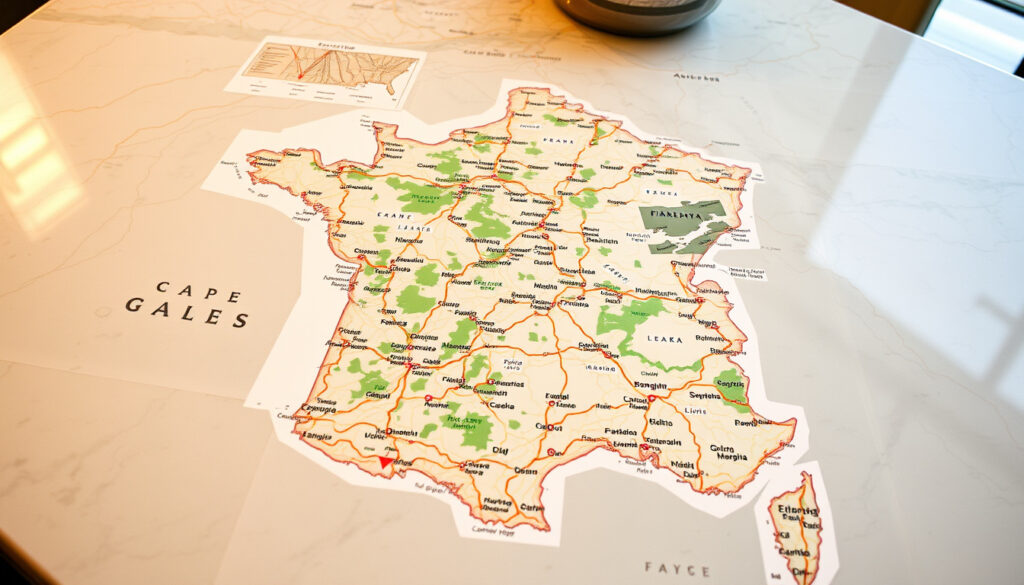
Map of France: Cities, Regions, Google & Detailed Guides
Whether you’re plotting a road trip through Provence or just trying to understand why your package keeps routing through Lyon, a solid map of France makes all the difference. France’s administrative geography is a bit of a puzzle: 13 regions on the mainland, 27 if you count the overseas territories, and more than 36,000 communes scattered across the whole.
Regions: 27 total (13 mainland) · Departments: 101 · Land Area: 551,695 km² · Population: 64.5 million
Quick snapshot
- 13 mainland regions, 27 total including overseas (Map-France.com)
- 101 departments split across metropolitan France (Map-France.com)
- 36,699 communes as of 2023 (Map-France.com)
- No official government interactive map URL confirmed (Map-France.com)
- Mobile app feature availability for specialized maps varies (Google Maps)
- 2016 reform consolidated 22 mainland regions into 13 (LinkParis.com)
- Google Maps France coverage active since 2005 (Google Maps)
- Continued expansion of interactive mapping tools (MapChart.net)
- Increased offline map availability for travelers (NationsOnline.org)
France’s key geographic and administrative data at a glance:
| Attribute | Value | Source |
|---|---|---|
| Capital City | Paris | Ezilon.com |
| Largest City | Paris (2.1M) | Ezilon.com |
| Regions (mainland) | 13 | LinkParis.com |
| Regions (total incl. overseas) | 27 | Map-France.com |
| Departments | 101 | Map-France.com |
| Total Area | 643,801 km² | NationsOnline.org |
| Communes | 36,699 | Map-France.com |
Map of France with Cities and Regions
France divides its territory into regions for both administrative and planning purposes, and most maps that show “cities and regions” will display the major urban centers alongside these administrative boundaries. The distinction matters: metropolitan France has 13 regions on the mainland, while including overseas territories pushes the total to 27 regions.
Major Cities
Three cities dominate most France maps: Paris, Marseille, and Lyon. Paris sits in the Île-de-France region and is marked distinctly on nearly every map type, often with a special symbol to denote its status as national capital.
According to Ezilon.com (geographical reference publisher), Paris is “marked with a red square on many maps” to highlight its significance. Marseille serves as France’s second-largest city and a major Mediterranean port, while Lyon acts as a key crossroads between northern and southern France.
Administrative Regions
The 2016 regional reform consolidated metropolitan France from 22 regions into the current 13. Northern France includes regions like Brittany, Normandy, Pays de la Loire, and Hauts-de-France, while the south features Provence-Alpes-Côte d’Azur, Occitanie, and Nouvelle-Aquitaine.
Interactive maps on sites like LinkParis.com (travel guide specializing in France) allow users to click directly on regions to access details about each area. These tools shade departments and use bold typography to distinguish major cities from smaller towns.
Interactive Views
Dedicated mapping sites like Ezilon.com (geographical reference publisher) and LinkParis.com (travel guide specializing in France) offer interactive maps where users can zoom, click regions, and explore city locations.
Map of France with Towns and Villages
Beyond the major cities, thousands of smaller settlements dot the French landscape. A map designed for countryside travel needs to show towns and villages in detail, not just the urban centers.
Rural Areas
France has 36,699 communes—the smallest administrative units—which range from tiny Alpine villages to mid-sized market towns. Map services like MapChart.net (custom mapping tool) allow users to customize views down to the department level, making it possible to focus on specific rural areas without visual clutter from distant regions.
Small Settlements
Detailed maps from sites like Ezilon.com show not just regional capitals but also secondary towns, with size graduated based on population.
These maps are particularly useful for travelers planning routes through less-touristed areas where GPS routing might not pick up smaller roads.
Zoomable Details
Google Maps and platforms like Satellites.pro (Google-based mapping service) support zooming from national level down to street view, revealing smaller towns and village names as you zoom in.
The trade-off is that Google Maps doesn’t offer a built-in “regions” filter—you search for specific locations rather than clicking on administrative areas.
Google Maps prioritizes real-time navigation over administrative boundaries. For regional context, dedicated geography sites like Map-France.com (administrative mapping reference) offer clearer territorial divisions.
Google Map of France
Google Maps remains the most accessible and widely used mapping tool for France, but understanding what it offers—and what it doesn’t—helps set expectations.
Basic Navigation
The Google Maps interface (primary interactive map service) provides a standard starting point for any France-based search. Type “France” and you’ll see the country outline with major cities marked.
The search function works for cities, regions, addresses, and businesses, but the map itself doesn’t highlight regional administrative boundaries by default.
Satellite View
Switching to satellite view reveals France’s topography—the Pyrenees along the Spanish border, the Alps in the southeast, and the Rhine valley in the east.
Rivers like the Loire, Seine, and Rhône appear clearly on satellite imagery, providing context that political maps may not emphasize.
Street Level
For urban areas, Google’s Street View coverage in France is extensive, particularly in Paris and other major cities. This enables virtual exploration of neighborhoods and landmarks before visiting in person.
NationsOnline.org (geographic reference resource) notes that their maps show “region capitals, major cities, expressways” alongside Google-based imagery for a fuller picture.
Google Maps works best as a navigation tool for France, but pair it with a dedicated geography site when you need to understand regional or departmental boundaries.
Detailed Map of France
“Detailed” can mean several things—physical geography, political boundaries, or topographic features. Understanding which details matter for your purpose narrows the map choice significantly.
Physical Features
Physical maps emphasize natural terrain: mountain ranges (Alps, Pyrenees, Massif Central, Vosges), major river systems, and coastal contours. NationsOnline.org (geographic reference resource) provides maps that combine political and physical elements.
France’s borders with eight countries appear clearly: Andorra, Belgium, Germany, Italy, Luxembourg, Monaco, Spain, and Switzerland, alongside maritime borders with the UK.
Political Boundaries
Political maps focus on administrative divisions—regions, departments, arrondissements, cantons, and communes. Map-France.com (administrative mapping reference) offers detailed breakdowns: 27 regions, 101 departments, 343 arrondissements, 4,058 cantons, and 36,699 communes. These maps are essential for understanding governance structures or for administrative correspondence.
Topography
Topographic maps add elevation data, useful for hiking or understanding terrain difficulty. Geological features like mountain ranges and river valleys appear in greater detail, with contours showing altitude changes.
Sites focusing on geography, like MapChart.net (custom mapping tool), allow users to create custom department-level maps that can highlight specific areas of interest.
The difference between physical and political maps isn’t cosmetic—it reflects different use cases. A traveler needs different information than someone filing administrative paperwork or studying regional economics.
Tourist Map of France with Towns
Tourist-focused maps prioritize visitor experience: scenic routes, major attractions, accommodation areas, and transportation connections rather than strict administrative boundaries.
Attractions
Many tourist maps from sites like TravelFranceBucketList.com (tourism-focused guide) highlight region-specific attractions—wine regions like Bordeaux and Burgundy, coastal destinations like the Riviera, and cultural hubs like the Loire Valley châteaux.
Roads and Transport
Transport-focused tourist maps emphasize major highways (autoroutes), scenic routes (routes départementales), train lines (TGV network), and ferry connections. These maps overlap significantly with cities and regions maps but add layers specifically relevant to travelers: rest areas, toll booths, and scenic overlooks.
Points of Interest
The best tourist maps distinguish between must-see destinations and lesser-known spots. DotsonMaps.com (interactive regional guide) provides focused guides for specific areas like Northern France, with suggestions that go beyond the standard Paris-Lyon-Marseille circuit.
Upsides
- Free access to comprehensive mapping tools
- Multiple map types serve different needs (navigation, planning, exploration)
- Zoomable interactive maps reveal details at any scale
- Satellite and terrain views add physical context
Downsides
- No single official government interactive map URL
- Google Maps lacks administrative boundary layers by default
- Real-time data may vary in coverage for rural areas
- Offline access requires advance downloading
“France is divided into 13 distinct regions, each with its own unique charm and character.”
— LinkParis.com (travel guide specializing in France)
“France mainland has 13 regions and choosing the wrong one for your travel style can mean missing the best the country has to offer.”
— TravelFranceBucketList (French local expert resource)
Related reading: Qantas Flight Tracker Live Maps · Chemist Warehouse Bondi Junction Map
Frequently asked questions
What is the best free map of France?
The best choice depends on your need: Google Maps for navigation and real-time data, Map-France.com for administrative boundaries, and Ezilon.com for combined political and physical geography. Each serves different purposes—pairing two or three gives the most complete picture.
How many regions are in France?
Metropolitan France has 13 regions on the mainland. Including overseas territories (Guadeloupe, Martinique, French Guiana, Réunion, Mayotte), France has 27 regions total as of 2023.
What are France’s major cities?
The three largest cities are Paris (the capital, population approximately 2.1 million in the city proper), Marseille (major Mediterranean port), and Lyon (key crossroads city). These three appear prominently on nearly every France map.
Are there offline maps of France?
Google Maps supports offline downloading for navigation without data connection. Dedicated mapping sites like MapChart.net allow you to create and download custom maps for offline reference. For extended travel, downloading multiple regional maps in advance ensures coverage in areas with limited connectivity.
What map shows France’s physical features?
Physical maps from NationsOnline.org and Ezilon.com show mountain ranges (Alps, Pyrenees, Massif Central, Vosges), major rivers (Seine, Loire, Rhône, Garonne), and coastal geography. Satellite views on Google Maps also reveal topography effectively.
How to zoom into France regions on Google Maps?
Search for a specific region name (e.g., “Provence-Alpes-Côte d’Azur”) to center the map on that area, then use the zoom controls or pinch gestures to examine details. Google Maps doesn’t shade regions automatically, but searching by name achieves similar visual results.
Is there a simple outline map of France?
Yes. Google Maps and most mapping sites offer default country-level views showing France’s outline without detailed annotations. For clean outline maps suitable for presentations or educational use, MapChart.net allows creating minimalist political boundary maps.
France’s mapping ecosystem offers tools for every level of specificity—from planning a route between major cities to understanding the nuances of 36,000 communes across metropolitan and overseas territory. Travelers, researchers, and anyone navigating France’s administrative complexity will find that matching the map type to their actual need—navigation, administrative planning, or geographical understanding—makes all the difference.
More related posts
 English to Tagalog Translator – Best Tools Compared
 No Doubt Band: History, Members, Songs & Tragedies
 Na’vi Language and Culture: Complete Guide
 Isaah Yeo: Injury, Salary, Family & Heritage Full Bio
 Mia Malkova: Biography, Age, Career, and Current Activities
 Trent Cotchin: What He Does Now, Wife, Net Worth & Retirement
 Cole Hauser: Net Worth, Yellowstone Role, and Relationships
 Lucky Blue Smith Biography: Age, Wife, Kids, Net Worth