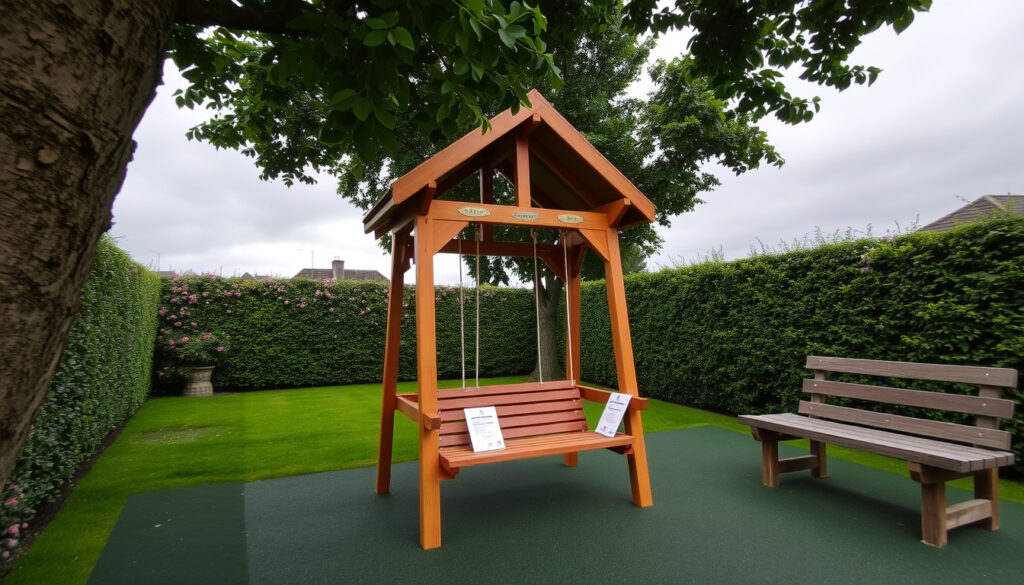
Swing Sets for Ireland: Brands, Safety & Buyer’s Guide
You know that feeling when the kids are climbing the walls and the garden calls for something better than a damp patch of grass? Choosing a swing set feels like it should be simple, but the minute you start weighing wood against metal, or wondering if the grass underneath is really safe, the questions pile up. This guide is for anyone in Ireland trying to make sense of it all—we’ll cut through the marketing fluff and look at what actually matters for safety, durability, and value in an Irish garden. Whether you’re a parent setting up a set for toddlers or a school committee planning a public play area, you’ll leave with clear, source-backed answers to the most important questions. Oh, and with Irish weather in mind, we’ve got you covered.
Snapshot of Key Facts
- Wooden sets: 10–15 years lifespan.
- Metal sets can last over 20 years with care.
- Grass and concrete are not safe under swings.
- Recommend depth: 30 cm of loose fill or rubber tiles.
- I.S. EN 1176-2:2017 is the Irish swing safety standard.
- No legal requirement for home garden surfacing, but best practice exists.
- Typical cost for a backyard swing set: €500–€2,500+.
- Installation and surfacing add extra.
Swing Type: Wooden · Average Cost: €500–€1,800 · Wooden Lifespan: 10–15 years · Metal Lifespan: 15–20+ years · Clearance Behind: 1.8–2.5 m minimum
Top-Rated Outdoor Swings: What Actually Matters?
When you search for the “top-rated” swings, you’ll find plenty of e-commerce lists and brand rankings. But a truly top-rated swing in Ireland is one that matches your garden size, your child’s age, and your safety expectations. It’s not about a single best brand—it’s about the right fit for your space and your family.
Here’s a quick look at what separates a good purchase from a regrettable one, based on our research across Irish retailers and standards bodies.
| Feature | Wooden Swing Sets | Metal Swing Sets |
|---|---|---|
| Durability | 10–15 years lifespan, requires annual sealing | 15–20+ years, galvanized anticorrosion coating |
| Cost | €700–€2,500 | €500–€1,500 |
| Safety | Can crack, check for splinters and loose bolts | Heats up in sun, check for sharp edges and rust |
| Maintenance | High: restain, sand, replace wood parts | Low: wipe down, check for rust, re-tighten bolts |
| Appearance | Natural, blends into garden | Modern, often lower visual impact |
So, for an Irish back garden, the choice of material affects both the look and the work you’ll have to do. Wood gives a natural aesthetic but demands seasonal maintenance; metal is lower-effort but consider the heat of direct sunlight and rust in the wet winter.
If you’re short on time, the biggest single decision is not the brand but the material.
Understanding Safety Standards and Irish Regulations
In Ireland, if you’re buying a set for a creche, school, or public park, the equipment must meet I.S. EN 1176, the European standard for playground equipment. According to the Government of Ireland’s “Ready, Steady, Play!” guide, this includes strict rules on swing height, surfacing depth, and clearance zones. For home use, it’s a voluntary code, but one you should take seriously.
For home gardeners, the law is surprisingly silent—Green Tree Play notes there is no specific legal requirement for safety surfacing in domestic garden contexts. However, that doesn’t mean you should ignore physics. The U.S. Consumer Product Safety Commission (CPSC) recommends using at least 30 cm of loose fill material (like wood mulch or pea gravel) or a rubber tile system beneath any swing, as impact with the ground causes most injuries.
What is I.S. EN 1176?
The I.S. EN 1176-2:2017 is the Irish edition of the European swing standard. It specifies, for example, that a standard swing’s minimum ground clearance at rest is 350 mm, and it introduced new requirements for chain tension to stop children reaching the links.
- Check your set for this standard’s mark.
- Follow the minimum space requirements for swings in motion.
- Read safety warnings about overhead clearance.
In practice, the standard gives you a checklist for what a safe swing set should look like, even if you buy a cheaper set without full certification.
Ireland’s Own “Ready, Steady, Play” Code
The Government of Ireland’s “Ready, Steady, Play!” document is aimed at schools and childcare providers, but it’s a great benchmark. It details how safety surfacing in Ireland should match the maximum fall height of the equipment, and that concrete, asphalt, or even compacted earth under a swing is dangerous.
This brings up a crucial insight: a swing set is not just a purchase, it’s an installation.
Metal vs. Wood: Which is the Better Long-Term Investment?
The eternal garden debate: natural wood or low-maintenance metal? The answer in Ireland combines a bit of both—because rain and moody weather test everything.
Let’s compare them side by side, then get into the details.
| Aspect | Wooden Swing Sets | Metal Swing Sets |
|---|---|---|
| Longevity | 10–15 years (with re-treatments) | 15–20 years (galvanized) |
| Initial cost | Higher (€1,000–€2,500) | Lower (€500–€1,200) |
| Maintenance hours/year | 10–20 hours (sand, stain, replace boards) | 2–3 hours (wash, check bolts, rust touch-up) |
| Safety in use | Stable, wooden surfaces can splinter if not sanded | May have sharp edges; conducts heat/cold, gets slippery when wet |
| Environmental impact | Sustainable, natural material, compostable at end of life | Recyclable, but higher initial CO2 footprint |
From a straight cost-per-year perspective, metal is the winner if you don’t enjoy upkeep. If you value natural aesthetics and don’t mind an annual re-stain, wood provides a classic look.
When thinking about lifespan, consider the Irish climate. Entrance Matting Ireland, a playground professional, warns that wet weather accelerates rot in wood if it’s not treated properly, while metal can develop surface rust in coastal areas.
Why Metal Sets in Ireland Hit a Sweet Spot
Given our rain and unpredictable winters, a galvanized metal set is incredibly practical. The new modern sets can be powder-coated in fun colors, and they don’t absorb moisture so they dry faster.
But wait, what about the danger of getting too cold or too hot?
Planning Your Installation: Safety Surfacing & Clearance Zones
So, you’ve picked your swing set. The next step is not assembling—it’s prepping the ground. This is the part most people mess up, and the part that absolutely must follow safety rules.
Why Grass Is Not a Playground Surface
It’s tempting to put a swing set on the lawn. But grass is often harder than you think, and over time, it wears down into a hard, slippery mud patch. Entrance Matting Ireland advises that concrete, asphalt, or even soil under a swing set is a “must avoid”. Their rule of thumb is that you should never have a hard surface under any equipment higher than 600 mm, because the impact risk is too great.
Instead, you want a “safety surface”—and it doesn’t need to be concrete or pour-in-place rubber if you’re on a budget. Pea gravel, wood mulch, or rubber mats are all good options.
Calculating the Fall Zone and Clearance
For a stationary swing, you need a “clear zone” where a child won’t accidentally walk into their path. The standard says to have at least 1.8 meters of clear space behind the swing (measured from the back of the user to the next object). More is better—many swing sets come with a pre-printed zone guide.
Here’s the lowdown on key numbers:
| Parameter | Recommended Value |
|---|---|
| Minimum clearance behind swing | 1.8–2.5 m |
| Safety surfacing depth (loose fill) | 30 cm (12 inches) |
| Max fall height for play area | Must not exceed equipment’s headroom |
| For baby/toddler swings (2 swings) | Need a top bar at least 12-14 ft (3.6-4.2 m) long |
This sounds like a lot, but it’s the difference between a close call and a trip to A&E when a child runs behind the swing.
Choosing the Right Size and Configuration
Now, for the specifics of what you’ll buy. Do you need a toddler swing, a bucket swing, or a full-on multi-activity tower? The right answer depends on your child’s age.
Toddlers: Low Toddler Swings
For toddlers, entrancematting suggests you should choose low-height sets. This means the swing seat itself is closer to the ground, reducing the fall height. It helps if the seat has a front support bar to stop the little ones from slipping out.
Three-Swing Sets: Better for Siblings
If you have a few kids, you’ll want a set with three swings. That requires a longer top bar—a swing set for three swings needs a top bar at least 12-14 feet long. That’s about 4.2 meters. Measure your garden before you buy, because fitting a 4-meter-long bar in a small plot is a common mistake.
Do you prefer a classic A-frame or a more modern turret design? The shape doesn’t matter much for safety (as long as it’s stable), but it will affect how much space you need.
Should You Build or Buy?
Building your own swing set is a fun DIY project, but if you build it yourself, you have to source the correct fixings, ensure the timbers are structurally sound, and make sure it meets EN 1176 standards on heights and spacing. Most people within a year find that a professionally manufactured set from a known brand like Wickey works out cheaper in mental energy.
Key Brands and Where to Buy in Ireland
While not exhaustive, here are some reliable paths and names that came up in our analysis. We focused on retailers that operate clearly in the Irish market, since shipping costs and support matters.
- Wickey: Known among experts for “very stable” sets with good load capacity. Their own guide notes that “safety is our top priority”.
- Mikado (Family Leisure): These sets are sold in various garden centres like Gardenlife. They have a wide range of metal and wood options for the Irish market.
- Argos / Smyths Toys: For budget-friendly, smaller sets and toddler swings, but check their ground clearance and fall zones.
A quick tip from Ireland’s “Ready, Steady, Play” guide: do not buy a set that says “domestic use only” if you’re planning to open it up to the neighborhood kids—it’s not built for that frequency of use.
Related reading: Red Kangaroo Facts: Size, Behavior, and Safety Guide
creativelandscapingworks.com, greentreeplay.ie, cpsc.gov, wickey.ie, standards.iteh.ai, nda.ie, tvs-group.ie
Frequently Asked Questions
What is the most durable swing set material?
Galvanized metal lasts longest (15–20 years) with minimal maintenance, but wood lasts 10–15 years if you re-stain it every couple of years. Metal sheds rain, but wood can warp and crack in heat waves.
Is it safe to put a swing set on grass?
It’s risky. Grass compresses over time, and it rarely has the necessary 30 cm of cushioning. The safest low-cost surfaces are wood chips, pea gravel, or rubber mats, especially under swings where kids get on and off.
What is the best safety surfacing for a swing set in Ireland?
For Irish rain, rubber tiles or pour-in-place rubber are excellent—they drain well and never degrade. Loose fill like wood mulch is fine, but needs to be replenished annually and checked for compaction.
Do I need a license or planning permission for a backyard swing set?
Generally, no, for a garden under 25 square metres in your private back yard, you don’t need planning permission for domestic outbuildings in Ireland—but large towers with roofs might affect your home insurance. Always check with your local council for strict rules about distance from boundaries (usually 1.5m).
What age is a swing set suitable from?
A toddler swing can be used from 6 months with full back and harness support. A standard belt swing is safe for ages 3+. Always follow the manufacturer’s age range, because they are based on crash test data regarding neck strength and motor skills.
How much space do I need behind a swing?
You need at least 1.8 metres of clear space behind the plane of the swing (where a child can run), and 1.8 metres to the side. For a typical 2-meter swinger, that means the entire set needs about 4 metres by 3 metres of clear space.
Summary: What to Buy for an Irish Garden
There is no single “best” swing set for every Irish garden; the best one is the one that matches your space and your kids’ age, that you anchor correctly, and that has safety surfacing installed beneath it. Prioritise a fence-to-swing clearance of 1.8+ meters, choose a material that works with your maintenance personality, and remember: a concrete-free safety zone is a non-negotiable—so measure carefully before you fall in love with a massive tower. Get those basics right, and you’ve got a place for years of happy memories.
More related posts
 Melbourne Cup Results – Winner, Placings, Prize Money
 Penny Marshall: Cause of Death, Life, Career & Family
 D’Arcy Carden: Biography, Career, Ethnicity, and Family
 Russell Morris: Farewell Tour 2025, Biography & Songs
 White Men Can’t Jump: True Story, Cast, Streaming & 2023 Remake
 Khabib Nurmagomedov: Record, Retirement, Net Worth & Family
 Gold Ring Guide: Divorce, Claddagh & V-Shaped Rings
 Salim Mehajer: What Happened to the Former Deputy Mayor