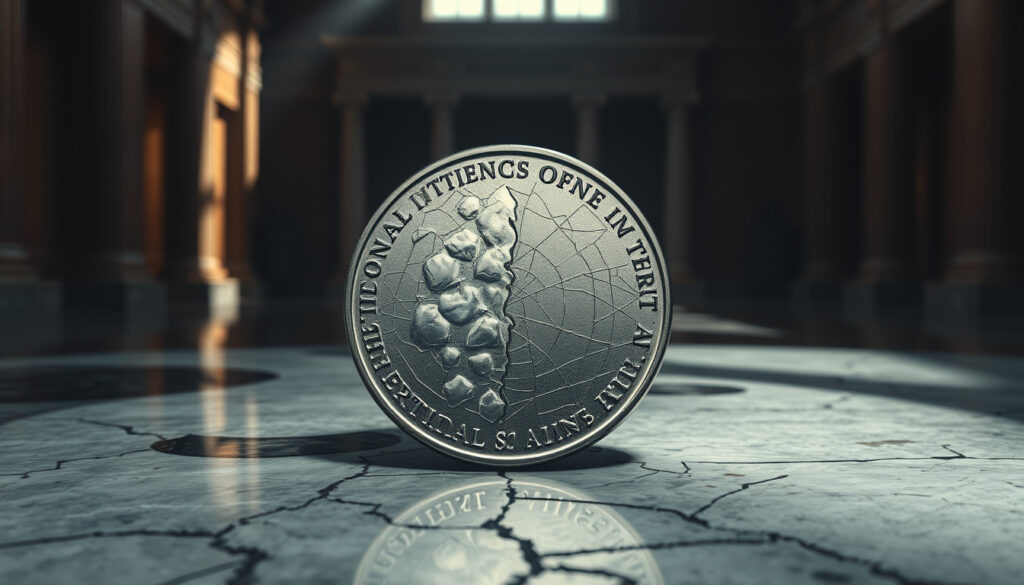
Two-Face: Harvey Dent’s Origin, Mental Illness & Relationships
Harvey Dent’s transformation from Gotham’s ideal district attorney to Two-Face began with a courtroom acid attack that broke his face and his faith in justice. This article traces his fall from white knight to criminal mastermind, the psychological forces that drive him, and why he remains one of Batman’s most tragic enemies.
First Appearance: Detective Comics #66 (1942) ·
Creators: Bob Kane and Bill Finger ·
Real Name: Harvey Dent ·
Affiliation: Batman (formerly), Gotham City underworld ·
Signature: Coin with scratched side
Quick snapshot
- Harvey Dent was Gotham’s district attorney (DC Official Character Page)
- Scarred by acid thrown by Sal Maroni (DC Blog: Making a Dent)
- Splits his coin and begins decisions by chance (Wikipedia)
- Obsession with duality and the number two (DC Blog: Making a Dent)
- Expert marksman and criminal strategist (Wikipedia)
- Uses a double-headed or double-tailed coin (Wikipedia)
- Gilda Dent (wife) (DC Blog: Making a Dent)
- Batman (former ally) (Wikipedia)
- Joker (rival) (Wikipedia)
- The Dark Knight (2008) played by Aaron Eckhart (Warner Bros. Entertainment Wiki)
- Batman: The Animated Series (DC Blog: Making a Dent)
- DC Comics main continuity (Wikipedia)
Six core facts define the character across decades of stories.
| Label | Value |
|---|---|
| Real Name | Harvey Dent |
| First Appearance | Detective Comics #66 (1942) |
| Creators | Bob Kane, Bill Finger |
| Alias | Two-Face |
| Occupation | Former District Attorney, Criminal Mastermind |
| Signature Weapon | A .22 caliber pistol and a two-headed coin |
Why Did Two-Face Become a Villain?
The accident that scarred Harvey Dent
- Harvey Dent was Gotham’s district attorney, a champion of justice (DC Official Character Page).
- During a trial, gangster Sal Maroni threw acid in Dent’s face, scarring half of it (DC Blog: Making a Dent).
- The physical disfigurement triggered a psychological fracture, giving birth to Two-Face (Wikipedia).
The implication: One moment—a splash of acid—erased years of civic dedication and replaced them with a rigid reliance on chance.
Role of trauma and justice system failure
- Dent’s faith in the system collapsed when his own case was exploited (ScreenRant).
- The trauma left him unable to trust his own judgment, outsourcing decisions to a coin (Wikipedia).
- In some tellings, Dent had pre-existing mental health issues that the acid worsened (Warner Bros. Entertainment Wiki).
The catch: Without the system’s betrayal, Harvey Dent might never have needed the coin at all.
What Is Two-Face’s Mental Illness?
Dissociative identity disorder vs. obsessive-compulsive tendencies
- DC canon never officially diagnoses Two-Face with a specific mental illness (DC Official Character Page).
- Fan wikis sometimes list bipolar disorder and paranoid schizophrenia, but these are not confirmed in primary material (Warner Bros. Entertainment Wiki).
- His behavior resembles obsessive-compulsive patterns because of the coin ritual (Wikipedia).
Comic book depiction of split personality
- The character is consistently portrayed as a man split between his good side and his criminal side (DC Official Character Page).
- The coin represents his inability to choose, so he externalizes morality to chance (Wikipedia).
- Some storylines show him acting heroically when the coin lands on the unscratched side (Warner Bros. Entertainment Wiki).
The pattern: Two-Face’s mental state is a dramatic device, not a clinical case study—but the lack of an official diagnosis leaves room for interpretation.
Without a canonical diagnosis, readers often project real disorders onto Two-Face. The ambiguity makes him more tragic: he’s not insane by a doctor’s definition, but by his own broken sense of fairness.
Was Two-Face a Good Guy?
Harvey Dent before the accident
- Dent was portrayed as Gotham’s “white knight”—a righteous district attorney who worked with Batman (DC Official Character Page).
- He was engaged to Gilda Gold and seemed to have a promising future (DC Blog: Making a Dent).
- His transformation was total—the man who fought for justice became one of Gotham’s most feared criminals (Wikipedia).
Two-Face as a tragic anti-hero
- Unlike pure villains, Two-Face occasionally helps Batman when the coin dictates (Wikipedia).
- His villainy stems from psychological damage rather than malice (DC Official Character Page).
- Readers often sympathize with the tragedy of what he lost (ScreenRant).
The trade-off: Two-Face is a villain by action, but a victim by origin—a duality that makes him one of comics’ most morally complex characters.
Does Two-Face Hate the Joker?
Relationship between Two-Face and Joker
- Two-Face and Joker are often portrayed as rivals for control of Gotham’s underworld (Wikipedia).
- In The Killing Joke, the Joker manipulates Harvey Dent, deepening his paranoia (DC Official Character Page).
- Their philosophies clash: Two-Face’s decisions are governed by rigid chance, while the Joker embraces chaos (Wikipedia).
Competition for control of Gotham’s underworld
- Both villains want to rule Gotham, but their methods differ drastically (ScreenRant).
- Two-Face sees the Joker as unpredictable and therefore a threat to his own order (Warner Bros. Entertainment Wiki).
The implication: Two-Face doesn’t hate the Joker emotionally—hate is too chaotic for a man of the coin. He simply calculates that the Joker’s randomness undermines his own system.
Who Was Two-Face in Love With?
Gilda Dent (comics)
- Harvey Dent married Gilda Gold, who stood by him before his transformation (DC Blog: Making a Dent).
- After his scarring, Gilda left him, unable to cope with his new identity (Wikipedia).
Relationship with Selina Kyle (in some interpretations)
- In certain storylines, Two-Face develops a romantic tension with Catwoman (Warner Bros. Entertainment Wiki).
- These interpretations are less canonical but add to his complexity (Wikipedia).
The pattern: Love for Two-Face is always a reminder of his former life—and the coin often decides whether he reaches out or pushes away.
Harvey Dent’s greatest tragedy is that the same system he defended destroyed him. For readers, the question “Was Two-Face a good guy?” misses the point: he’s both, and neither, depending on which side of the coin faces up.
Pros and Cons: Understanding Two-Face as a Character
Upsides
- Deeply tragic backstory that invites empathy
- Unique decision-making mechanic that drives narrative tension
- Visually iconic design that communicates duality instantly
- Moral ambiguity makes him more than a one-note villain (DC Official Character Page)
Downsides
- Underutilized as a pure villain in some adaptations
- Coin gimmick can feel repetitive in long story arcs
- Modern interpretations sometimes reduce him to the scarred look
- Mental health portrayal is vague, risking trivialization (Warner Bros. Entertainment Wiki)
What this means: Two-Face’s strengths as a character stem from his tragic depth, while his weaknesses arise from inconsistent handling across adaptations.
Timeline: Two-Face Through the Ages
- – Two-Face first appears in Detective Comics #66 as a villain (DC Official Character Page).
- – Surname changed from Kent to Dent in Batman #50 (DC Blog: Making a Dent).
- – Two-Face is reintroduced after years of sparse use (ScreenRant).
- – Batman: The Animated Series reimagines the tragic backstory (DC Blog: Making a Dent).
- – Aaron Eckhart portrays Harvey Dent in The Dark Knight (Warner Bros. Entertainment Wiki).
The arc: Two-Face transitioned from a rarely used Golden Age villain to a modern tragic icon through key media reimaginings.
Confirmed Facts vs. What’s Unclear
Confirmed facts
- Harvey Dent was a district attorney before becoming Two-Face (DC Official Character Page)
- He uses a coin to make decisions (Wikipedia)
- He was scarred by acid in a courtroom (DC Blog: Making a Dent)
What’s unclear
- The exact nature of his mental illness (canon does not specify a diagnosis) (DC Official Character Page)
- Whether he ever fully reconciles his good side (Wikipedia)
The bottom line: What is confirmed about Two-Face is his origin and coin; what remains ambiguous is the psychological depth that makes him compelling.
“The only morality in a cruel world is chance.”
Harvey Dent, The Dark Knight (2008) – Warner Bros. Entertainment Wiki
“Two-Face is a creature of duality—a man split between good and evil. That internal conflict is what makes him compelling.”
Bob Kane, co-creator (as quoted in DC Blog: Making a Dent)
For fans of complex villainy, the lesson is clear: Two-Face isn’t just a scarred face—he’s a mirror reflecting how thin the line is between hero and villain. For new readers, the takeaway is that his coin is never just a prop; it’s the engine of his identity. And for those who grew up with him in the animated series or the Dark Knight, the character remains a haunting reminder that justice, when broken, can become the most unpredictable weapon of all.
Related reading: **Silver Surfer: Powers, Gender, and Morality Explained** · **Darth Vader: Villain or Hero? His Story & Redemption**
batman.fandom.com, it.wikipedia.org, cs.wikipedia.org, dc.fandom.com, comicvine.gamespot.com, de.wikipedia.org, fr.wikipedia.org
Frequently asked questions
Is Two-Face an anti-hero?
In some storylines, Two-Face acts heroically when his coin lands on the unscratched side, which puts him in the anti-hero category. However, he is primarily a villain because his crimes are deliberate and harmful (Wikipedia).
What is Two-Face’s real name?
His real name is Harvey Dent, formerly a district attorney for Gotham City (DC Official Character Page).
How does Two-Face make decisions?
He flips a two-headed coin (one side scratched) and lets the outcome decide every action—from crime to charity (Wikipedia).
Who created Two-Face?
Two-Face was created by Bob Kane and Bill Finger, first appearing in Detective Comics #66 in 1942 (DC Official Character Page).
What are Two-Face’s powers?
Two-Face has no superpowers. He relies on marksmanship, criminal strategy, and his coin for decision-making (Wikipedia).
Did Two-Face ever work with Batman again?
Occasionally, their paths cross as reluctant allies when the coin orders cooperation, but he remains an adversary (Wikipedia).
What is the significance of Two-Face’s coin?
The coin symbolizes his fractured psyche and his belief that chance is the only fair judge. One side is scratched, one side is clean—representing his two sides (Wikipedia).
More related posts
 Luis Enrique: Daughter’s Death, Messi Conflict, and Career
 Darth Vader: Villain or Hero? His Story & Redemption
 Nintendo Direct 2026: June 9 Date and Switch 2 Reveals
 LG Fridge Reliability: Common Problems, Lifespan, Reset
 Aaron Eckhart Biography: Movies, Net Worth, Career
 Rachel Maddow: Biography, Health, Salary, and Career
 Missing You Meaning: John Waite’s 1984 Hit and More
 Mt Fuji Climbing Guide: Volcanic History, Routes, Safety