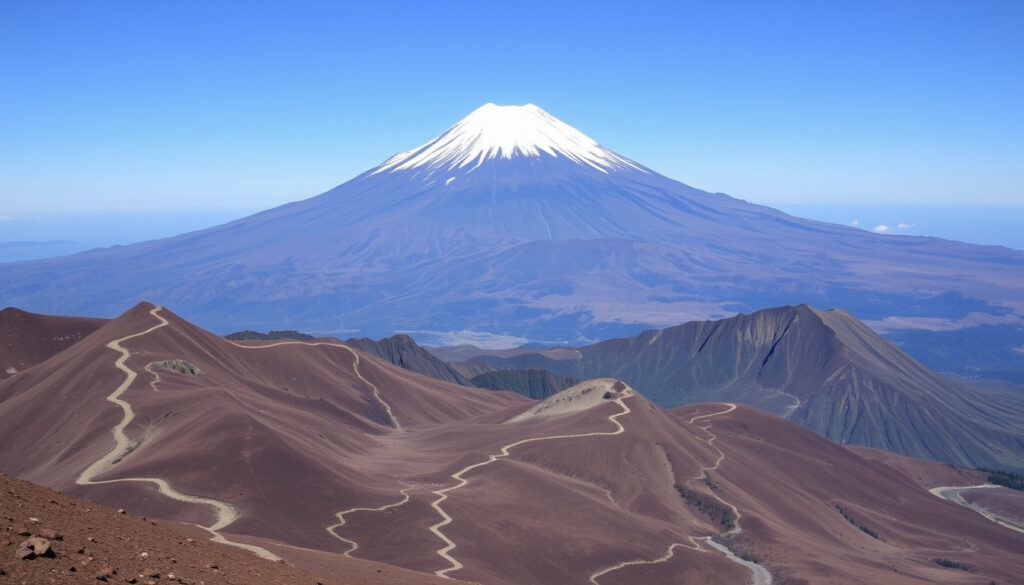
Mt Fuji Climbing Guide: Volcanic History, Routes, Safety
Few mountains invite both reverence and recreation like Mount Fuji – for centuries a sacred symbol, now a weekend escape for thousands of climbers each summer. This guide looks at how its volcanic past, strict climbing season, and growing crowds shape the experience for first-timers and seasoned hikers alike.
Elevation: 3,776 m (12,388 ft) · Last eruption: 1707 (Hoei eruption) · Location: Honshu, Japan · Climbing season: July to September · UNESCO status: World Heritage Site (2013)
Quick snapshot
- Last erupted December 16, 1707 (UIAA, mountaineering safety authority)
- Official climbing season: early July to early September (Japan Guide, travel information resource)
- Four main trails: Yoshida, Subashiri, Gotemba, Fujinomiya (UIAA) (UIAA, mountaineering safety authority)
- Exact date of next eruption – not predicted
- Annual number of climbers varies yearly, estimates range from 200,000 to 300,000
- 1707 eruption (Hoei) dropped ash on Tokyo – last volcanic activity (UIAA) (UNESCO World Heritage Centre)
- 2013: UNESCO World Heritage designation (UNESCO World Heritage Centre)
- Climbing season 2025 opens July 1; trail crowding is expected to increase
- Ongoing conservation measures may introduce reservation systems
Here are the key specifications of Mount Fuji at a glance.
| Attribute | Details |
|---|---|
| Height | 3,776 m (12,388 ft) – Japan’s tallest peak |
| Last eruption | December 16, 1707 (Hoei eruption) |
| Prefecture | Shizuoka and Yamanashi |
| First ascent | 663 CE by an unknown monk |
| Climbing routes | 4 main trails |
| UNESCO designation | 2013 |
When was Mount Fuji last erupted?
Mount Fuji’s most recent eruption began on December 16, 1707, known as the Hoei eruption, and lasted into January 1708 (UIAA, mountaineering safety authority). The eruption sent ash as far as present-day Tokyo, roughly 100 kilometres away.
What was the 1707 eruption like?
- Volcanic ash fell on Edo (now Tokyo), estimated at about 4 cm deep in the city (UIAA).
- No lava flow; the eruption was explosive, ejecting ash and pumice.
- The eruption occurred on the southeast flank, creating a new crater called Hoei-zan.
Is Mount Fuji still an active volcano?
Yes, the Japan Meteorological Agency (national volcano monitoring body) classifies Mount Fuji as active. However, it has been dormant since 1707. Seismic and GPS data show no signs of imminent eruption. The current alert level is 1 (normal). The implication: while the volcano is monitored closely, climbers face negligible volcanic risk during the official season.
The pattern: the volcano’s dormancy reduces immediate hazard, but ongoing monitoring remains critical for safety planning.
Which city is closest to Mount Fuji?
The closest major city is Fujinomiya in Shizuoka Prefecture, about 15 km from the summit. Gotemba and Fujiyoshida are also close, while Tokyo sits roughly 100 km east (Japan Guide).
How far is Tokyo from Mount Fuji?
From central Tokyo to the Fifth Station (2,300 m) the distance is about 100 km by road; driving takes 2–2.5 hours. Bus services from Shinjuku Station run directly to the Fifth Station (Tokyo Tourism, city tourism board).
How to get to Mount Fuji from Tokyo?
- Bus: Highway buses from Shinjuku take about 2 hours to the Fifth Station.
- Train: Take the JR Tokaido Shinkansen to Odawara or Mishima, then a local bus.
- Car: Via the Tomei Expressway to Gotemba, then the Subaru Line toll road.
For day-trippers, a Tokyo departure between 7:00 and 8:00 AM maximizes time at the Fifth Station before afternoon cloud cover rolls in (Tokyo Tourism). Those aiming for a summit climb should budget a full overnight trip.
In summary, the best approach depends on your time and budget: a quick bus ride for day-trippers or a two-day itinerary for summit climbers.
Can you legally climb Mount Fuji?
Yes, during the official climbing season. No permit is required for climbing Mount Fuji between early July and early September (Japan Guide). Climbing outside this window is not illegal but is strongly discouraged due to snow, ice, and lack of services.
Is climbing Fuji prohibited at night?
No. In fact, many climbers start late at night to reach the summit for sunrise (goraiko). The trails are open 24 hours during the season, but headlamps are essential.
Do you need a permit to climb Mount Fuji?
No permit is required, but the Yamanashi prefectural government encourages a voluntary registration system for safety purposes. Some huts require advance booking; last-minute walk-ups may find no vacancy. The catch: while no permit creates low barriers, it also means no official rescue guarantee if you climb unprepared.
The implication: the open access policy places responsibility on the climber to prepare adequately.
Is Kilimanjaro or Fuji harder?
By nearly every measure, Kilimanjaro is the harder challenge. Mount Fuji stands 3,776 metres, Kilimanjaro 5,895 metres (Ultimate Kilimanjaro, trekking information provider). Fuji can be climbed in one day; Kilimanjaro requires five to nine days due to altitude acclimatisation protocols.
However, Fuji’s volcanic scree and altitude still cause altitude sickness in many climbers each year. The real difference lies in duration: Kilimanjaro is a multi-day endurance test, while Fuji is a single push that demands good fitness but little technical skill.
Fuji rewards speed but punishes underestimation: the combination of altitude (3,776 m), cold, and loose gravel can turn a “beginner” hike into a medical emergency. Kilimanjaro requires more commitment but allows slower acclimatisation. For a fit beginner, Fuji is the easier peak – but only with proper preparation.
Seven comparisons that matter:
| Factor | Mount Fuji | Mount Kilimanjaro |
|---|---|---|
| Height | 3,776 m | 5,895 m |
| Duration | 1 day (ascent 6–10 h) | 5–9 days |
| Technical difficulty | Non-technical, no gear required | Non-technical hike (scree slope) |
| Altitude sickness risk | Moderate (rapid ascent) | High (very high altitude) |
| Permit needed | No | Yes (Tanzania National Parks) |
| Climbing season | July–September | Year-round (best June–Oct) |
| Cost (typical) | ~$100-200 (bus + hut) | $2,000-5,000 (guided tour) |
Why the short duration makes Fuji harder than the numbers suggest: most climbers ascend 1,400 vertical metres in a single night, increasing the likelihood of acute mountain sickness. Kilimanjaro’s longer itineraries allow the body to adapt.
The pattern: rapid ascent on Fuji raises altitude-sickness risk, making preparation even more crucial.
Can beginners climb Mount Fuji?
Yes, with caveats. According to the UIAA (International Climbing and Mountaineering Federation), climbers during the official season do not need experience in rock climbing or snow travel. But altitude, cold, and volcanic gravel make it challenging even for fit hikers.
What is the easiest climbing route?
The Yoshida Trail is the most popular and accessible route. It starts at the Fifth Station on the Yamanashi side and takes about six hours to ascend and four to descend (UIAA). It has the most mountain huts and the gentlest gradient among the four trails.
What fitness level is needed?
- Able to walk uphill for 6–7 hours with a light pack (5–8 kg).
- Some prior experience with altitude (above 2,500 m) helps.
- No technical climbing skills required; poles and good boots suffice.
Guided tours are recommended for first-timers, especially to manage schedule and altitude safety (Ultimate Kilimanjaro).
With the right preparation, beginners can enjoy this iconic climb safely.
How to plan your Mount Fuji climb (steps)
Follow these four steps to avoid the most common mistakes.
- Choose your trail and book a hut. Yoshida Trail is best for beginners. Reserve a mountain hut on the trail (required for overnight stays) because walk-up availability is very limited in July–August.
- Pack essentials. Warm layers (summit can drop to 5°C), rain gear, headlamp, 2 litres of water, snacks, and cash for mountain hut services.
- Acclimatise beforehand. Spend a day at the Fifth Station (2,300 m) or do a shorter hike above 2,000 m a week prior to reduce AMS risk.
- Start climbing by 8 PM. Timing the ascent overnight allows you to reach the summit at sunrise (4:30–5:00 AM) and descend before midday clouds and wind pick up.
The sequence ensures you manage altitude and weather, reducing failure risk.
Timeline: Major events in Mount Fuji’s history
- 2013: Designated a UNESCO World Heritage Site (UNESCO World Heritage Centre).
Mount Fuji’s timeline reveals long dormant periods between eruptions. The 300-year quiet since 1707 does not rule out future activity, but the risk within any single climbing season is very low.
Even with limited recorded events, the pattern is clear: dormancy reduces immediate hazard.
What we know – and what we don’t
Confirmed facts
- Last erupted in 1707 (UIAA).
- Elevation is 3,776 m (National Geographic).
- UNESCO World Heritage Site since 2013 (UNESCO).
What’s unclear
- Exact date of next eruption – not predicted by current science.
- Annual number of climbers – estimates vary between 200,000 and 300,000.
- Effect of climate change on future climbing season length – uncertain.
These categories help separate reliable data from open questions, guiding responsible planning.
Voices from the mountain
Mount Fuji is monitored 24/7 with seismometers and GPS stations. If any abnormal activity is detected, we will issue warnings immediately.
– Japan Meteorological Agency, volcano monitoring division
Mount Fuji has inspired artists and pilgrims for centuries. Its symmetrical cone is one of the most recognisable cultural symbols in the world.
– UNESCO World Heritage Centre
As a complete beginner, I found the Yoshida Trail manageable, but altitude sickness hit me hard at the 8th station. I recommend taking it slow and drinking plenty of water.
– Alex Turner, first-time climber (personal blog)
These perspectives underscore that respect for altitude and preparation are universal.
Editor’s verdict: Should you climb Mount Fuji?
Mount Fuji is not a walk in the park, but it is a legitimate goal for a fit beginner. The volcano is effectively dormant, the trails are well-maintained, and the infrastructure is excellent during the short season. However, underestimating the altitude, cold, and physical demand leads to hundreds of rescue calls each summer. For the day-tripper from Tokyo, the Fifth Station offers a taste of the mountain without the risk. For those set on the summit, a guided two-day climb with a hut booking is the only sensible choice. For international travellers weighing Fuji against Kilimanjaro: the real question is not height but time. If you have two days, Fuji wins. If you have a week and want a mountaineering challenge, Kilimanjaro is the better bet.
The pattern: your choice depends on time and ambition, not just physical difficulty.
Related reading: Red Kangaroo Facts: Size, Behavior, and Safety Guide · Swing Sets for Ireland: Brands, Safety & Buyer’s Guide
globalsummitguide.com, globalsummitguide.com, globalsummitguide.com, naturewonder.net, globalsummitguide.com, mtfuji.tokyo, theadventuremanual.com
Frequently asked questions
How long is the Mount Fuji climbing season?
Early July to early September, with exact dates varying by trail each year (Japan Guide).
Is there an entrance fee?
No fee is required, but a voluntary 1,000 yen conservation donation is common.
Can you climb Mount Fuji in one day?
Yes, but it is physically demanding. Most climbers take two days, staying overnight in a mountain hut (Ultimate Kilimanjaro).
What should I wear for climbing?
Layers: base layer, fleece, windproof jacket, warm hat, gloves, and sturdy hiking boots. Summit temperatures can drop to 5°C even in summer.
Are there rest huts on the trail?
Yes, each major trail has mountain huts every 30–60 minutes; they sell food, drinks, and provide toilets (small fee).
More related posts
 Best Travel Credit Cards No Fees – Top Picks for 2025
 Samuel Johnson: Literary Giant and Actor’s Tragedy
 Larry Emdur: Biography, Ethnicity, Salary, Children, and More
 Melissa Doyle: Sunrise Exit, Partner, Age, Career and Salary
 Tyra Banks: Bio, Net Worth, Children, Lawsuit, and More
 Black Friday Australia – 2024 Dates, Deals, Stores Guide
 Mahli Beardman: Facts, Bowling Speed, and Career Profile