Kilimanjaro Peak: Facts, Climbing Difficulty, K2 vs Everest
Almost everyone who looks up Kilimanjaro’s numbers ends up asking the same thing: can someone like me actually climb that? The answer is more encouraging than the mountain’s reputation suggests. At 5,895 meters, Africa’s highest peak is routinely climbed by first-timers with no technical skill, and trek operators describe the ascent as a non-technical walk rather than a climb (Much Better Adventures). The honest picture: a very attainable summit that still costs a few lives each year — and a comparison with K2 and Everest that most articles get wrong.
Height: 5,895 m (19,341 ft) ·
Location: Tanzania, Africa ·
First ascent: 1889 ·
Mountain type: Stratovolcano (dormant) ·
Climbing routes: 7 main routes ·
Fatality rate: ≈0.03% per attempt
Quick snapshot
- Guides consistently flag altitude illness, not technical falls, as the main safety risk on Kilimanjaro (KiliPeak).
- Mount Kilimanjaro is a free-standing volcanic massif with three cones: Kibo, Mawenzi, and Shira (SnowBrains).
- K2’s death-to-summit rate is estimated at roughly 9.5% and Everest’s at about 2.5%, but methodology shifts the numbers (Global Summit Guide).
- Other analyses put Everest near 4% and K2 near 13% depending on how attempts are counted (Sports Illustrated).
- 1889 — first recorded ascent by Hans Meyer, Ludwig Purtscheller, and Yohanas Kinyala Lauwo (SnowBrains).
- 1964 — Kaiser Wilhelm Peak renamed Uhuru Peak after Tanzanian independence (Snow Africa Adventure).
- Longer itineraries improve acclimatization and summit odds (Much Better Adventures).
- Supplemental oxygen on descent is linked to better survival on Everest and K2 (University of Washington News).
Nine facts, one pattern: the numbers that matter on Kilimanjaro concern altitude and route choice, not technical danger.
| Metric | Value |
|---|---|
| Height | 5,895 m (19,341 ft) |
| Highest point | Uhuru Peak, on the crater rim of the Kibo cone |
| Location | Kilimanjaro National Park, Tanzania |
| Mountain type | Dormant stratovolcano; three cones — Kibo, Mawenzi, Shira |
| First ascent | 1889 — Hans Meyer, Ludwig Purtscheller, Yohanas Kinyala Lauwo |
| Former name | Kaiser Wilhelm Peak; renamed Uhuru Peak in 1964 |
| Climbing routes | 7 main routes |
| UNESCO status | World Heritage Site since 1987 |
| Fatality rate | Roughly 3–10 deaths per year among 35,000+ attempts, by one operator estimate |
What is the peak of Kilimanjaro called?
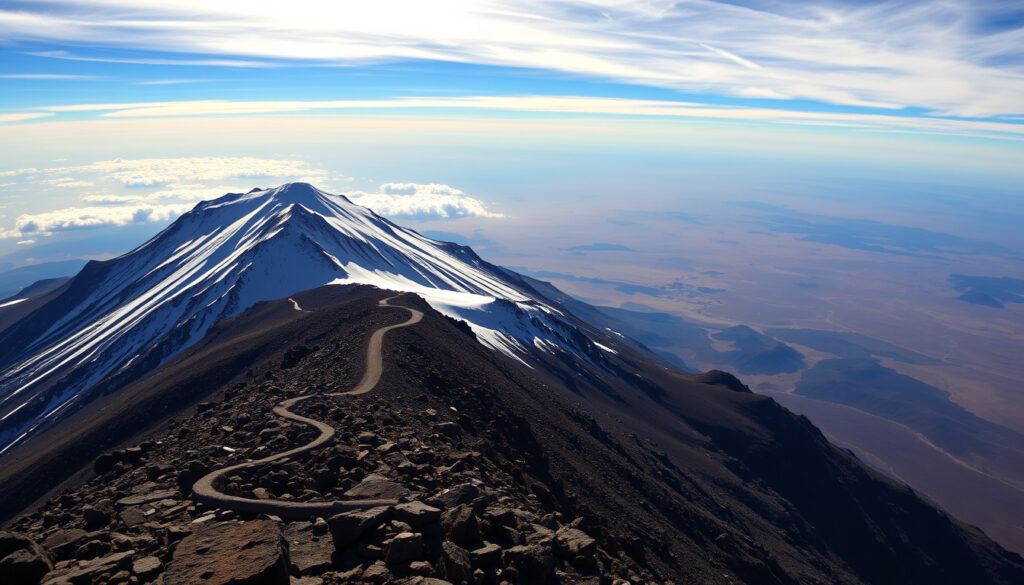
Kilimanjaro’s summit is Uhuru Peak, a Swahili name for “freedom,” on the southern rim of the Kibo cone. It reaches 5,895 meters (19,341 feet), making it the highest point on the African continent (Snow Africa Adventure).
Official name and history
- Under German administration, the peak was known as Kaiser Wilhelm Peak.
- After Tanzanian independence, it was renamed Uhuru Peak in 1964.
- The first recorded ascent took place in 1889; the summit party included Hans Meyer, Ludwig Purtscheller, and Yohanas Kinyala Lauwo.
- Kilimanjaro National Park was established in 1973 and became a UNESCO World Heritage Site in 1987.
Volcanic cones: Kibo, Mawenzi, Shira
- Kibo is the highest cone and is dormant, not extinct; Mawenzi and Shira are older, heavily eroded, and lower.
- Kilimanjaro is a free-standing volcanic massif rather than part of a mountain range.
Every summit of Kilimanjaro is a summit of Kibo. That explains why the climb is an endurance problem first and a mountaineering problem second.
The implication: when climbers say “Kilimanjaro,” they mean Kibo. The summit is a crater rim, not a knife-edge ridge — which is exactly why the climb rewards patience rather than technical skill.
Can a beginner climb Kilimanjaro?
Short answer: yes, with honest preparation. The mountain separates the prepared from the unprepared more than it separates athletes from non-athletes.
Physical fitness requirements
- Kilimanjaro is a trek, not a technical climb; success depends on aerobic endurance, steady pacing, and gear, not rope work (Much Better Adventures).
- Fit beginners summit every season when they train for long days on their feet and choose an appropriately long itinerary.
Acclimatization and altitude risk
- Safety guides consistently flag altitude illness — not technical falls — as the main risk on the mountain (KiliPeak).
- Operators commonly recommend 7–9 day itineraries because extra days at altitude reduce the risk of acute mountain sickness (KiliPeak).
- The standard safety rule is simple: if symptoms appear, descend.
Success rates by route
- Published estimates put summit success on popular routes between 65% and 80%, with longer routes recording the better outcomes.
- Shorter itineraries tend to produce lower summit rates for the same reason: less time to acclimatize.
What this means: the deciding variable on Kilimanjaro is not whether you have climbed before; it is how many days you give your body to adapt — and how willing you are to turn around.
The trade-off: proper acclimatization takes time, and time is exactly what most first-timers underestimate when planning the climb.
How many climbers died in Kilimanjaro?
Few questions about the mountain produce more contradictory numbers. The honest answer is that reliable figures exist — and they are much lower than most people expect.
Annual fatality statistics
- One operator’s long-term estimate puts deaths at roughly 3–10 per year out of 35,000+ attempts, around 0.03% (Snow Africa Adventure).
- There is no single official public database for Kilimanjaro fatalities, which is why published numbers vary.
Most common causes of death
- Altitude-related illness leads the list; falls and hypothermia account for a smaller share.
- Operators warn that ignoring symptoms and pushing for the summit is what turns altitude sickness into an emergency.
Kilimanjaro’s risk is altitude, not the mountain itself. A climber who takes an 8-day route and agrees to turn around if symptoms appear has already removed most of the danger.
The pattern: deaths on Kilimanjaro are rare, and the cause is almost always physiological rather than technical. That is precisely why the mountain keeps getting compared to K2 — and why the comparison usually misses the point.
How does Kilimanjaro compare to other peaks like K2 and Everest?
The internet loves ranking deadly mountains, but rankings without definitions mislead. Start with the measurable differences.
Which is highest, K2 or Kilimanjaro?
- K2 reaches 8,611 meters, Everest 8,848 meters, and Kilimanjaro 5,895 meters — roughly two-thirds of Everest’s height.
- Height matters, but physiology matters more: researchers at the University of Washington found supplemental oxygen was associated with better survival on descent on both Everest and K2 (University of Washington News).
Fatality rates: Everest vs Kilimanjaro
- In fatality-per-summit terms, K2 is substantially more dangerous than Everest (TheTravel).
- Published estimates range from roughly 9.5% to 14% for K2 and 2.5% to 4% for Everest, depending on the dataset (Sports Illustrated; Global Summit Guide).
- Kilimanjaro’s rate sits near 0.03% of attempts — a different statistical universe.
- Everest also draws far more climbing traffic than K2, which inflates its raw death count and makes comparisons sensitive to the denominator (Sports Illustrated).
Climbing difficulty for beginners
- K2 requires technical climbing on steep, exposed terrain; Everest is a sustained high-altitude expedition; Kilimanjaro is a non-technical trek.
- For fit beginners, Kilimanjaro is the only one of the three that is realistically attainable with planning and guided support.
Why this matters: the three mountains belong to different sports. Kilimanjaro tests your lungs and your patience; Everest and K2 test your judgment, your experience, and sometimes your luck.
Why is K2 not one of the 7 summits?
The Seven Summits list confuses a lot of people, and K2 is the usual source of the confusion.
Definition of the Seven Summits
- The Seven Summits are the highest peaks on each of the seven continents — a geographical checklist, not a difficulty ranking.
- Kilimanjaro is Africa’s entry, and it is the only peak on this page that counts as a genuine trek.
K2’s continental position
- K2 sits in the Karakoram range in Asia, but it is not Asia’s highest mountain; Everest holds that title.
- K2 is the world’s second-highest peak, yet it holds no continental record — which is why the Seven Summits list ignores it.
- Among the three mountains compared here, K2 is repeatedly characterized as the most dangerous by mountaineering news outlets such as SnowBrains.
The trade-off: K2’s fame rests on being the hardest, not the highest. That reputation makes it a benchmark for professional mountaineers — and a poor yardstick for measuring Kilimanjaro.
Kilimanjaro vs Everest vs K2: side-by-side
Three peaks, one pattern: fatality risk climbs with altitude and technical difficulty in lockstep, and Kilimanjaro sits at the bottom of both curves.
| Metric | Kilimanjaro | Everest | K2 |
|---|---|---|---|
| Height | 5,895 m (19,341 ft) | 8,848 m | 8,611 m |
| Technical difficulty | Non-technical trek | Extreme — high-altitude expedition | Extreme — steep, technical, weather-driven |
| Fatality rate (estimates) | ≈0.03% per climb | ≈2.5–4% death-to-summit (Global Summit Guide) | ≈9.5–14% death-to-summit (TheTravel) |
| Supplemental oxygen | Not typically required | Routinely used on summit push | Routinely used; linked to survival on descent |
| Beginner suitability | Yes, with acclimatization | No | No |
The denominators are not comparable. Kilimanjaro’s 0.03% measures tens of thousands of first-timers every year; K2’s 9.5–14% measures a small community of elite mountaineers. The same statistic means something different in those two populations.
The honest reading: Kilimanjaro is statistically safe but physiologically demanding, while K2 is dangerous in both senses. Each mountain punishes a different kind of mistake.
Confirmed facts vs. what’s still unclear
Some claims about Kilimanjaro are settled; others depend entirely on which source you read.
What’s confirmed
- Uhuru Peak, on Kibo’s crater rim, is Kilimanjaro’s highest point at 5,895 meters (SnowBrains).
- Altitude illness is the main risk on Kilimanjaro, not technical climbing accidents.
- The first recorded ascent was completed in 1889.
- Kilimanjaro’s fatality rate is lower than Everest’s and K2’s.
What’s still unclear
- Exact annual death totals: sources range from 3 to 10 per year, and no single official database exists.
- Cause-of-death breakdowns: park authorities have not published a systematic public record.
- Route-by-route success rates: not centrally tracked; published figures vary by operator and season.
- Everest and K2 ratios: estimates span 2.5–4% for Everest and 9.5–14% for K2 depending on the dataset.
The pattern: the core geography is settled, but the statistics repeated online — death rates, success rates, danger rankings — shift with the source. That is why comparing multiple sources matters more on this topic than on most.
What the sources actually say
Two voices frame the risk conversation differently: a trek operator and a medical researcher.
“Mount Kilimanjaro is widely described as a non-technical trek rather than a technical climb.”
Much Better Adventures, beginner climbing guide
“None of the 47 successful K2 climbers using supplemental oxygen died during descent, while 22 of 117 climbers without bottled oxygen did.”
The pattern: the operator explains who can go, and the researcher explains who survives. Read both together and Kilimanjaro’s risk becomes specific instead of scary.
What this means for your climb
Mount Kilimanjaro rewards planning more than bravery. Its near-0.03% fatality rate and non-technical terrain make it the most accessible of the world’s great peaks — but only for climbers who respect altitude illness, book enough days to adapt, and stay willing to turn around. Everest and K2 are useful mainly as calibration: they show how wide the gap is between a long walk in thin air and a genuine expedition. For the first-time trekker, the choice is clear: plan for altitude, book 7–9 days, and treat summit day as optional — the mountain will still be there when you are ready.
travelhimalayanepal.com, factsanddetails.com, businessinsider.com
Frequently asked questions
How long does it take to climb Kilimanjaro?
Plan for 7 to 9 days on the mountain. Shorter routes exist, but longer itineraries meaningfully reduce altitude-illness risk and improve summit odds.
What is the best time of year to climb Kilimanjaro?
The mountain is climbed year-round, but season interacts with route and fitness: success rates fluctuate by season, so operators schedule around the most stable weather windows.
Do you need oxygen to climb Kilimanjaro?
No. At 5,895 meters, Kilimanjaro stays below the altitude where supplemental oxygen becomes standard. The bottleneck is acclimatization, and the treatment for altitude illness is descent, not bottled oxygen.
Is Kilimanjaro harder than Mount Everest?
No. Kilimanjaro is a non-technical trek; Everest is a multi-week expedition with extreme altitude, weather, and crowding risks, and its death-to-summit rate is far higher (TheTravel).
What is the success rate for climbing Kilimanjaro?
Published estimates put summit success on popular routes between 65% and 80%, with longer itineraries reporting better outcomes.
Can you climb Kilimanjaro without a guide?
It is not recommended. Successful beginner ascents consistently involve guided support, proper acclimatization, and a willingness to descend if symptoms appear.
Related reading
- Mt Fuji Climbing Guide — another stratovolcano where preparation beats technical skill.
- Tokyo Skytree Visitor Guide — a vertical landmark with a much gentler learning curve.
More related posts
 Miss Moni: Age, Nationality & Husband – Is She Good for Kids
 Custom Shirts: Design & Print in Ireland
 North Ringwood Medical Centre – Hours, Fees and Booking Guide
 How to Reduce Corti ol Level Naturally: 7 Proven Method
 Business Portal Login: ROS, myAccount, AIB & Enterprise Ireland
 Chloe Parker: Age, TikTok, Acting Career & Relationship Facts
 Billy Graham: Life, Ministry, Net Worth, and Political Views
 Rebecca Yarros: Disability, Books, and Bio