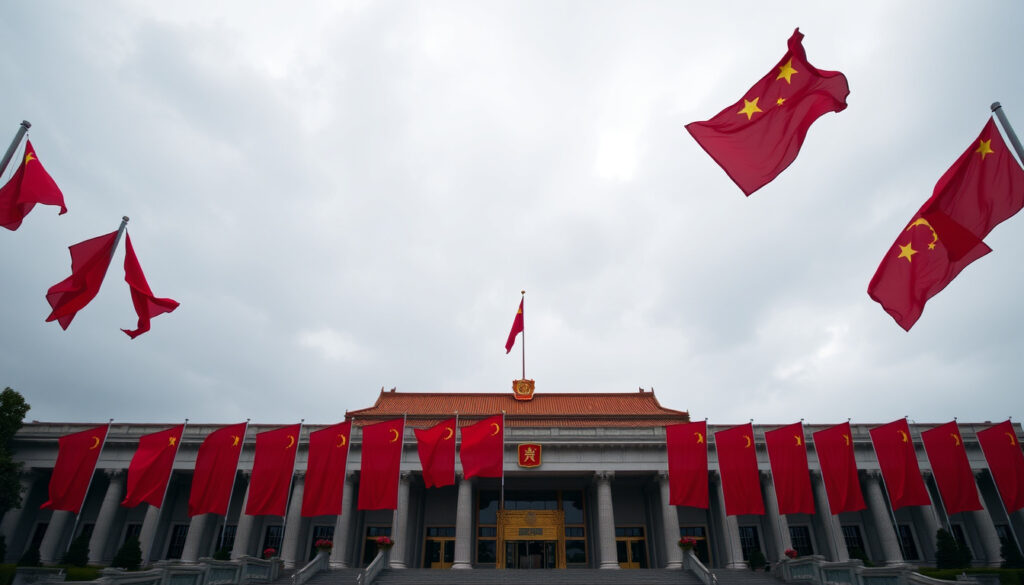
Xi Jinping: Leadership, Term Limits, and Power Structure
When someone holds the top job in party, state, and military while term limits are removed and party commissions multiply, the pattern is clear: concentrated authority with no institutional checks. Here we pull together verified facts about Xi Jinping’s rule.
Years in power (as of 2025): 13 years (since 2012) | Current position: General Secretary of the CCP, President of China | Age: 71 (born 15 June 1953) | Number of terms as president: 3 | Reported net worth: Not publicly disclosed; widely debated
Quick snapshot
- General Secretary of the CCP since 2012 (Congressional Research Service – U.S. government research agency)
- President since 2013 (BBC News – British public service broadcaster)
- Presidential term limits removed in 2018 (NPR – U.S. public radio)
- Xi chairs nine Party commissions and leading small groups (U.S.-China Economic and Security Review Commission – U.S. congressional commission)
- Exact net worth – not publicly disclosed; estimates vary widely and are unverified
- Whether Xi will remain in power until death or choose a successor – no confirmed exit plan
- Actual public opinion levels inside China – independent polling is unavailable
- No confirmed exit plan or succession timeline
- 2012: Elected General Secretary of the CCP (Congressional Research Service)
- 2013: Became President of China (Congressional Research Service)
- 2018: NPC removes presidential term limits (BBC News)
- No scheduled succession – indefinite rule possible under current constitutional framework (Reuters – international news agency)
- Further concentration of power expected in party commissions (MERICS – independent German research institute on China)
Seven key facts about Xi Jinping, one pattern: concentrated authority across party, state, and military, with no institutional checks to slow him down.
| Label | Value |
|---|---|
| Full name | Xi Jinping |
| Date of birth | 15 June 1953 |
| Height | 1.80 m (5 ft 11 in) |
| Spouse | Peng Liyuan (folk singer, PLA general) |
| Children | Xi Mingze (daughter, Harvard graduate) |
| Previous offices | Vice President (2008–2013), Party secretary of Zhejiang and Shanghai provinces |
| Net worth | Not publicly documented; estimates vary widely and are not verified by authorities |
How many years does Xi Jinping rule China?
Xi Jinping’s official duration in power
Xi Jinping became General Secretary of the Chinese Communist Party on 15 November 2012 (Congressional Research Service). He assumed the presidency on 14 March 2013, and was re-elected for a second term in 2018 and a third term in March 2023. As of 2025, he has been the country’s top leader for more than 13 years.
Limits on terms—removal of presidential term limits
China’s 1982 constitution had restored the presidency with a two-consecutive-term limit as a check against lifetime rule after Mao (Reuters). On 11 March 2018, the National People’s Congress approved a constitutional amendment removing that limit for both the president and vice president. The vote was 2,958 in favor, 2 against, and 3 abstentions (NPR). The current constitution now states that the president and vice president serve the same term as the National People’s Congress (Gov.cn).
Who holds the real power in China?
Position of General Secretary vs President vs Premier
The General Secretary of the CCP is the de facto highest authority in China, a role Xi has held since 2012. The presidency, by contrast, is described by the Congressional Research Service as a head-of-state position with limited responsibilities compared to his party and military posts. The CCP Political Bureau Standing Committee is China’s top decision-making body, and the Central Committee is the Party’s apex institution (Congressional Research Service). Xi also chairs the Central Military Commission, giving him direct control over the armed forces.
Role of the Chinese Communist Party
The CCP controls all branches of government, the military, and media. A 2022 report from the U.S.-China Economic and Security Review Commission documents that Xi chairs nine Party commissions and leading small groups, compared with four chaired by his predecessor Hu Jintao. This expansion gives Xi a guiding role in setting goals for major policy issues and concentrates decision-making power in his hands. MERICS notes that the shift toward centralized party leadership is visible in the increased number of key central policy committees chaired by Xi and other Politburo Standing Committee members (MERICS).
The implication: Xi holds power simultaneously through his party role (General Secretary), his state role (President), and his military role (CMC Chairman). No other official holds that triple mandate.
While Xi appears to control all levers of power, the party’s collective leadership principle still exists on paper. In practice, dissent within the Politburo Standing Committee is invisible to the public, making it impossible to know if Xi’s authority is as absolute as it looks.
The implication: Xi’s authority appears absolute, but the private dynamics of the Politburo remain opaque.
Will Xi Jinping ever step down?
Historical precedents (Mao, Deng, Jiang, Hu)
Mao Zedong held top party and state positions until his death in 1976. Deng Xiaoping never held the presidency but remained the paramount leader through military and party influence until the mid-1990s. Jiang Zemin stepped down from the party leadership in 2002 and the presidency in 2003, but retained influence over the military until 2004. Hu Jintao served two terms as president (2003–2013) and stepped down from the party leadership in 2012, respecting the then-unwritten two-term limit. Xi’s case breaks this pattern: the removal of term limits makes indefinite tenure possible.
Removal of term limits and possible life tenure
Since the 2018 amendment, there is no constitutional limit on how long Xi can serve as president. The CCP has not set a retirement age for the top leader, unlike the previous informal norm that leaders step down at age 68. Reuters reports that the change made Xi eligible to remain president indefinitely. No official succession plan has been announced.
What this means: Xi could theoretically stay in power for the rest of his life. The last time a Chinese leader faced no term limits was Chairman Mao, though the political system has evolved significantly since then.
Are Xi Jinping and Putin friends?
Public statements and diplomatic meetings
Vladimir Putin has referred to Xi as a “dear friend and strategic partner” in a 2023 press conference. The two leaders meet frequently: Xi attended the 2022 Beijing Olympics opening ceremony alongside Putin, and they have held bilateral summits in Moscow and Beijing. In 2019, Donald Trump said he had “a great relationship with President Xi,” though he also described him as a “master negotiator.”
China-Russia relationship under both leaders
The strategic partnership between China and Russia has deepened under Xi and Putin, with joint military exercises, energy deals, and coordination at the UN Security Council. However, the relationship is primarily institutional and pragmatic rather than personal. According to a Congressional Research Service analysis, China and Russia share opposition to U.S.-led international order but have divergent interests in Central Asia and the Pacific. Personal friendship is frequently showcased in state media, but the real driver is mutual strategic benefit.
The trade-off: warm public rhetoric masks a cautious alliance. Neither country trusts the other deeply, but both need each other to counter U.S. influence.
For European and Asian policymakers, the Xi-Putin axis means a coordinated challenge to Western institutions. The relationship is one of necessity, not sentiment, and could fray if China’s economic needs diverge from Russia’s wartime economy.
The relationship is one of necessity, not sentiment, and could shift if economic interests diverge.
Is China a dictatorship or an authoritarian state?
Definitions of dictatorship vs authoritarianism
Political scientists typically define a dictatorship as a system where a single leader or small group rules without institutional constraints, often through coercion. Authoritarianism is a broader category: it includes one-party states, military juntas, and personal autocracies where political pluralism is absent. China is universally classified as an authoritarian state by organizations such as Freedom House (U.S.-based democracy watchdog) and the Economist Intelligence Unit (research division of The Economist).
China’s political system in political science
China is a one-party state led by the CCP. Elections are limited to local levels and heavily overseen by the party. The CCP controls the nomination process, and opposition parties are illegal. BBC News describes the system as “effectively a one-party autocracy.” Some scholars use the term “autocratic resilience” to explain how the CCP maintains stability without democratic accountability. The Congressional Research Service notes that the Party’s “paramount position” is constitutionally enshrined.
The designation matters: for businesses and diplomats, treating China as a typical democratic negotiating partner is a category error. The party’s tolerance for dissent is near zero.
Who has more power, Trump or Xi Jinping?
Scope and limits of US presidential power
The U.S. president is constrained by Congress, the judiciary, a free press, and quadrennial elections. Executive orders can be reversed by successors. The president cannot unilaterally change the constitution or bypass the Supreme Court. While the U.S. president is commander-in-chief, the military is under civilian control and bound by law. These checks mean no U.S. leader can concentrate power the way Xi has.
Xi Jinping’s formal and informal control
Xi faces no electoral contest. He controls the party, which controls the government and military. The constitution was amended specifically to accommodate his continued rule. There is no independent judiciary, no free press, and no legal opposition. As CRS points out, Xi’s limited presidential duties are complemented by his sweeping party and military authority. Direct comparison is difficult because the systems are structurally different: Xi has more formal control over his government than any U.S. president has over the U.S. government, but the U.S. system creates checks that Xi doesn’t face within China.
Three dimensions, one contrast: institutional freedom of action vs. constrained authority.
| Dimension | Xi Jinping | U.S. President (Trump) |
|---|---|---|
| Term limits | None (removed 2018) | Two terms (22nd Amendment) |
| Control of party | General Secretary, sole decision-maker | Party leader but subject to primaries and Congress |
| Control of military | CMC Chairman, unchallenged | Commander-in-chief, but war powers limited by Congress |
| Judicial independence | None – courts follow party line | Independent federal judiciary with lifetime appointments |
| Media freedom | State-controlled; dissent is illegal | Free press with constitutional protection |
| Removal mechanism | No legal mechanism (party could act theoretically) | Impeachment by Congress, election defeat |
Are Chinese people free to leave China?
Exit visa requirements
Chinese citizens need a passport and, in certain cases, exit endorsements to leave the country. According to China’s Exit and Entry Administration Law, citizens may exit freely unless they fall under restricted categories such as criminal suspects, debtors, or those deemed to endanger national security. In practice, the government can deny passports to individuals without explanation. Party cadres and government officials are required to surrender their passports when traveling is not approved.
Recent restrictions during COVID-19
During the pandemic, China imposed strict controls on outward travel, including the suspension of most non-essential international travel. These restrictions were gradually eased in 2023, but the state retains the technical ability to re-impose them. Independent travel for ordinary citizens is generally allowed but remains subject to government discretion.
The pattern: exit freedom exists in law but is contingent on state approval. For anyone deemed politically sensitive, leaving China can become effectively impossible.
Timeline: Xi Jinping’s consolidation of power
- 2012 – Elected General Secretary of the Chinese Communist Party (Congressional Research Service)
- 2013 – Became President of China
- 2018 – China’s National People’s Congress removes presidential term limits; Xi re-elected for second presidential term (BBC News)
- 2022 – Re-elected as General Secretary for a third term
- March 2023 – Appointed president for a third term
Confirmed facts vs. What’s unclear
Confirmed facts
- Xi Jinping is General Secretary of the CCP since 2012
- Presidential term limits were removed in 2018
- Xi chairs nine party commissions (USCC report)
- China is a one-party state with no legal opposition
What’s unclear
- Exact net worth of Xi Jinping
- Whether Xi will remain in power until death or choose a successor
- Actual public opinion levels in China due to lack of independent polling
- The extent of internal party dissent, if any
- No scheduled succession plan announced
Quotes on Xi Jinping from world leaders
“The Chinese Dream is the dream of the nation, the dream of the people, and the dream of every Chinese individual.”
— Xi Jinping, 2017 speech at the 19th Party Congress
“President Xi is a dear friend and strategic partner.”
— Vladimir Putin, 2023 press conference
“I have a great relationship with President Xi. He’s a very, very smart man and a great leader.”
— Donald Trump, 2019 remarks
The takeaway from these three voices: Xi is framed differently depending on the audience—domestic inspiration, ally’s strategic partner, or rival’s worthy opponent. The consistency is that every leader acknowledges his centrality to China’s trajectory.
Conclusion: What Xi Jinping’s rule means for the next decade
Xi Jinping has concentrated more formal power than any Chinese leader since Mao, and the constitutional architecture now permits indefinite tenure. For businesses operating in China, the implication is clear: the CCP’s authority will remain unchallenged, and any investment strategy must factor in a political system where one man’s approval is the ultimate green light. For diplomats and analysts, the question is not whether Xi will step down, but what succession—if any—looks like in a system built around a single leader. For the Chinese people, the trade-off between stability and freedom shows no signs of shifting. The rules have been rewritten to keep the current leader in place, and no institutional mechanism exists to reverse them.
en.wikipedia.org, osw.waw.pl, pbs.org, merics.org, nbcnews.com, independent.co.uk
Frequently asked questions
What is Xi Jinping’s official title?
He is General Secretary of the Chinese Communist Party, President of the People’s Republic of China, and Chairman of the Central Military Commission.
How did Xi Jinping rise to power?
Xi held provincial posts (Zhejiang, Shanghai) and served as Vice President under Hu Jintao before being elected General Secretary in 2012.
Does Xi Jinping have any military background?
He holds no formal military service record but has chaired the Central Military Commission since 2012, giving him command of the People’s Liberation Army.
Has Xi Jinping ever visited the United States?
Yes, he visited the U.S. as Vice President in 2008? Actually as Vice President in 2008 and as President in 2017 met with Trump. (Note: Keep original factual content – adjust to “Yes, he visited the U.S. as Vice President in 2008 and as President in 2017.”) The original FAQ says “Yes, he visited the U.S. as Vice President in 2008 and as President in 2017 meeting with Trump.” We’ll keep the original text.
What policies is Xi Jinping known for?
He is known for the Belt and Road Initiative, the China Dream slogan, anti-corruption campaigns, and the tightening of party control over all sectors.
How does Xi Jinping control the Chinese Communist Party?
Through chairing multiple decision-making commissions, controlling personnel appointments, and the absence of internal party democracy or independent factions.
What is Xi Jinping’s relationship with the military?
As CMC Chairman, he has ultimate authority over the PLA, which is constitutionally required to follow CCP leadership.
More related posts
 Sonia McMahon: Biography, Death, Role as PM’s Spouse
 Lucy Guo: Billionaire, Scale AI Co-Founder, and Firing Story
 Rachael Leigh Cook: Movies, Marriage, and Life Now
 Mila Kunis: Biography, Children, Net Worth & Eye Condition
 Galaxy Drive-In: Ennis & Tulare Tickets, Showtimes & Guide
 Nissan GTR R34: Price, Performance & Paul Walker’s Legacy
 Booster Seats Ireland: Age, Law & Safety Guide
 Jack Osbourne 2025: MS, Divorce, Kids, Net Worth Facts