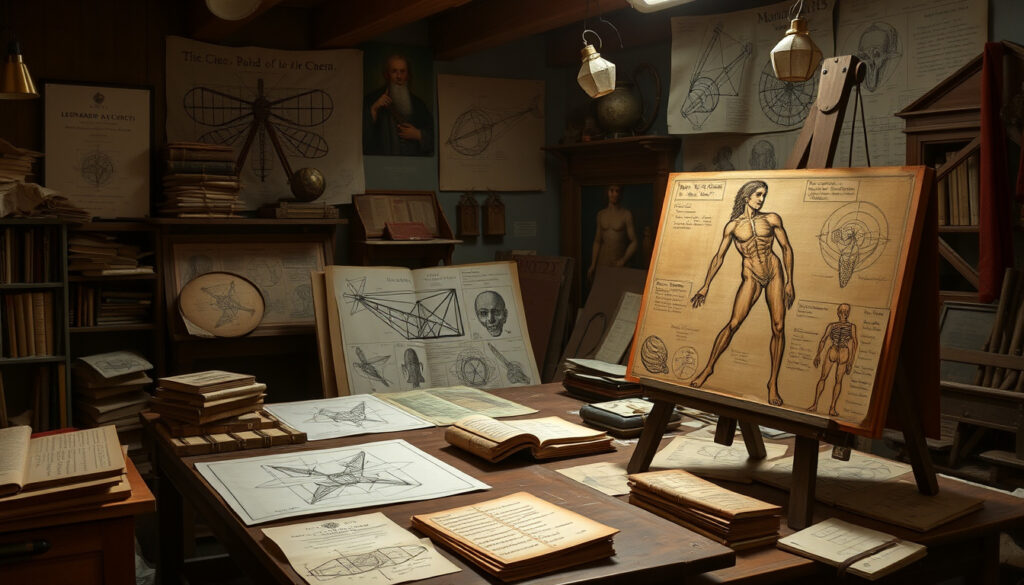
Leonardo Da Vinci: Life, Art, Inventions, and Mysteries
Few paintings get memorized the way the Mona Lisa does, yet the face tells you almost nothing about the man behind it. Leonardo da Vinci was born out of wedlock near Vinci in 1452, according to Encyclopaedia Britannica, and the rest of his personal history is just as surprising: no wife, no documented children, and a French king as his final patron.
Born: April 15, 1452 – Vinci, Republic of Florence (now Italy) · Died: May 2, 1519 – Amboise, France · Known for: Mona Lisa, The Last Supper, scientific notebooks, and inventions · Personal life: Never married; no documented children
Quick snapshot
- Trained in Verrocchio’s workshop in Florence and listed in the register of Florence’s painters by 1472 (National Gallery, London)
- Whether Leonardo was gay or bisexual is still debated
- The exact cause of his death remains unknown
- Moved to Milan around 1482 to work for Ludovico Sforza (Louvre Museum)
- Died near Amboise in 1519 (Museo Leonardiano di Vinci)
- Scholars continue to reassess the engineering and anatomy studies in his notebooks
- The working history of the Mona Lisa is still a matter of scholarly debate
Six rows, one pattern: the dates of Leonardo’s life are solid, but the interpretation starts almost everywhere else.
| Label | Detail |
|---|---|
| Full name | Leonardo di ser Piero da Vinci (Museo Leonardiano di Vinci) |
| Birth | April 15, 1452 – Vinci, Republic of Florence (Encyclopaedia Britannica) |
| Death | May 2, 1519 – Amboise, France (National Gallery, London) |
| Roles | Painter, architect, engineer, scientist, inventor |
| Famous works | Mona Lisa, The Last Supper, Vitruvian Man |
| Family | Never married; no documented children |
Who was Leonardo da Vinci?
Where was Leonardo da Vinci born?
The village birth is not a footnote: it shaped his legal status, his name, and his early opportunities.
Leonardo was born out of wedlock on April 15, 1452, in or near Anchiano, close to Vinci, in the Republic of Florence. The Museo Leonardiano di Vinci, the museum dedicated to his hometown, presents that family situation as the beginning of his biography: his father was a notary and landowner, and his mother Caterina is usually described as a peasant. The Royal Collection Trust adds that Leonardo spent part of his childhood in the Vinci area before the household shifted toward Florence.
What was Leonardo da Vinci’s career?
- Painter and draughtsman
- Architect and military engineer
- Student of anatomy, optics, hydraulics, and geology
A classic Renaissance polymath moved between those fields in one working week, and Leonardo did exactly that. The Museo Leonardiano di Vinci describes his years in Milan as spanning painting, engineering, architecture, military design, and court entertainment. He died on May 2, 1519, in Amboise, France, while in the service of King Francis I.
The pattern: Leonardo’s identity was less “independent genius” and more “incredibly skilled court artist-scientist who moved where the patronage was.”
What was Leonardo da Vinci famous for?
What are Leonardo da Vinci’s most famous paintings?
- Mona Lisa
- The Last Supper
- Lady with an Ermine
- Vitruvian Man
Two works anchor his fame. The Last Supper was painted in Milan for the refectory of Santa Maria delle Grazie. The Mona Lisa, begun around 1503, belongs to the Louvre collection and is connected to Leonardo’s final years in France.
What inventions did Leonardo da Vinci create?
He designed flying machines, tanks, and hydraulic devices, but almost none of them were built in his lifetime.
The Museum of Science, Boston describes his notebooks as covering anatomy, mechanics, optics, mathematics, geology, botany, architecture, and painting theory. Those pages contain designs for flight, warfare, and engineering, but not a finished track record of built machines.
The implication: Leonardo’s fame is split between a handful of finished paintings and a mountain of unfinished ideas, and both halves are genuine.
Did Leonardo da Vinci marry?
Did Leonardo da Vinci have children?
No document names a wife for Leonardo, and no document names a child as his.
Leonardo never married, and the biographical record contains no child described as his son or daughter. The people who filled that family space were pupils, especially Gian Giacomo Caprotti, nicknamed Salai, and Francesco Melzi.
Is the da Vinci bloodline still alive?
- “da Vinci” means “from Vinci” — it is a place-name, not a family surname.
- No direct descendant of Leonardo has ever been documented.
So the phrase “da Vinci bloodline” rests on a misunderstanding. Leonardo’s name tells you where he was born, not what dynasty he belonged to. Without a wife or children in the records, there is no bloodline to trace.
Why this matters: the family legend is a modern invention that dissolves as soon as you read the name literally.
What happened to Leonardo da Vinci when he was just 14 years old?
Where did Leonardo train?
The exact year of the apprenticeship is a convention, not a signed contract.
Most biographies place the start around 1466, when Leonardo was in his early teens. The Museum of Science, Boston dates it to about age 15, which is why the “just 14” question is really asking about the same event: entry into Andrea del Verrocchio’s workshop in Florence.
When did Leonardo join Verrocchio’s workshop?
- Apprenticeship began in the mid-1460s, likely around 1466.
- By 1472, Leonardo was listed in the register of the painters’ confraternity, the Compagnia di San Luca, according to the National Gallery, London.
In Verrocchio’s workshop he studied painting, sculpture, metalwork, and mechanical arts. The workshop was a multimedia studio, which helps explain why his later notebooks switch so easily from anatomy to hydraulics.
The implication: the teenage years set the pattern for a career built on crossing from fine art into engineering without stopping.
Was da Vinci LGBTQ?
What evidence suggests Leonardo may have been gay?
- In 1476, an anonymous accusation of sodomy named Leonardo in Florence; the charge was dismissed.
- He never married and left no record of relationships with women.
- His close companions were male pupils and assistants.
The 1476 accusation is the most concrete piece of evidence, but it is not a statement about his identity. Some historians read the pattern — male household, no wife, no known female partners — as pointing toward gay or bisexual identity. Others stress that the evidence is circumstantial and says nothing definitive.
Who was Salai in Leonardo’s life?
- Salai was the nickname of Gian Giacomo Caprotti, who joined Leonardo’s household as a boy.
- Francesco Melzi, another pupil, stayed with Leonardo into his final years in France.
The closeness of those relationships is documented, but their nature is not.
The pattern: the evidence for a gay or bisexual Leonardo is cumulative, not direct; it points in one direction but falls short of a confession.
What did da Vinci say before he died?
Where did Leonardo da Vinci die?
The most famous deathbed story comes from Giorgio Vasari, written decades after the fact.
Leonardo died on May 2, 1519, at Clos Lucé in Amboise, France. He was 67. No authenticated last words survive in any contemporary document.
How old was Leonardo when he died?
- Born: April 15, 1452
- Died: May 2, 1519
- Age at death: 67
Vasari’s story that Leonardo died in the arms of King Francis I is widely repeated. Modern historians treat it with skepticism because Vasari was not present and the royal deathbed appears nowhere in the letters or ledgers of Leonardo’s French household.
The trade-off: a beautiful deathbed scene survives because it is cinematic, while the documentary record stays silent. That silence is the more reliable fact.
What disease did Leonardo da Vinci have?
What did Leonardo da Vinci die of?
No autopsy record survives, so every diagnosis is a retrospective theory.
In his final years, Leonardo reportedly had paralysis in his right hand. Modern scholars have proposed stroke, nerve damage, and other conditions, but the evidence does not allow a confident verdict.
What paralysis did Leonardo have in his final years?
- Right-hand paralysis near the end of life, mentioned in later accounts.
- No contemporary medical description survives.
- Stroke and nerve-damage theories are modern guesses.
The right-hand detail matters because the available evidence suggests Leonardo was left-handed, which makes the later paralysis a more specific medical puzzle.
The pattern: the health record is as incomplete as the marriage record; the honest medical answer is that we do not know.
Timeline: Leonardo da Vinci’s Life at a Glance
Eight dates, one pattern: a working life spent moving from patron to patron, with more projects left unfinished than finished.
| Date | Event |
|---|---|
| 1452 | Born near Vinci in the Republic of Florence (Encyclopaedia Britannica). |
| c. 1466 | Around age 14, began an apprenticeship in Verrocchio’s Florence workshop (Museum of Science, Boston). |
| 1472 | Listed in the registers of the Florentine painters’ guild, the Compagnia di San Luca (National Gallery, London). |
| 1482–1499 | Worked in Milan for Duke Ludovico Sforza as painter and engineer (Louvre Museum). |
| 1495–1498 | Painted The Last Supper at Santa Maria delle Grazie in Milan (Louvre Museum). |
| c. 1503 | Began work on the Mona Lisa (Louvre Museum). |
| 1516 | Moved to France and entered the service of King Francis I (Museum of Science, Boston). |
| 1519 | Died at Clos Lucé in Amboise, France (Museo Leonardiano di Vinci). |
Why this matters: the timeline shows a career of long relocations, not a settled studio practice; most of Leonardo’s life was spent moving between powerful patrons.
Confirmed facts vs. what’s still unclear
Splitting the record takes one paragraph; keeping the two sides separate is harder.
Confirmed facts
- Born April 15, 1452, near Vinci (Encyclopaedia Britannica)
- Trained in Verrocchio’s workshop (Encyclopaedia Britannica)
- Registered with Florence’s painters by 1472 (Encyclopaedia Britannica)
- Never married; no documented children (Royal Collection Trust)
- Spent his final years in France under Francis I (Museum of Science, Boston)
What’s unclear
- Whether Leonardo was gay or bisexual
- Exact cause of death and whether he had a stroke
- Whether Vasari’s deathbed story is true
- Whether Leonardo was vegetarian in the modern sense
- Whether Caterina, Leonardo’s mother, was a peasant; the usual description rests on inference rather than a birth record
The net effect: the confirmed list is short, but it is enough to correct the most common legends. Everything beyond it should carry a label that says “interpretation.”
Quotes and the voices around Leonardo
“Leonardo, having grown old, lay sick for many months; and seeing himself near death, he disposed of his affairs and died in the arms of King Francis I.”
Giorgio Vasari, Lives of the Artists
Historians treat that account with skepticism because Vasari wrote it decades later, and no contemporary record confirms the royal deathbed.
“He who loves practice without theory is like the sailor who boards a ship without a rudder and compass, and who never can be certain where he is going.”
Leonardo da Vinci, notebooks
The pattern: legend gave Leonardo a cinematic exit; Leonardo’s own notebooks give him a working method. The first is memorable, the second is testable.
Leonardo’s records are incomplete enough to frustrate a biographer, but they are clear on the two questions people ask most: he did not marry, and no documented child survived him. The legends about his deathbed say more about what later audiences wanted him to be than about the man at Clos Lucé. For museum visitors and writers alike, the practical choice is clear: quote the records on dates and works, and label the deathbed moment as legend until a primary source says otherwise.
Frequently asked questions
One pattern: the questions people ask about Leonardo are rarely about the paintings; they are about the man.
Did da Vinci eat meat?
Close to none. No contemporary document says Leonardo was vegetarian, and the claim circulates through later anecdotes rather than his own writings. If he avoided meat, it was a personal habit, not a documented fact.
Did da Vinci know Jesus?
No. Leonardo lived roughly 1,500 years after Jesus and had no documented personal connection to him. The question comes from modern memes, not from any Renaissance record.
How much money did Leonardo da Vinci make?
Surviving records are partial. He received salaries and commissions from patrons like Ludovico Sforza and Francis I, but no reliable annual total exists. Any exact number you see is a guess.
Was Leonardo da Vinci left-handed?
Strong circumstantial evidence suggests he was left-handed, including his mirror writing and the shading direction in his drawings. No contemporary statement confirms it, so the word “suggests” matters.
Why did Leonardo da Vinci write backwards?
He wrote in mirror script more often than normal script, probably because it was more comfortable for his left hand. It was not a secret code; his notebooks also contain readable left-to-right writing.
What happened to Leonardo’s notebooks after he died?
Francesco Melzi inherited them after Leonardo’s death. After Melzi’s death the collection was broken up, and manuscripts are now scattered across archives including the Royal Collection Trust.
The pattern: the FAQ answers are short because most of Leonardo’s personal record is fragmentary; where documents exist, they settle the question, and where they do not, the honest move is to say so.
Related reading
- Frank Lloyd Wright: Biography, Masterpieces, Controversies
- Martin Luther: Biography, Reformation, 95 Theses, and Legacy
These profiles use the same evidence-first approach: separate the documented record from the legend built around it.
More related posts
 Top 10 Famous People: YouGov vs IMDb Rankings 2026
 Urzila Carlson: Biography, Family, Career, and Upcoming Tour
 Chemist Warehouse Bondi Junction – Address, Hours, Map and Services
 Rachel Maddow: Biography, Health, Salary, and Career
 Sam Claflin’s Relationship Status, Family, and Career in 2025
 Abel Tasman: Explorer, Voyages, and Namesake Park
 Caitlin Foord: Age, Height, Partner, Arsenal Stats
 Anant Ambani Net Worth, Health Journey & Family Facts