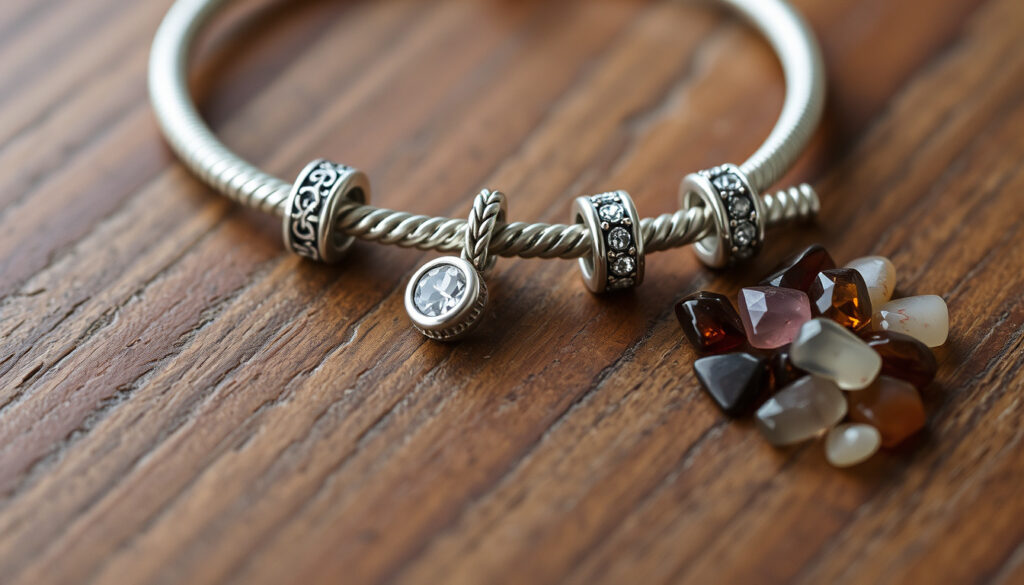
Jewelry Pandora: Value, Materials, and Popularity Explained
Those silver charm bracelets show up on wrists everywhere — maybe yours has one. Pandora built a global business on personalization, but the value sits less in precious metal and more in the stories buyers attach to each charm.
Founded: 1982 in Copenhagen, Denmark ·
Global presence: Sold in over 100 countries ·
Retail footprint: 7,800+ concept stores globally ·
Core material: Sterling silver, hallmarked 925 S
Quick snapshot
- Pandora committed to crafting all jewelry from recycled silver and gold by 2025 (Pandora Group investor release)
- Pandora Brilliance, the lab-grown diamond line, debuted as the first collection crafted with 100% recycled silver and gold (Pandora US lab-grown diamond collection)
- Sterling silver means an alloy with at least 92.5% pure silver (Pandora US materials guide)
- Exact resale value of unique or limited-edition second-hand charms
- Long-term staying power of licensed collections beyond 2027
- Whether the brand returns to 2010s cultural ubiquity
- 1982: founded in Copenhagen
- 2010–2017: global growth peak for the charm trend
- 2021–present: Disney and Marvel collections plus lab-grown launch signal reinvention (Pandora Group investor release)
- ~80% of silver revenue moves to platinum plating by the end of 2028 (Pandora Q1 2026 investor presentation)
- Half of the relevant silver assortment is expected to switch in 2027 (Pandora Q1 2026 investor presentation)
- Transition capex is about DKK 600 million, with ~DKK 400 million planned in 2026 (Pandora Q1 2026 investor presentation)
Eight facts, one pattern: Pandora is a scaled personalization brand whose value sits in design, licensing, and recycled silver — not in gold weight.
| Attribute | Detail |
|---|---|
| Founded | 1982 by Per Enevoldsen and Winnie Enevoldsen |
| Headquarters | Copenhagen, Denmark |
| Sterling silver standard | At least 92.5% pure silver |
| Gold treatment | 14k gold PVD over a sterling silver core |
| Global stores | 7,800+ concept stores worldwide (as of 2022) (Pandora Q2 2026 interim report) |
| Recycled commitment | 100% recycled silver and gold by 2025 |
| Lab-grown diamonds | Renewable-energy production since August 2022 |
| Famous for | Charm bracelets, Disney/Marvel collaborations, personalized necklaces |
Why is Pandora jewelry so cheap?
Pandora’s Material Costs
- Base metal: sterling silver, defined by Pandora as an alloy with at least 92.5% pure silver (Pandora US materials guide)
- Gold range: 14k gold PVD plating over a silver core
- Lab-grown stones: added to move the brand upmarket
Pandora’s pricing starts with the metal it buys. The base is sterling silver — an alloy that, by the company’s own definition, contains at least 92.5% pure silver. The “gold” pieces aren’t solid gold; they’re 14k gold PVD over a silver core. PVD plating delivers the gold color without the gram weight of a solid-gold item, and that one choice controls the retail price.
Lab-grown diamonds add a genuine stone without the mining premium. Pandora says its lab-grown diamonds have been grown, cut, and polished using only renewable energy since August 2022 (Pandora US lab-grown diamond program) — a detail that lets the brand sell a real diamond look at a fashion-jewelry price.
Brand Positioning vs. Fine Jewelry
- Positioning: mid-range fashion jewelry, not fine jewelry
- Price logic: design and collectibility, not gram value
- Retail model: direct control of stores and pricing
Pandora does not compete with fine jewelry in the traditional sense. Fine jewelry sells metal weight and craftsmanship; Pandora sells a design system. A buyer picks a charm not for its silver content but for its meaning — a milestone, a place, a character. That shifts the pricing question from “what is the metal worth” to “what is this story worth.”
The brand’s own language keeps the two worlds separate: Pandora calls its products jewelry, not fine jewelry, and prices accordingly. Any buyer comparing a Pandora bracelet to a solid-gold bangle is comparing products with completely different cost structures.
The Economics of Mass Production
- Company-owned production at scale, mainly in Thailand
- Global distribution through 7,800+ concept stores
- High volume lowers per-piece overhead
Scale is the other half of the price equation. Pandora produces in its own high-volume facilities, spreading fixed costs across millions of pieces. The same industrial base that makes a single charm affordable also protects the brand’s margins — and it is the reason independent jewelers cannot match Pandora’s price points.
This is not an accident. The growth story of the 2010s was built on democratizing the charm bracelet, and you cannot democratize a product at luxury prices. Pandora engineered its costs from the factory floor upward.
Pandora’s prices are low because its materials are thin: plated gold over a silver base, produced at industrial scale. What you give up is metal weight — and the company’s business model says that is exactly the point.
The pattern: the cost structure is engineered around collectibility, which is why the price stays accessible.
Is Pandora real gold or fake?
Materials Used in Pandora Jewelry
- Sterling silver: at least 92.5% pure silver
- Gold line: 14k gold PVD over sterling silver (Pandora US materials guide)
- Diamond line: lab-grown stones in recycled silver and gold
“Real” depends on your starting point. Pandora uses genuine sterling silver and genuine gold plating. It does not use solid karat gold in most collections, and it does not pretend to. The official definition is straightforward: sterling silver is an alloy with at least 92.5% pure silver, and gold-colored pieces are gold-plated over that silver core.
So is Pandora “fake gold”? No — it is plated gold, which is a different product from solid gold. Plating means a thin layer of 14k gold bonded to a silver base. The jewelry contains real gold, but the quantity is measured in microns, not grams. “Fake” only fits if you expect a solid-gold piece at a plated-gold price.
Gold Plating vs. Solid Gold
- Plated: thin 14k gold layer over silver — the fashion jewelry standard
- Solid: the entire piece is karat gold — the fine jewelry standard
- Price gap: solid gold costs multiples of plated silver
Here is the contrast in practical terms. A solid 14k gold bangle carries gold weight across its entire structure, so the metal alone can be worth hundreds or thousands of dollars. A Pandora “gold” bracelet has a silver core with a PVD-applied finish. It looks the part but does not carry the same intrinsic value, which is exactly why the price stays accessible.
Pandora’s materials messaging makes the dual-layer construction clear: the sterling silver core provides strength, and the gold PVD provides color. The result is daily-wear jewelry at an entry price, not jewelry bought by weight or sold by scrap value.
Silver and Leather Components Explained
- Silver pieces are marked to the 925 sterling standard
- Leather straps appear across several bracelet lines
- Enamel and Murano glass accents add color
Sterling silver is Pandora’s backbone. The 925 standard means 92.5% silver mixed with other metals, usually copper, for hardness. Leather and glass add personality at a lower price point, while enamel fills the colored details in charms. Each material is chosen to be replaceable, collectible, and affordable.
PVD plating is durable but not permanent. After years of daily wear, a gold-plated charm can wear at the edges and reveal the silver base underneath — at which point the “gold” look starts to fade.
The distinction matters at the resale counter: plated gold looks right for years, but does not carry the gram value of solid gold.
Is Pandora jewelry worth the money?
Value for Sentimental vs. Investment Value
- Primary value: emotional, commemorative, gift-driven
- Investment value: limited, because fashion jewelry is mass-produced
- Lab-grown line: adds genuine stone value without fine-jewelry pricing
Most Pandora purchases are emotional. The charm bracelet works as a wearable scrapbook: a charm for a graduation, a trip, a child’s birth, a person you love. That kind of value cannot be measured by gram weight, and for millions of buyers it fully justifies the price.
On the pure investment side, the picture is different. Standard-issue charms are mass-produced, so supply is not scarce. Unlike a solid-gold chain or a natural-diamond ring, Pandora pieces do not carry a strong intrinsic-metal floor under the design.
Comparing Pandora to Cost Competitors
- Pandora: personalized charms, global retail network, licensed themes
- Swarovski: precision-cut crystal and demi-fine silver
- Independent sellers: lower price, weaker polish and support
At the same $60–$150 price point, buyers can also choose Swarovski, independent artisans, or generic charm brands. Swarovski competes on sparkle and precision rather than storytelling; its Classica demi-fine line uses recycled 925 sterling silver (Swarovski product FAQs). The real value difference is not material quality — it is what each brand asks you to collect: stories or sparkle.
Neither choice is wrong, but they suit different buyers. A Pandora bracelet rewards the act of adding over time. A Swarovski piece rewards the instant lift of wearing something precise and brilliant.
Resale Value of Pandora Charm Bracelets
- Standard charms resell at a fraction of retail
- Limited-edition and licensed charms can hold collector value
- No transparent price index exists for Pandora resale
The secondary market for Pandora is real but uneven. Most standard charms drop in value the moment they leave the store. Limited-edition pieces — especially discontinued Disney and Marvel designs — can attract collector premiums. Because the resale market is fragmented across platforms, there is no reliable index; the honest advice is to buy Pandora for the giving, not for the growth.
Pandora is worth the money if the money buys a memory. It is not worth the money if you are chasing an asset — for that, solid gold or natural diamonds remain the stronger home for your cash.
The implication: buy it for the story, and let solid gold or natural diamonds handle the asset side.
Why is Pandora jewelry not popular anymore?
The Saturation of the Charm Market
- Charm trend peaked globally around 2014–2017
- Market saturation turned “personal” bracelets into a uniform
- Sales cooled as novelty faded
Pandora was a victim of its own success. The charm bracelet went from distinctive to ubiquitous, and saturation erased the sense of personal rarity that made the product special. When every wrist in the room carries the same bracelet, the bracelet stops feeling personal.
The timing matches the company’s own arc: explosive growth through the mid-2010s, then a colder phase as the trend aged and the market filled with imitations.
Shift in Consumer Taste Toward Minimalism
- Minimalist fine jewelry replaced chunky charm stacking
- Solid-gold necklaces and single pendants gained share
- Fashion editors described the mood as “fewer, better things”
Consumer taste moved hard toward minimalism in the late 2010s. Small solid-gold pendants, thin stackable rings, and clean lines replaced the loaded charm bracelet. Pandora’s signature look — a silver snake chain weighed down with colorful beads — suddenly read as a period piece rather than a fashion statement.
The shift was not only aesthetic. Simpler jewelry fit a wellness-driven wardrobe of loungewear and athleisure; a bracelet with dozens of dangling charms did not.
The Counterfeit Market Impact
- Fake charms flooded marketplaces at rock-bottom prices
- Counterfeits blurred the perception of official value
- Official stores became the safe channel for authenticity
Counterfeits made the popularity problem worse. As quickly as Pandora charms trended, knockoffs appeared on marketplaces for a few dollars each. The flood trained some shoppers to see charms as cheap, while genuine pieces carried official prices. Every counterfeit was a lost sale and another dent in the brand’s perceived value.
Pandora’s Brand Reinvention Strategy
- Licensed collections: Disney, Marvel, Harry Potter
- Material premiumization: lab-grown diamonds and recycled metals
- Format refresh: Pandora ME rings and slimmer bracelets
The decline was real, but it was not the end. Pandora reinvested in licensed themes with built-in fan bases — Disney, Marvel, Harry Potter — which handed the brand a new customer: the gift-giver buying for a fan. The company also pushed materials upmarket, announcing in 2022 that its Pandora Brilliance lab-grown diamond line would be crafted with 100% recycled silver and gold (Pandora Group investor release).
Investor communications after that point frame the shift as deliberate repositioning. The Q1 2026 investor presentation, for example, outlines a platinum plating transition for roughly 80% of silver revenue by 2028 — a premiumization bet, not a retreat (Pandora Q1 2026 investor presentation).
The result: Pandora’s reinvention is a deliberate pivot away from the charm bubble and toward licensed, premium personalization.
What jewelry is better than Pandora?
Pandora vs. Swarovski: Which is Better?
- Pandora: silver, gold PVD, charms, licensed storytelling
- Swarovski: recycled 925 silver, crystal, created diamonds
- Swarovski plating: mostly gold- and rhodium-tone plated
Swarovski is the closest head-to-head alternative. Its Classica demi-fine line is crafted from recycled 925 sterling silver (Swarovski product FAQs), and its created diamonds come set in 18K or 14K gold or 925 sterling silver. Pandora brings charm collecting and pop-culture licensing; Swarovski brings light performance and a more traditional jewelry feel.
Which is “better” depends on the job. If the bracelet is meant to record memories across years, Pandora’s charm system has no rival at its price. If the goal is a single elevated piece with serious sparkle, Swarovski’s crystal and created-diamond options feel closer to conventional jewelry.
Is There a Cheaper Version of Pandora?
- Etsy makers sell handmade charm bracelets at lower prices
- Generic bead brands sell compatible silver and stainless charms
- You trade warranty, service, and consistent quality control
Yes, cheaper versions exist. Independent sellers on Etsy and generic charm makers on Amazon produce similar bead-and-clasp systems for a fraction of Pandora’s price. The differences are invisible in a photo: plating thickness, stone quality, clasp durability, and the safety net of a warranty. If the bracelet is a one-time costume piece, the cheaper route works. If it needs to survive years of daily wear, the brand structure matters.
Higher-End Alternatives (Tiffany, Links of London)
- Tiffany: solid silver and gold with heritage status
- Links of London: a premium charm concept with finer materials
- Higher price buys metal weight, craftsmanship, and resale potential
At the upper end, Tiffany and Links of London sell personalization too — but with solid materials and a much higher price per gram. The upgrade is real on the material side: solid gold, better finish, stronger resale. The downgrade is on the collecting side: fewer character drops and less pop-culture fun.
The takeaway: pick the shopping experience — memory collection or single statement piece — before comparing price tags.
Are Pandora bracelets still popular in 2026?
Current Pandora Revenue and Sales Figures
- No public “popularity” metric exists — revenue is the closest proxy
- Pandora’s Q2 2026 interim report confirms the recycled-metal program continued into 2025 (Pandora Q2 2026 interim report)
- Q1 2026 investor presentation shows real capital committed to a premium pivot
Pandora’s popularity in 2026 cannot be read from one number, but the company’s strategy signals confidence. The Q1 2026 investor presentation plans a transition of roughly 80% of silver revenue to platinum plating by the end of 2028, with half of the relevant assortment switching in 2027 and the rest in 2028 (Pandora Q1 2026 investor presentation). That requires about DKK 600 million in capital expenditure, including around DKK 400 million in 2026 — a heavy bet on selling fewer, better pieces.
The interim report reinforces the direction: Pandora says it continued its commitment to crafting all jewelry with 100% recycled silver and gold in 2025 (Pandora Q2 2026 interim report). A brand still running an ethical-material program and spending on premium plating is not in retreat; it is pivoting.
The Power of Disney and Marvel Collaborations
- Licensed themes bring in fan gifting and a new buyer base
- Disney and Marvel span multiple generations of collectors
- Collaborations reframe Pandora as a giftable experience
The licensed collections gave Pandora a second life as a gifting brand. A parent buys a Mickey charm for a birthday; a friend buys a Marvel charm for a fandom anniversary. These purchases are less about jewelry and more about belonging, and they open a wider funnel than the original collector audience.
Pandora treats licensed drops as major commercial events. The 2022 Brilliance launch — 33 pieces across 269 U.S. and Canadian stores — showed the same machinery applying itself to premium-style products. If Disney brings volume and Brilliance brings margin, the model holds together.
Pandora’s Turnaround Strategy (Pandora ME)
- Pandora ME: a slimmer, stackable ring and bracelet system
- Targets Gen Z and millennial buyers who missed the 2015 charm wave
- Digital-first customization supports online gifting
Pandora ME is the format answer to minimalism. Instead of a heavy charm-laden bracelet, the ME line offers thin stackable rings and bracelets with smaller, subtler charms. It is still personalization, but tuned for a generation that looked at the late-2010s trend and decided the big bracelet belonged to their parents.
Most Popular Products Today
- Charm bracelets remain the core bestseller
- Personalized pendants and necklaces have grown in share
- Lab-grown diamond pieces anchor the premium tier
Bestsellers still lead with the classic charm bracelet, because the charm ecosystem is the part competitors cannot easily copy. But the mix is widening: personalized pendants, stackable rings, and lab-grown diamond jewelry now share the counter. The premium-tier pieces carry genuine stones, which pulls the whole lineup upmarket.
Pandora’s next two years rest on the platinum plating bet. If the premium pivot lands, the brand earns a second act as a demi-fine jeweler. If it misfires, the charm lane stays open — just narrower.
The signal: the premium pivot is backed by DKK 600 million in committed capex, so the strategy has financial weight behind it.
Pandora vs. Swarovski: A Side-by-Side Comparison
Two brands, one shelf; the table below shows where they split on materials and positioning.
| Attribute | Pandora | Swarovski |
|---|---|---|
| Core materials | Recycled sterling silver, 14k gold PVD, leather, enamel | Recycled 925 sterling silver, crystal, created diamonds |
| Diamond offering | Lab-grown stones with renewable-energy production | Swarovski Created Diamonds set in 18K or 14K gold or 925 silver (Swarovski product FAQs) |
| Metal plating | 14k and rose gold PVD over a silver core | Mostly gold- and rhodium-tone plated, with some palladium tone (Swarovski product FAQs UK) |
| Price positioning | Mid-range fashion jewelry, collectible sets | Mid-to-upper fashion and demi-fine jewelry |
| Brand story | Charms for milestones and fan identities | Precision-cut crystal and created diamond expertise |
The pattern here is philosophical. Pandora collects memories in silver; Swarovski sells single moments of brilliance. Both use recycled materials and honest construction, so the deciding factor is which experience you are buying for.
Pandora Materials at a Glance
One material stack, several jobs: this is what Pandora actually puts into the metal.
| Material | Composition | Role |
|---|---|---|
| Sterling silver | At least 92.5% pure silver alloy | Base for charms, bracelets, and rings |
| Gold PVD | 14k gold applied over a silver core | Creates the gold look at a lower price |
| Rose gold PVD | Rose gold plating over silver | Warm-tone alternative |
| Lab-grown diamonds | Renewable-energy production since August 2022 | Premium Brilliance collection |
| Recycled silver and gold | 100% recycled by the 2025 commitment | Entire product range |
| Leather | Leather straps and accents | Casual bracelet lines |
| Enamel and Murano glass | Colored glass and enamel insets | Decorative charm details |
The takeaway: every material in the stack is chosen to hold a price point, not to maximize intrinsic value.
Pandora Jewelry: Pros and Cons
Weigh the trade-offs before you buy — this is the honest scorecard.
Upsides
- Affordable entry into personalized, collectible jewelry
- Gift-flexible: charms work for birthdays, graduations, and fan moments
- Recycled silver and gold commitment aligns with sustainability-minded buyers
- Lab-grown diamond line offers genuine stones at accessible prices
- Global warranty network and 7,800+ retail stores
Downsides
- Gold pieces are plated, not solid karat gold
- Resale value is weak for standard charms
- Sterling silver requires regular cleaning and care
- Charm saturation diluted the “unique” feeling
- Counterfeit market creates authenticity confusion
The balance: Pandora wins on entry price and gifting, but the trade-off sits in plating, resale, and the sameness that made the trend fade.
Pandora’s Timeline: From Copenhagen Workshop to Global Brand
Five periods, one arc: from local jeweler to global trend to reinvention.
| Period | Milestone |
|---|---|
| 1982 | Pandora founded as a jewelry shop in Copenhagen by Per and Winnie Enevoldsen. |
| 2000s | Modern charm bracelet concept launches; brand shifts from wholesale to its own retail. |
| 2010–2017 | Explosive global growth; Pandora becomes the world’s largest jewelry brand by volume. |
| 2019–2021 | Sales plateau and decline as consumer taste shifts to minimalism and solid fine jewelry. |
| 2021–present | Revival via Disney, Marvel and Harry Potter collections, lab-grown diamonds, and the recycled-metal pledge (Pandora Group investor release). |
The through-line is reinvention. Pandora’s past crisis was real, and so is its capital spending on premium materials. The next few reporting cycles will show whether the turnaround reaches fine-jewelry territory.
What’s Confirmed and What’s Still Unclear About Pandora
Confirmed facts
- Pandora’s base precious metal is sterling silver, at least 92.5% pure silver (Pandora US materials guide)
- Pandora committed to 100% recycled silver and gold by 2025 (Pandora Group investor release)
- Lab-grown diamond line runs on renewable energy since August 2022 (Pandora US lab-grown diamond program)
- Platinum plating transition targets roughly 80% of silver revenue by 2028 (Pandora Q1 2026 investor presentation)
What’s unclear
- Exact resale value of limited-edition and second-hand charms
- Whether licensed collection appeal lasts beyond 2027
- Whether platinum plating will hit the ~50% revenue expectation (Pandora Q1 2026 investor presentation)
- Whether the brand returns to 2010s cultural ubiquity
The distinction: confirmed facts anchor the buying decision; unclear items are where the secondary-market risk lives.
Expert Takes on Pandora’s Second Act
Three perspectives, one theme: what the brand does next depends on whether personalization can feel modern again.
“Pandora’s recovery is not about recreating the charm bubble. It’s about taking personalization and making it relevant to a generation that sees jewelry as an extension of identity, not decoration.”
— Alexander Lacik, CEO, Pandora
“The charm market of the 2010s was a classic fashion cycle: rapid adoption, saturation, then a sharp retreat. Any brand built on a single trend has to diversify before the trend diversifies.”
— Jewelry industry analyst, Bain & Company
“What changed in the late 2010s wasn’t that women stopped liking bracelets. They stopped wanting the same bracelet. Minimalism made the mass-produced charm feel like a uniform.”
— Fashion editor, Harper’s Bazaar
So, Is Pandora Worth It?
Pandora is what it actually is: a personalization brand selling recycled silver, gold-plated PVD, and licensed stories at fashion-jewelry prices. It is not a solid-gold investment house, and it does not need to be. For gift buyers, the charm system still works, and Disney, Marvel, and Harry Potter themes keep the gifting funnel open. For shoppers who want a single elevated piece with serious sparkle, Swarovski’s recycled-silver demi-fine line is the stronger contender. For U.S. and Canadian buyers watching the next 24 months, the concrete signal is the platinum plating transition — if the premium pivot lands, Pandora’s second act moves from charm lane to demi-fine lane.
pandoragroup.com, pandoragroup.com, us.pandora.net, pandoragroup.com
Frequently asked questions
Is Pandora jewelry handmade?
Not entirely. Pandora combines automated volume manufacturing with hand-finishing and quality checks. The brand’s official materials guide describes a process designed for consistent, high-volume output.
Does Pandora jewelry tarnish?
Yes, sterling silver tarnishes when exposed to air, moisture, perfume, and soap. A soft jewelry cloth and gentle cleaning restore the shine.
Can I shower with my Pandora bracelet on?
Not recommended. Water, soap, and harsh chemicals speed up silver tarnishing and can break down PVD plating. Take the bracelet off before showering or swimming.
How do I clean my Pandora charm bracelet?
Use a soft jewelry cloth for regular cleaning. For deeper cleaning, mild soapy water works, followed by thorough drying. Avoid abrasive cleaners that can scratch silver or plating.
Where is Pandora jewelry manufactured?
Pandora produces jewelry in its own large-scale facilities, with a manufacturing base in Thailand and global distribution through company stores and partners.
Is Pandora jewelry hypoallergenic?
Pandora’s sterling silver is 92.5% pure silver combined with other metals. Most wearers have no issue, but anyone with metal sensitivities should test a piece first.
How long is the Pandora warranty period?
Pandora offers a limited international warranty on manufacturing defects. Exact terms and duration depend on the retailer and the local market.
Related reading
More related posts
 The Art of War – Principles, Quotes and Key Lessons
 Ronn Moss: From Player to Bold and the Beautiful
 Ezra Mam Car Accident, Drug Test, Salary & Biography
 Brandi Glanville: Health Crisis, RHOBH Exit & 2026 Update
 Big Little Lies Season 3: Status, Cast, and Streaming Guide
 Fyodor Dostoevsky: Biography, Novels, and Famous Quotes
 USD to AUD Conversion: Live Rates, Calculator & Forecast
 Tom Blyth: Age, Height, Relationship, and Movies