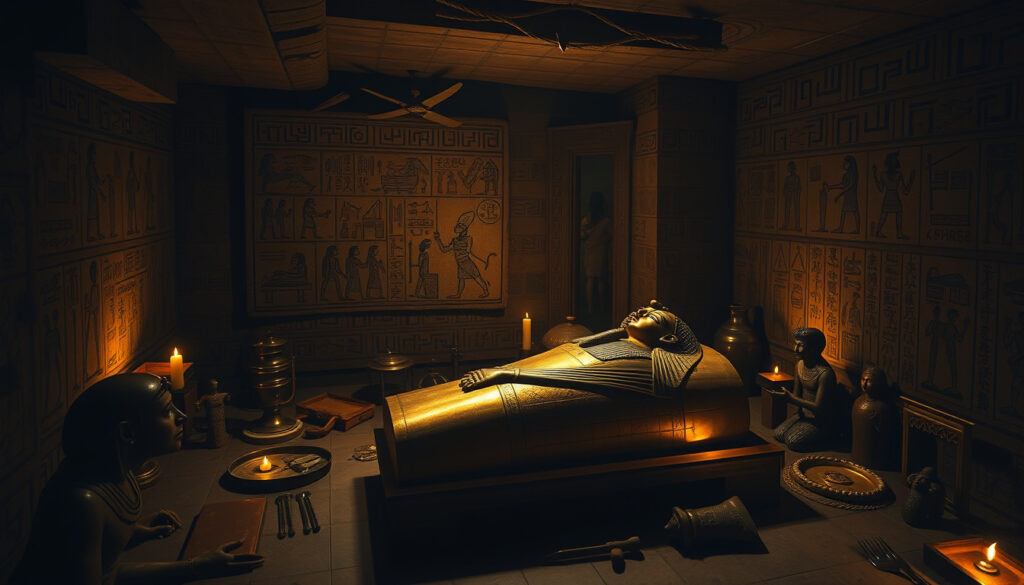
King Tut: Life, Death, and Legacy of the Boy Pharaoh
Few names from ancient history spark as much curiosity as King Tutankhamun, the boy king who ruled Egypt for a brief decade and has captivated us ever since his tomb was discovered nearly intact in 1922. But behind the golden mask lies a life marked by illness, genetic complications, and a death that scientists are still debating.
Reign: c. 1332–1323 BC ·
Age at accession: 8–9 years old ·
Age at death: 18–19 years old ·
Tomb discovered: 1922 by Howard Carter ·
Known wife: Ankhesenamun (half-sister) ·
Burial site: KV62, Valley of the Kings
Quick snapshot
- Born c. 1341 BC (Britannica (encyclopedia))
- Became king at age 8–9 (British Museum (institution))
- Reigned 1332–1323 BC (Britannica) (Britannica (encyclopedia))
- Died at 18–19 (PBS (public broadcaster)) (Britannica (encyclopedia))
- Club foot and scoliosis (National Geographic (science media))
- Evidence of malaria (JAMA (peer-reviewed medical journal)) (National Geographic (science media))
- Inbreeding from sibling marriage (National Geographic) (National Geographic (science media))
- Walked with canes (JAMA) (National Geographic (science media))
- Discovered 1922 by Carter (Britannica) (National Geographic)
- Over 5,000 artifacts (British Museum) (National Geographic)
- Golden death mask weighs 11 kg (National Geographic)
- Two mummified fetuses found (National Geographic) (National Geographic)
- Reversed Akhenaten’s monotheism (Britannica) (Egypt Exploration Society (research body))
- Restored traditional religion (Egypt Exploration Society (research body))
- Global icon of ancient Egypt (Egypt Exploration Society (research body))
Seven key facts about Tutankhamun, one pattern: his life and death are a study in contrasts — immense wealth and fragile health, short reign and lasting fame.
| Attribute | Value |
|---|---|
| Full name | Tutankhamun (alternatively Tutankhamen) |
| Dynasty | 18th Dynasty |
| Father | Akhenaten (likely) (Britannica) |
| Mother | The Younger Lady (identified as a sister of Akhenaten) (JAMA) |
| Chief wife | Ankhesenamun (Britannica) |
| Height | Approximately 5 feet 6 inches (1.67 m) |
| Cause of death | Complications from a leg fracture and severe malaria (probable) (JAMA) |
What is the reason King Tut died?
Despite a century of research, the exact cause of Tutankhamun’s death remains unconfirmed — but the evidence points to a perfect storm of infection and disease rather than murder.
Leading theories: accident, murder, or disease
- Infected leg fracture: A 2005 CT scan revealed a break in Tutankhamun’s left thighbone (National Geographic). The fracture showed no signs of healing, suggesting it occurred shortly before death.
- Malaria: DNA testing published in JAMA in 2010 found genetic traces of Plasmodium falciparum — the parasite that causes malaria tropica — in his mummy (JAMA (peer-reviewed medical journal)).
- Combination theory: The same JAMA study concluded that avascular bone necrosis together with a malarial infection was the most likely cause of death. Neither condition alone would have been fatal, but the combination proved deadly.
- Earlier hypotheses: Some researchers once speculated about murder, a chariot accident, or even gynecomastia, but these have been largely ruled out by forensic data (Egypt Exploration Society).
CT scans and modern forensics
- Scanning in 2005 also identified a kneecap fracture without healing — compelling evidence for a short-term injury before death (PBS (public broadcaster)).
- The chariot accident theory remains popular but unconfirmed; no direct evidence links the fractures to a crash.
What disabilities did King Tut have?
The same inbreeding that gave Tut his royal lineage also left him with a body that required walking sticks — a detail confirmed by both his skeleton and the more than 130 canes found in his tomb.
Club foot and bone abnormalities
- CT scans and DNA analysis revealed a club foot on his left foot — a congenital deformity that would have made walking painful (National Geographic (history section)).
- He also had scoliosis (curved spine) and a partially cleft palate (National Geographic).
- Köhler disease II — a rare bone disorder of the foot — was diagnosed in the 2010 study (JAMA).
Genetic conditions from inbreeding
- His parents were likely siblings — Akhenaten married his own sister, the “Younger Lady” – a practice common among Egyptian royals but devastating for health.
- Inbreeding explains many of Tut’s congenital conditions. The 2010 study described him as a “frail pharaoh” compromised by generations of intermarriage.
- Artifacts depict him using walking sticks, and over 130 canes were buried with him — not ceremonial, but practical aids.
What are 5 interesting facts about King Tut?
Behind the golden mask is a story of a boy who became king at eight, reversed his father’s religious revolution, and still fascinates the world a century after his tomb was opened.
The boy king
Tutankhamun ascended the throne at around eight or nine years old, after the death of his father Akhenaten (British Museum). His reign lasted roughly nine to ten years, ending when he died at 18–19.
The implication: his youth made him susceptible to court influence and health vulnerabilities.
The tomb discovery
Howard Carter discovered the nearly intact tomb (KV62) in the Valley of the Kings in 1922. It contained over 5,000 objects, from chariots to jewelry, providing an unmatched window into New Kingdom Egypt.
The golden mask
The iconic death mask is made of 11 kg (24.2 lb) of solid gold, inlaid with lapis lazuli and other semi-precious stones (Britannica). It remains one of the most recognizable artifacts in the world.
Two mummified fetuses
Two tiny mummies of stillborn daughters were found in the tomb. They are believed to be the children of Tutankhamun and his wife Ankhesenamun (National Geographic).
Religious revolution reversal
Tutankhamun reversed the radical monotheistic reforms of his father Akhenaten, restoring the traditional Egyptian pantheon and moving the capital back to Thebes (Britannica).
How old was King Tut when he became king and died?
Age at ascension
Tutankhamun became pharaoh around 1332 BC at age 8–9 (British Museum).
Length of reign
He reigned for approximately 10 years, until c. 1323 BC.
Age at death
Consensus places his death at 18–19 years old (PBS). The hasty preparation of his tomb suggests an unexpected death.
The pattern: a ruler who never reached full adulthood, shaping the speed of his burial and the incompleteness of his legacy.
How many wives did King Tut have?
Chief wife: Ankhesenamun
His only confirmed wife was Ankhesenamun, his half-sister and daughter of Akhenaten and Nefertiti (Britannica). The two mummified fetuses found in his tomb are believed to be their stillborn daughters.
Possible other wives
There is no evidence of any other wives. Some inscriptions mention a “Great Royal Wife” but they almost certainly refer to Ankhesenamun.
The catch: the absence of a surviving heir contributed to the instability after his death.
Who’s older, King Tut or Cleopatra?
The answer is clear — and surprising. Tutankhamun lived roughly 1,200 years before Cleopatra VII.
Tutankhamun’s reign: c. 1332–1323 BC. Cleopatra’s reign: 51–30 BC. The chronological gap is over a millennium. To put it in perspective: Cleopatra lived closer to the first moon landing than to Tut’s reign.
| Ruler | Lived | Reign | Time gap from today |
|---|---|---|---|
| King Tutankhamun | c. 1341–1323 BC | c. 1332–1323 BC | ~3,350 years |
| Cleopatra VII | 69–30 BC | 51–30 BC | ~2,050 years |
The implication: the two figures belong to entirely separate eras, with Tutankhamun’s world closer to the building of the pyramids than to the Roman Empire.
Timeline of King Tut’s life and after
- c. 1341 BC: Tutankhamun born, possibly in Amarna.
- c. 1332 BC: Becomes pharaoh at age 8–9 after death of his father Akhenaten.
- c. 1332–1323 BC: Reigns; moves capital back to Thebes; restores traditional polytheistic religion.
- c. 1323 BC: Dies at age 18–19; buried in KV62.
- 1922: Howard Carter discovers the nearly intact tomb.
- 1925–1932: Excavation and preservation of artifacts.
- 2005–2010: CT scans and DNA analysis of mummy.
What’s confirmed and what’s unclear
Confirmed facts
- King Tutankhamun reigned c. 1332–1323 BC (Britannica)
- He died around age 18–19 (PBS)
- His tomb was discovered in 1922 by Howard Carter
- He had a club foot and used walking sticks (JAMA)
- He married his half-sister Ankhesenamun
What’s unclear
- Exact cause of death – leading theory: leg fracture infection plus malaria (JAMA)
- Whether he was murdered or died from an accident (Egypt Exploration Society)
- His exact parentage – father is Akhenaten, but mother is not fully confirmed
- Number of children – two stillborn daughters, but no surviving heirs
“At first, I could see nothing, the hot air escaping caused the candle to flicker, but presently, as my eyes grew accustomed to the light, details of the room within emerged slowly from the mist, strange animals, statues, and gold — everywhere the glint of gold.”
— Howard Carter, on first entering Tutankhamun’s tomb in 1922
“The combination of avascular bone necrosis and malarial infection offers the most plausible explanation for the death of the young pharaoh.”
— Dr. Ashraf Selim, radiologist who led the 2005 CT scans, as reported in National Geographic
“Tutankhamun was not a strong pharaoh. He was a boy with a club foot and malaria, and his genetic inheritance from generations of inbreeding made him vulnerable.”
— Zahi Hawass, Egyptologist and former Minister of Antiquities, in commentary on the 2010 JAMA study
For the millions of visitors who flock to see his treasures each year, the choice is clear: King Tut remains an enduring symbol of ancient Egypt’s grandeur — and a cautionary tale about the fragility of power.
sites.arizona.edu, pubmed.ncbi.nlm.nih.gov, wheelchairhistorian.blogspot.com, reddit.com, egypttoursportal.com, egypt-museum.com, beyondkingtut.com, reddit.com
Frequently asked questions
Did King Tut have children?
Two mummified fetuses were found in his tomb, believed to be his stillborn daughters by Ankhesenamun. No living heirs survived.
What was King Tut’s golden mask made of?
It is made of 11 kg of solid gold, inlaid with lapis lazuli, quartz, and other semi-precious stones. It was designed to protect the pharaoh in the afterlife.
Why was King Tut’s tomb so well-preserved?
Unlike many other pharaonic tombs, KV62 was buried under debris from later construction, remaining hidden for over 3,200 years until Carter’s 1922 discovery.
How did King Tut’s reign change Egypt?
He reversed his father Akhenaten’s monotheistic revolution, restoring the traditional Egyptian religion and moving the capital back to Thebes.
Is the curse of King Tut real?
No scientific evidence supports the “curse.” The deaths of some early visitors were coincidental or exaggerated by media.
Where is King Tut’s mummy now?
It remains in the Valley of the Kings (Luxor, Egypt) in a climate-controlled chamber at the original burial site, KV62.
More related posts
 NRL Scores Today – Live Results Ladder Updates
 NYT Connections Today: Hints & Answers for June 6, 2026
 Jules Bianchi: the 2014 Suzuka crash and the halo question
 Rachel Maddow: Biography, Health, Salary, and Career
 Jon Adgemis: Rise and Fall of Australia’s Biggest Bankrupt
 Mahli Beardman: Facts, Bowling Speed, and Career Profile
 Chuck Norris Obituary: Death, Cause of Death, Legacy
 Urzila Carlson: Biography, Family, Career, and Upcoming Tour