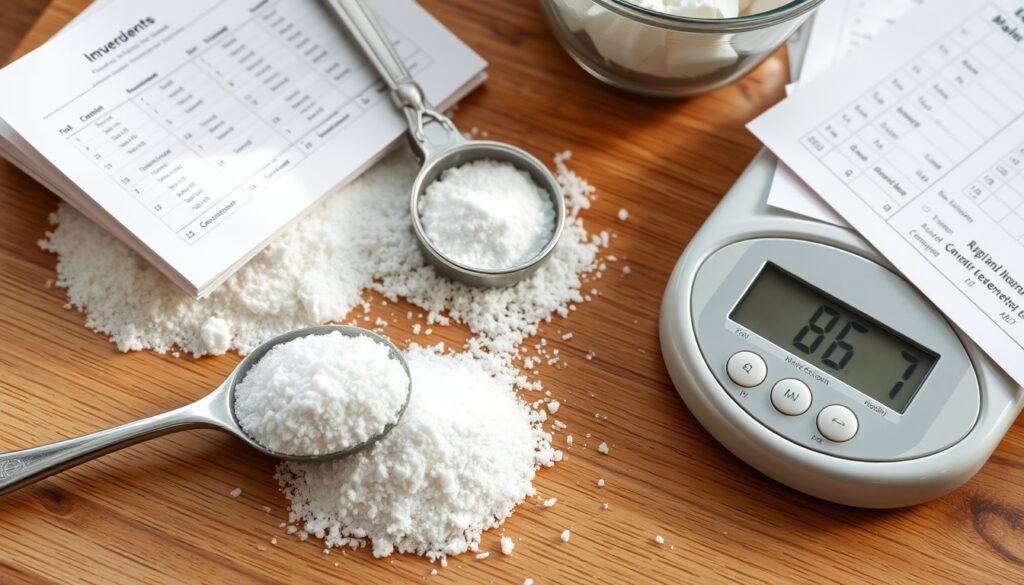
How Many Grams in a Teaspoon – Charts for Sugar, Flour, Salt & More
How Many Grams in a Teaspoon? Converter + Charts for Sugar, Flour & More
A standard teaspoon holds approximately 5 milliliters of liquid, but the weight in grams varies dramatically depending on what fills that spoon. The difference between a teaspoon of water and a teaspoon of flour, for instance, spans several grams—a gap rooted in density, packing, and ingredient composition.
For anyone following a recipe precisely, whether baking bread or measuring supplements, understanding these variations matters. Professional bakers consistently emphasize that baking differs from cooking: ratios matter, and eyeballing measurements often leads to disappointing results. This guide synthesizes conversion data from established baking references to help readers convert teaspoon measurements to grams with greater confidence.
The numbers below represent averages from multiple sources, including professional baking authorities and culinary conversion specialists. Actual weights can shift based on brand, moisture content, and how ingredients are measured.
How Many Grams Are in a Teaspoon of Sugar?
Granulated sugar consistently weighs between 4 and 4.3 grams per teaspoon across most reliable sources. Caster sugar, with its finer crystals, typically registers at approximately 4.2 grams. Brown sugar varies more widely due to moisture content, often falling between 4 and 5 grams depending on packing density.
When a recipe calls for “packed” brown sugar, press it firmly into the measuring spoon. This adds weight and affects the final result in ways that matter for baking chemistry.
Quick-Reference Conversion Grid
| Ingredient | 1 tsp (grams) | 1/2 tsp (grams) | 1/4 tsp (grams) |
|---|---|---|---|
| Sugar (granulated) | 4.0–4.3 | 2.0–2.15 | 1.0–1.1 |
| Water | 5.0 | 2.5 | 1.25 |
| Flour (all-purpose) | 2.6–5.0 | 1.3–2.5 | 0.65–1.25 |
| Salt (fine/table) | 5.0–5.7 | 2.5–2.85 | 1.25–1.4 |
Key Insights on Teaspoon Measurements
- Water serves as the baseline reference point: 5 grams per teaspoon, since its density equals 1 gram per milliliter
- Sugar consistently measures 4.2–4.3 grams across multiple authoritative baking sources
- Flour weight varies by 50% or more depending on whether it is sifted or packed
- Salt weighs more than sugar volume-for-volume due to its crystalline density
- Professional sources recommend using a scale for precision baking
- Fractions follow predictable halving patterns, though rounding creates minor variations
Grams in a Teaspoon of Honey, Butter, and Other Ingredients
Denser liquids and semi-solids present their own measurement challenges. Honey, for example, clings to measuring spoons and resists clean removal, making its effective weight per teaspoon higher than many expect.
Honey, Butter, and Spreads
Honey measures approximately 7 grams per teaspoon when poured smoothly, though sticky residue on spoons reduces实际操作量. One cup of honey equals roughly 340 grams, which helps contextualize the per-teaspoon figure. Butter, when softened and measured by volume, comes in at around 4.7 grams per teaspoon—derived from the common 14-gram tablespoon measurement.
Honey’s viscosity means recipes often specify “lightly spooned” measurements. Overpacking honey into a spoon inflates the weight, potentially disrupting delicate balance in recipes like macarons or glazes.
Powders and Leavening Agents
Baking powder and baking soda both weigh between 3 and 5 grams per teaspoon, with baking powder slightly heavier due to its composition. Instant dry yeast registers at 3.1 grams per teaspoon, meaning a standard 7-gram packet contains roughly 2.25 teaspoons.
Coffee and Cocoa
Ground coffee varies considerably based on grind fineness, generally falling between 2 and 3 grams per teaspoon. Cocoa powder, similarly light and fluffy, approximates 3 grams per teaspoon. These ingredients’ weights fluctuate more than granulated ingredients due to particle size variability.
Converting 1/2 Teaspoon and 1/4 Teaspoon to Grams
Fractional teaspoon measurements follow straightforward halving logic, but precision requires attention to rounding. Most conversion references derive half-teaspoon and quarter-teaspoon values by dividing the full-teaspoon weight, though direct measurements sometimes reveal slight discrepancies.
Salt as an Example
Fine table salt provides one of the clearest examples: 1 teaspoon equals 5–5.7 grams, making 1/2 teaspoon approximately 2.5–2.85 grams and 1/4 teaspoon roughly 1.25–1.4 grams. The range reflects natural variation in crystal size and packing.
Practical Application
For home cooks working with fractional amounts, simple division works adequately in most cases. A recipe calling for 1/4 teaspoon of baking powder can reasonably be calculated as approximately 1–1.25 grams. Online conversion tools can provide more precise figures when accuracy matters critically, such as in bread-making where yeast ratios affect proofing times.
Baking recipes specifying very small quantities—1/8 teaspoon or less—typically require scaling up and measuring proportionally rather than attempting to split teaspoon fractions further. Invest in 1/8 teaspoon measuring spoons for best results.
Why Grams per Teaspoon Vary by Ingredient
The underlying principle involves density: how much mass packs into a given volume. Water’s density of 1 gram per milliliter makes it the natural reference point. One teaspoon of water (5 milliliters) equals exactly 5 grams. Other ingredients deviate from this benchmark based on their physical properties.
Density and Measurement Factors
Powdered ingredients like flour weigh less than water because their particles contain significant air. All-purpose flour measures roughly 2.6–5 grams per teaspoon depending on sifting—a difference of nearly 50%. Sifting introduces air between particles, reducing weight for the same volume. Unsifted flour from a bag compresses during scooping, adding both air pockets elimination and additional settling.
Salt crystals interlock differently than flour particles, creating more mass per volume. Fine table salt reaches 5.7 grams per teaspoon, heavier than sugar despite similar crystal size. Coarse kosher salt, with its larger flakes, measures considerably less—sometimes under 3 grams per teaspoon—which explains why many recipes specify weight rather than volume for salt.
Sifting, Packing, and Brand Variations
Even within the same ingredient category, brand matters. King Arthur Baking rates their all-purpose flour at 120 grams per cup, while other sources cite 125–140 grams. These differences cascade through teaspoon calculations. For flour, the range spans 114–150 grams per cup depending on measurement method, translating to 2.4–3.1 grams per teaspoon when divided by 48 teaspoons per cup.
Baking references consistently note that these variations are normal and expected. The guidance from established baking authorities emphasizes using scales rather than volume measurements when precision matters—which describes most baking scenarios.
The History of Teaspoon Standardization
The teaspoon as a measurement unit evolved through centuries of domestic cooking tradition rather than scientific standardization. In the United States, the conventional teaspoon was legally defined as 4.93 milliliters in the late 19th century, aligning with the emerging system of liquid measures.
- Early domestic use (pre-1800s): Teaspoons varied widely by region and household, reflecting local traditions rather than standardized volumes
- 1890s standardization: The U.S. legally defined the teaspoon as 1/6 fluid ounce, approximately 4.93 milliliters
- Metric adoption era: Most countries adopted metric definitions; the international teaspoon standardized at exactly 5 milliliters
- Modern kitchen tools: Contemporary measuring spoons conform to either 4.93ml (US) or 5ml (metric) standards
- Baking precision movement: Professional and home bakers increasingly prefer weight-based measurements over volume
This historical context explains why some conversion charts show water as 4.93 grams (US measurement) while others cite 5 grams (metric). Both values are correct for their respective systems.
What We Know for Certain and What Remains Unclear
Understanding where conversion data is solid versus where uncertainty exists helps readers apply this information appropriately.
| Established Information | Information That Remains Unclear |
|---|---|
| Water: 5 grams per teaspoon (metric standard) | Exact flour weight depends on sifting method and brand |
| Sugar: 4.2–4.3 grams (consistent across sources) | Brown sugar weight varies with moisture content |
| Salt: 5–5.7 grams (density well-documented) | How humidity affects powder weights in real-time |
| Baking powder: 4–5 grams | Variations between brands for specialty ingredients |
| Honey: approximately 7 grams | Exact honey weight varies by floral source |
The research consistently shows that water and granulated sugar measurements are highly reliable across sources. Specialty ingredients—particularly those affected by moisture, particle size, or brand-specific processing—carry wider ranges that merit caution.
Understanding Density-Based Conversions
The fundamental formula connecting volume and weight is straightforward: grams equal volume in milliliters multiplied by density in grams per milliliter. One teaspoon equals 5 milliliters, making the baseline water measurement simply 5ml times 1g/ml, equaling 5 grams.
For other ingredients, density determines the conversion. Salt’s density roughly 2.8g/ml means 5ml of salt weighs approximately 14 grams divided across 3 teaspoons, or about 4.7 grams per teaspoon—though direct measurements show 5–5.7 grams due to packing characteristics.
When working with an ingredient not listed in conversion charts, dividing cup weight by 48 (the number of teaspoons in a cup) provides a reasonable estimate. This method works best for ingredients where cup-to-gram data exists even without teaspoon-specific measurements.
For those seeking deeper understanding of measurement principles, educational resources on dimensional analysis explain how volume-to-weight conversions work across different measurement systems.
What Professional Sources Say
“One teaspoon of granulated sugar weighs approximately 4.2 grams. This conversion is consistent across most sugar types, though brown sugar may vary due to moisture content.”
“Water density provides the baseline for volume-to-weight conversions. One teaspoon of water weighs 4.93 grams in the US system or 5 grams using the metric standard.”
— Inch Calculator, Teaspoon to Gram Conversion Guide
“Baking is a precise craft. When a recipe fails, the culprit is often imprecise measurement. A kitchen scale eliminates the guesswork that volume measurements introduce.”
— King Arthur Baking, Ingredient Weight Reference
Putting This Information into Practice
For everyday cooking, approximate teaspoon-to-gram conversions serve well. Understanding that sugar weighs around 4 grams while water reaches 5 grams helps readers adjust recipes intuitively. When a dish calls for 2 teaspoons of sugar, estimating 8–9 grams provides reasonable accuracy.
For baking specifically, investing in a reliable digital scale transforms measurement precision. Professional bakers and passionate home bakers alike increasingly measure ingredients by weight rather than volume. This approach eliminates the variable that causes most baking failures: inconsistent measurement.
Those interested in exploring related measurement conversions can find comprehensive guides covering tablespoon-to-grams and other volume-to-weight relationships. Understanding how these conversions connect helps build a complete picture of kitchen measurement.
Frequently Asked Questions
How many grams are in a teaspoon of powder?
Baking powder and similar powders typically weigh 4–5 grams per teaspoon. Cocoa powder and ground coffee fall slightly lower at 2–3 grams due to lower density.
How many milliliters are in a teaspoon?
A US conventional teaspoon holds 4.93 milliliters. The metric teaspoon equals exactly 5 milliliters. Most countries use the metric standard.
How many tablespoons equal 1/4 cup?
Four tablespoons equal 1/4 cup. Since a tablespoon holds 3 teaspoons, 1/4 cup contains 12 teaspoons total.
Why does flour weight vary so much per teaspoon?
Sifting introduces air between flour particles, reducing weight by 10–20%. Unsifted flour from a bag can weigh 50% more per teaspoon due to compaction.
Should I use a scale for baking?
Professional bakers universally recommend scales. Volume measurements introduce variability through packing, sifting, and humidity that scales eliminate entirely.
How do I convert unlisted ingredients to teaspoons?
Divide the cup weight by 48 (teaspoons per cup) to estimate teaspoon weight. This method provides approximate values when direct teaspoon data isn’t available.
More related posts
 Jofra Archer Injury Update: Why He’s Not Playing
 Michelle Monaghan: Age, Height, Movies & Net Worth
 Engagement Rings Sydney: Prices, Styles & Top Jewellers
 What Is 30 Days From Today: Calculator, Steps & Examples
 Worlds Hardest Game – Guide to All 30 Levels
 Apple Watch Charger – Types, Compatibility and Best Picks
 Chicken Caesar Salad – Recipe, Nutrition and Keto Guide
 The Grand Tour – Cancellation Confirmed Seasons Hosts Watch Guide